1

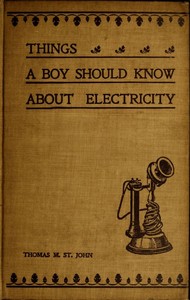
Things a Boy Should Know About Electricity Second Edition — Inside the Classic
(0 User reviews)
920
Project Gutenberg
2014
Not confirmed
Electricity
Readers of public-domain and historical texts
Project Gutenberg digital edition
en
Edition facts
Words
36,381
Reading time
159 min
Text sections
9
This digital edition of Things a Boy Should Know About Electricity Second Edition — Inside the Classic is described by source-level measurements including 36,381 words, 2 hr 39 min estimated reading time, and 9 detected text sections.
The text analysis averages about 14.4 words per sentence, while the detected sections provide another way to judge how the source is divided.
Project Gutenberg metadata also associates the work with “Electricity,” connecting these edition facts with the source record’s subject description.
Source:
Project Gutenberg record #44665
This 1903 guide uses plain language and diagrams to explain electricity for boys, covering frictional electricity, magnets, cells, wiring, and safety devices. The author's direct, instructional voice and focus on practical apparatus distinguish it from textbooks.
Editorial Edition Score
4.7/5
★★★★★
★★★★★
Calculated from edition completeness, EPUB availability, text structure and catalogue metadata. Not a user rating.
How this score is calculated
- Description quality20 pts
- Title & short description10 pts
- Source metadata20 pts
- Text length15 pts
- Chapters / structure15 pts
- EPUB file integrity20 pts
Total of 100 points, scaled to a 2.5-5.0 range. Editions with an empty description or a missing EPUB file are not scored.
Edition quality
Public-domain source text
Read the source text
The source text is kept in the dedicated reader, separate from this catalogue record and its commentary.
Thomas M. St. John addresses his reader as an active experimenter, not a passive student. In Things a Boy Should Know About Electricity, he consistently uses the second person and imperative verbs: “remember that the current has to be carried to the lamp or motor.” The book assumes a boy who wants to build his own apparatus—St. John’s earlier titles include How Two Boys Made Their Own Electrical Apparatus—and this edition reflects that hands-on ethos. Diagrams are referenced by figure numbers (e.g., “Fig. 157”), and the text frequently shifts between explanation and practical warning, as when noting that “a break anywhere in the circuit stops the current.” The author’s voice is confident, economical, and rooted in the material world of wires, cleats, and conduits.
The Author’s Direct Address to the Reader
St. John’s prose is built around commands and conditional statements that place the boy in the role of builder. He writes, “the sizes of all of these wires depend upon how much current has to pass through them,” a sentence that teaches a principle while implying the reader will choose wire sizes. The author rarely uses passive constructions; instead, he tells the reader what must be done: “insulators are as important as conductors.” This imperative tone is consistent from the first chapter on frictional electricity through the later sections on dynamos. The book’s structure—short chapters, numbered paragraphs, frequent cross-references to figures—mirrors a manual more than a narrative. St. John trusts the boy to follow technical details, such as the distinction between mains, service wires, and risers, without oversimplifying the vocabulary.
Diction: Plain Language for Practical Ends
The vocabulary is deliberately concrete. St. John uses terms like “cleats,” “mouldings,” “porcelain insulators,” and “coupling-box” without defining them in a glossary; he expects the reader to learn by context and diagram. When he introduces a concept, he often anchors it in a familiar analogy: “just as water-pressure is kept up by the constant working of pumps.” The word “current” is treated as a flow, and “circuit” as a path that must be complete. Abstract terms are rare; even “electricity” is handled as a force to be channeled, not theorized. The author’s own background—he was a metallurgical engineer—shows in his preference for functional description over mathematical formulas. The result is a text that feels spoken aloud, as if St. John were standing beside a workbench pointing to components.
Structure: The Logic of a Progressive Build
The book’s organization moves from simple to complex: frictional electricity, magnets, voltaic cells, then wiring and safety devices. Each chapter builds on the previous one, and St. John often recaps a principle before extending it. For instance, after explaining how a dynamo generates current, he describes how that current travels through “mains,” “service wires,” and “risers” to reach a lamp. The progression is spatial as well as conceptual—from the cell to the house to the street. The author also uses repetition of key ideas: the necessity of a complete circuit appears in multiple chapters. This structure suits a self-taught reader who may dip into chapters out of order, though the book rewards sequential reading. The final chapters on safety devices show St. John’s awareness that a boy building his own apparatus needs to know how to prevent overheating and short circuits.
Recurring Details: Diagrams, Figures, and the Material World
Every few paragraphs, St. John inserts a reference to a figure: “Fig. 157 shows sections of man-holes and various devices used in conduit work.” The text is inseparable from its illustrations, which depict cross-sections of tubes, cleats, and wiring layouts. The author describes objects in terms of their function and placement: “porcelain cleats… are fastened to ceilings or walls, and firmly hold the insulated wires in place.” He also notes materials—creosoted wood, iron pipe, rubber—as if the reader might need to select or identify them. Safety devices receive particular attention: “when too large a current passes through a wire, the wire becomes heated and may even be melted.” This practical warning recurs, reinforcing the idea that electricity is a force to be respected. The book’s final pages include a catalog of the author’s other works, positioning this volume as part of a larger educational project.
Readers will find this book most useful if they read with a pencil and paper, sketching the circuits described. St. John’s explanations reward slow, careful attention to each component’s role. The book is not a history or a theory; it is a guide to making and understanding electrical systems as they existed in 1903. For a modern reader, the value lies in seeing how a technical author shaped language to teach a hands-on skill—and in recognizing that the principles of current, circuit, and safety have changed less than the materials.
Sometimes I think of that sturdy 1903 manual, the one that taught boys to wire a bell with such plain-spoken patience. Its quiet faith in young hands finds a gentle echo in Harper's Electricity Book for Boys — A Closer Reading, which pauses over those very pages like an old friend turning them slowly. There is a kinship between them, a shared breath. I have lost hours there happily.
There are no reviews for this eBook.
There are no comments for this eBook.
Reader reflection
Take a moment to reflect on this book
Create a short personal record of your experience with this book.
Your progress
0
/
10
2
What was your overall reaction to the book?
3
Would you encourage someone else to read it?
4
Did the language feel accessible?
5
Is this a title worth rereading?
6
Could you follow the author’s main argument?
7
Would you like to discuss this book with someone?
8
Did the story or argument move comfortably?
9
What is the main idea you are taking away?
10
![Cover of The Complete Works in Philosophy, Politics and Morals of the late Dr. Benjamin Franklin, Vol. 2 [of 3] — Reading Companion](https://eatsb.com/storage/media/covers/pg48137.jpg)