1

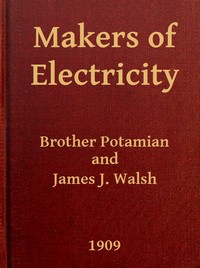
Makers of Electricity — A Reader’s Guide
(0 User reviews)
885
Project Gutenberg
2014
Not confirmed
Electricity -- Biography
Readers of public-domain and historical texts
Project Gutenberg digital edition
en
Edition facts
Words
119,373
Reading time
520 min
Text sections
17
This digital edition of Makers of Electricity — A Reader’s Guide is described by source-level measurements including 119,373 words, 8 hr 40 min estimated reading time, and 17 detected text sections.
The text analysis averages about 30.4 words per sentence, while the detected sections provide another way to judge how the source is divided.
Project Gutenberg metadata also associates the work with “Electricity -- Biography,” connecting these edition facts with the source record’s subject description.
Source:
Project Gutenberg record #45446
This editorial note examines how the opening, middle, and later excerpts of 'Makers of Electricity' guide a first reading, focusing on the authors' biographical approach, the humanizing anecdotes of scientists, and the interplay of discovery and personality.
Editorial Edition Score
4.9/5
★★★★★
★★★★★
Calculated from edition completeness, EPUB availability, text structure and catalogue metadata. Not a user rating.
How this score is calculated
- Description quality20 pts
- Title & short description10 pts
- Source metadata20 pts
- Text length15 pts
- Chapters / structure15 pts
- EPUB file integrity20 pts
Total of 100 points, scaled to a 2.5-5.0 range. Editions with an empty description or a missing EPUB file are not scored.
Edition quality
Public-domain source text
Read the source text
The source text is kept in the dedicated reader, separate from this catalogue record and its commentary.
The preface of Makers of Electricity immediately establishes the authors' intention to provide a 'biographical history of electricity,' focusing on the lives of pioneer workers rather than solely on their discoveries. The authors emphasize that these scientists were not only intellectually gifted but also morally upright, believing in Providence and personal responsibility. This framing sets the stage for a narrative that intertwines scientific progress with human character, inviting readers to view the history of electricity through the lens of its creators' personal qualities.
The Biographical Approach
The preface explicitly states that the book aims to offer 'brief yet reasonably complete sketches' of the lives of 'ground-breaking investigators.' This approach is evident in the excerpts, where the authors recount not only Oersted's discovery but also his thirteen-year search for a connection between electricity and magnetism. The authors argue that 'accidents of the Oersted type happen only to men who deserve them,' suggesting that the book will consistently highlight the deliberate effort behind seemingly serendipitous breakthroughs. Readers should expect each chapter to balance scientific explanation with personal narrative, emphasizing the human effort and perseverance behind each discovery.
Humanizing the Scientists
A striking feature of the excerpts is the authors' use of vivid, humanizing anecdotes. For instance, they describe how Lavoisier, Gay-Lussac, Davy, and Faraday all expressed joy through dancing after successful experiments. Faraday is quoted as exclaiming, 'There they go, there they go; we have succeeded at last,' before proposing a visit to Astley's to see trained horses. These details serve to make the scientists relatable, countering the stereotype of the detached, emotionless researcher. The authors deliberately include such stories to illustrate that these men were 'as far above the average of mankind in their personal ethics as they were in their intellectual qualities.' This pattern suggests that the book will consistently use personal anecdotes to illuminate character.
The Role of Anecdote in Scientific History
The excerpts demonstrate that the authors value anecdote not merely as entertainment but as a tool for understanding the scientific process. For example, they discuss Ampère's 'rule of the little swimmer' as a memoria technica that 'pleases while it instructs.' This reflects a broader pedagogical aim: to make complex ideas accessible through memorable stories. Similarly, the authors compare Oersted's discovery to those of Musschenbroek, Galvani, and Roentgen, each of whom capitalized on an 'accident' due to a prepared mind. This comparative approach suggests that the book will draw connections between different scientists' methods and personalities, offering readers a cohesive view of how electrical science advanced through a combination of insight, persistence, and sometimes luck.
Reading the Excerpts as a First-Time Reader
For a first reading, the excerpts offer a clear entry point into the book's structure and tone. The preface outlines the authors' dual focus on scientific history and human documents, while the later excerpt on Oersted exemplifies this blend. Readers should note how the authors move from describing the discovery itself to detailing the scientist's emotional response and the broader reception. The inclusion of Faraday's praise—that Oersted's work 'burst open the gates of a domain in science'—signals that the book will often let contemporaries speak, providing multiple perspectives. Pay attention to how the authors use direct quotations sparingly but effectively, and how they integrate technical explanations with narrative flow. This balance is key to the book's appeal as both a historical account and a collection of inspiring life stories.
As you begin Makers of Electricity, keep in mind that the authors are as interested in the character of the scientists as in their discoveries. The anecdotes of dancing, exclamations of joy, and personal habits are not digressions but central to the book's purpose: to show that great science comes from great people. Let the human stories guide your reading, and you will find the scientific details more memorable and meaningful.
Reading Makers of Electricity, I kept noticing how the human moments—faraday’s shyness, Volta’s quiet persistence—linger longer than the equations. That same warmth returns in An epitome of electricity & galvanism — Edition Insights, where the personalities behind the sparks feel just as present. It’s a gentle echo, like finding an old friend’s handwriting in a margin.
There are no reviews for this eBook.
There are no comments for this eBook.
Reader reflection
What was your reading experience?
Capture what you thought, learned, and would like to remember.
Your progress
0
/
10
2
How much did you enjoy the reading experience?
3
Would you recommend this book to another reader?
4
How demanding did the text feel?
5
What was the strongest part of the book?
6
Would this book work well in a reading group?
7
How strongly did the book affect you emotionally?
8
Would you read this book again?
9
Which lesson or insight stayed with you?
10
![Cover of The Complete Works in Philosophy, Politics and Morals of the late Dr. Benjamin Franklin, Vol. 2 [of 3] — Reading Companion](https://eatsb.com/storage/media/covers/pg48137.jpg)