1

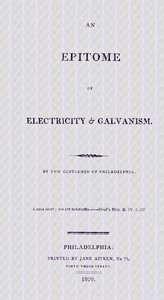
An epitome of electricity & galvanism — Edition Insights
(0 User reviews)
1013
Project Gutenberg
2024
Not confirmed
Electricity -- Early works to 1850
Readers of public-domain and historical texts
Project Gutenberg digital edition
en
Edition facts
Words
58,847
Reading time
256 min
Text sections
16
For An epitome of electricity & galvanism — Edition Insights, the stored edition analysis reports 58,847 words, 4 hr 16 min estimated reading time, and 16 detected text sections.
The text analysis averages about 26.9 words per sentence, while the detected sections provide another way to judge how the source is divided.
Project Gutenberg metadata also associates the work with “Electricity -- Early works to 1850,” connecting these edition facts with the source record’s subject description.
Source:
Project Gutenberg record #74933
An 1809 American manual on electricity and galvanism, co-authored by Jacob Green and Erskine Hazard, offering concise explanations of principles, experimental apparatus, and medical applications, with a practical, instructional tone.
Editorial Edition Score
4.8/5
★★★★★
★★★★★
Calculated from edition completeness, EPUB availability, text structure and catalogue metadata. Not a user rating.
How this score is calculated
- Description quality20 pts
- Title & short description10 pts
- Source metadata20 pts
- Text length15 pts
- Chapters / structure15 pts
- EPUB file integrity20 pts
Total of 100 points, scaled to a 2.5-5.0 range. Editions with an empty description or a missing EPUB file are not scored.
Edition quality
Public-domain source text
Read the source text
The source text is kept in the dedicated reader, separate from this catalogue record and its commentary.
Jacob Green and Erskine Hazard, identifying themselves only as “Two Gentlemen of Philadelphia,” published this compact manual in 1809, a time when electrical science was rapidly expanding. The authors adopt a direct, instructional voice, addressing readers who seek a working knowledge of electricity and galvanism without wading through extensive treatises. The book’s motto from Ovid—Causa latet; vis est notissima (the cause is hidden; the force is well known)—signals a focus on observable effects and practical utility rather than theoretical speculation. Three professors from the University of Pennsylvania, the College of New Jersey, and Yale College contributed endorsements, praising the work’s clarity and suitability for youth and general readers.
A Manual Built for Instruction
The authors structure their epitome as a teaching tool, moving systematically from basic concepts to applied techniques. They define electricity as a fluid that can be transferred, accumulated, and discharged, and they describe the Leyden jar, the electrophorus, and the electrical machine with precise, step-by-step instructions. For instance, they explain how to measure a shock’s intensity by the distance between the electrometer’s ball and the jar’s knob: “when the shock is large it will pass from one knob to the other at a larger distance.” This emphasis on measurable, repeatable procedures reflects the authors’ pedagogical aim. They also include warnings about handling equipment safely, such as using a glass tube as an insulating handle when drawing sparks from a patient’s ear.
The Electrical Physician’s Toolkit
A substantial portion of the text is devoted to medical electricity, detailing instruments and methods for treating ailments. The authors describe a “bottle director,” a modified Leyden jar with a hook at the bottom, used to direct shocks through specific body parts. They also recommend a ball “either of metal, or of wood covered with tin foil” for drawing sparks, and a wooden point for applying a continuous stream of electricity. The language is practical and prescriptive: “The next thing to be provided is a ball… this must have a metallic handle.” The authors present these tools as part of a systematic approach, with four graded applications: simple insulation, friction, sparks, and the stream. Each method is linked to particular conditions, such as spasms, cutaneous eruptions, or deafness.
A Case Study in Treating Deafness
The authors include a rare first-person clinical account, describing their treatment of a gentleman who had suffered “an almost total loss of hearing for more than six months.” They placed him on an insulated chair connected to the prime conductor and, using a blunt pointed wire inserted into a glass tube, drew sparks from the meatus auditorius for eight to ten minutes per session, two or three times a week. After four or five weeks, the patient “left us almost entirely recovered.” The authors note their belief that more frequent sessions would have hastened the cure. This anecdote, presented without statistical context, illustrates the empirical, case-based reasoning common in early 19th-century medical writing. The authors do not claim universal efficacy but offer the episode as evidence of electricity’s potential.
Diction and the Rhetoric of Certainty
Throughout the epitome, the authors employ a confident, declarative style that minimizes hedging. They state that “electricity thus applied has often removed violent spasms” and that deafness “has been entirely cured by the electric spark, when every other remedy has proved ineffectual.” Such assertions are tempered only occasionally by phrases like “it may be suspected that so gentle a treatment could have but little influence.” The vocabulary is technical but accessible: terms like “prime-conductor,” “electrical stool,” and “metallic handle” are used without elaborate definition, assuming a reader familiar with basic apparatus. The authors’ choice to publish anonymously, yet include endorsements from prominent academics, suggests a desire to establish credibility while keeping the focus on the science rather than the authors’ reputations.
Readers approaching this 1809 epitome should expect a concise, hands-on guide rather than a theoretical treatise. The authors’ emphasis on practical application—especially in medical contexts—reflects the era’s optimism about electricity’s therapeutic potential. The book rewards attention to its detailed descriptions of apparatus and procedures, which reveal how early practitioners translated laboratory discoveries into bedside treatments. For those interested in the history of science and medicine, this work offers a vivid snapshot of electrical practice in early America.
There’s something tender about those 1809 pages—Green and Hazard treating electricity like a quiet miracle you could hold in a jar. It makes me think of the boy who’ll later find that same wonder in Harper's Electricity Book for Boys — A Closer Reading, where the spark becomes a friend. Two centuries apart, still the same small thrill.
There are no reviews for this eBook.
There are no comments for this eBook.
Reader reflection
How did this book work for you?
Your answers remain private and are stored only in this browser.
Your progress
0
/
10
2
How much did you enjoy the reading experience?
3
Is this a title you would suggest to others?
4
How much effort did this book require?
5
Did the book meet your expectations?
6
Would you start a conversation about this book?
7
How would you rate its originality?
8
Could you see yourself revisiting this book?
9
What is the main idea you are taking away?
10

![Cover of The Complete Works in Philosophy, Politics and Morals of the late Dr. Benjamin Franklin, Vol. 2 [of 3] — Reading Companion](https://eatsb.com/storage/media/covers/pg48137.jpg)