1

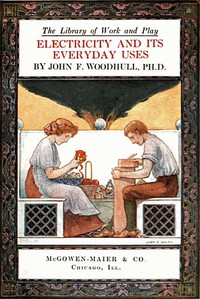
The Library of Work and Play: Electricity and Its Everyday Uses — Reading Notes
(0 User reviews)
1389
Project Gutenberg
2014
Not confirmed
Electricity -- Juvenile literature
Readers of public-domain and historical texts
Project Gutenberg digital edition
en
Edition facts
Words
70,100
Reading time
305 min
Text sections
11
For The Library of Work and Play: Electricity and Its Everyday Uses — Reading Notes, the stored edition analysis reports 70,100 words, 5 hr 5 min estimated reading time, and 11 detected text sections.
The text analysis averages about 19.5 words per sentence, while the detected sections provide another way to judge how the source is divided.
Project Gutenberg metadata also associates the work with “Electricity -- Juvenile literature,” connecting these edition facts with the source record’s subject description.
Source:
Project Gutenberg record #45331
Woodhull recounts how he and his son studied electricity by tackling practical problems directly, using a bell, spark coil, and dry cells to explore voltage, current, and induction through hands-on experiments.
Editorial Edition Score
4.8/5
★★★★★
★★★★★
Calculated from edition completeness, EPUB availability, text structure and catalogue metadata. Not a user rating.
How this score is calculated
- Description quality20 pts
- Title & short description10 pts
- Source metadata20 pts
- Text length15 pts
- Chapters / structure15 pts
- EPUB file integrity20 pts
Total of 100 points, scaled to a 2.5-5.0 range. Editions with an empty description or a missing EPUB file are not scored.
Edition quality
Public-domain source text
Read the source text
The source text is kept in the dedicated reader, separate from this catalogue record and its commentary.
Woodhull opens by contrasting schoolroom instruction with the method he used with his son: instead of starting with bar magnets and building up to the dynamo, they “attack our problems directly” and let principles emerge only when needed. This preface frames the entire book as a record of a father-son investigation, not a formal textbook. The reader is invited to follow their sequence of experiments, beginning with simple cells and bells, and to watch how theoretical concepts like voltage and wattage are introduced only after a practical need arises.
Learning by Direct Experiment
Woodhull’s narrative is built around specific, repeatable experiments. In one early sequence, he connects two dry cells to a bell, using the hammer as an interrupter to produce a secondary current that “forced its way through four bodies,” demonstrating high voltage. He explicitly notes the primary circuit has “not more than three volts while the secondary has more than a hundred.” This concrete measurement grounds the reader in observable outcomes rather than abstract formulas. The author repeatedly returns to the bell as a touchstone, later using it to power a miniature lamp requiring 10 volts and 0.1 ampere, showing how adding cells increases energy until the lamp reaches “full brilliancy.”
Voltage, Current, and the Trade-Off
A central lesson emerges from the bell experiments: “each increase in voltage necessitates a proportional sacrifice of quantity.” Woodhull illustrates this with a worked example: a primary circuit of 3 volts and 0.25 ampere yields 0.75 watt; stepping voltage up to 150 volts reduces current to about 0.005 ampere. He emphasizes that the 150-volt alternating current from the bell is “more tolerable than that from a 150-volt dynamo” because the quantity is limited. This trade-off is revisited with the spark coil, where voltage reaches “between 5000 and 10,000” and the spark jumps a gap of one-sixteenth to one-eighth of an inch, hot enough to light gasoline in a watch crystal.
From Bell to Spark Coil
The spark coil is presented as a scaled-up version of the bell’s mechanism. Woodhull details the components: a larger primary coil with more turns of wire, more iron in the core, and five dry cells instead of two. The vibrator acts “precisely like the hammer of an electric bell” to make and break the primary circuit. The secondary coil’s many turns step voltage up to thousands. A condenser is mentioned but deliberately left undescribed—“not to be described in this book.” This selective omission mirrors the book’s method: only principles needed for the immediate experiment are explained, leaving deeper theory for later or for the curious reader to pursue elsewhere.
A Father-and-Son Approach to Teaching
Woodhull’s preface reveals his educational philosophy: the school method “rarely yields fruit which lasts beyond the examination period,” whereas many boys have become electrical experts “without the aid of a school.” He draws an analogy to how his son learned to read—by having stories read aloud while watching the printed page, so that “the construction of sentences out of words and words out of letters had come to him very incidentally.” The same incidental, problem-driven approach is applied to electricity. The book’s structure mirrors this: each chapter likely begins with a practical problem, and principles are introduced only as tools to solve it. Readers are encouraged to replicate the experiments, using the same equipment (dry cells, bells, spark coils) and to observe the same phenomena firsthand.
Woodhull’s book is best read with a battery, a bell, and a spark coil at hand. The experiments are described in enough detail to be reproduced, and the narrative follows the order in which he and his son encountered each puzzle. Readers who skip ahead will miss the careful scaffolding: each new device builds on the previous one, and each principle is earned through direct observation. Treat the text as a guided laboratory notebook rather than a lecture, and let the sparks—literal and figurative—lead the way.
I remember Woodhull and his boy, fingers smudged with solder, learning current by making a bell ring. That patient, trial-and-error affection carries over into Electricity and Magnetism — Context and Discussion, where the same gentle wonder hums beneath the diagrams. They are not twins, but cousins—both whisper that understanding comes from quiet, curious handling.
There are no reviews for this eBook.
There are no comments for this eBook.
Reader reflection
Record your reading impressions
A brief reflection can help important ideas stay with you longer.
Your progress
0
/
10
2
How did the book work for you overall?
3
How likely are you to recommend this book?
4
What was the reading difficulty like?
5
How closely did the book connect with your experience?
6
Which aspect of the book did you value most?
7
How valuable was this book for your own interests?
8
Did the book meet your expectations?
9
Which lesson or insight stayed with you?
10
![Cover of The Complete Works in Philosophy, Politics and Morals of the late Dr. Benjamin Franklin, Vol. 2 [of 3] — Reading Companion](https://eatsb.com/storage/media/covers/pg48137.jpg)