1

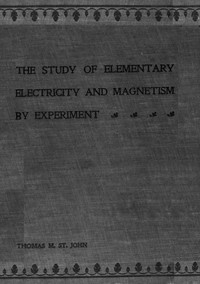
The Study of Elementary Electricity and Magnetism by Experiment Containing Two Hundred Experiments Performed with Simple, Home-made Apparatus — Key Ideas to Explore
(0 User reviews)
1390
Project Gutenberg
2015
Not confirmed
Electricity -- Experiments; Magnetism -- Experiments
Readers of public-domain and historical texts
Project Gutenberg digital edition
en
Edition facts
Words
70,451
Reading time
307 min
Text sections
38
Before opening The Study of Elementary Electricity and Magnetism by Experiment Containing Two Hundred Experiments Performed with Simple, Home-made Apparatus — Key Ideas to Explore, the edition data offers a quick orientation: 70,451 words, 5 hr 7 min estimated reading time, and 38 detected text sections.
The text analysis averages about 12.9 words per sentence, while the detected sections provide another way to judge how the source is divided.
Project Gutenberg metadata also associates the work with “Electricity -- Experiments,” connecting these edition facts with the source record’s subject description.
Source:
Project Gutenberg record #48041
A systematic 1900 textbook guiding amateurs through 200 electricity and magnetism experiments using simple, home-made apparatus, emphasizing hands-on learning and practical construction.
Editorial Edition Score
4.9/5
★★★★★
★★★★★
Calculated from edition completeness, EPUB availability, text structure and catalogue metadata. Not a user rating.
How this score is calculated
- Description quality20 pts
- Title & short description10 pts
- Source metadata20 pts
- Text length15 pts
- Chapters / structure15 pts
- EPUB file integrity20 pts
Total of 100 points, scaled to a 2.5-5.0 range. Editions with an empty description or a missing EPUB file are not scored.
Edition quality
Public-domain source text
Read the source text
The source text is kept in the dedicated reader, separate from this catalogue record and its commentary.
Thomas M. St. John's 1900 textbook presents two hundred experiments in electricity and magnetism designed for amateurs and students using simple, home-made apparatus. The author, a metallurgical engineer, explicitly advises readers to begin at the beginning, perform experiments in order, and understand each step before proceeding. This structured approach reflects a pedagogical commitment to building knowledge incrementally, with practical applications following foundational principles.
The excerpts reveal a text that balances theoretical explanation with hands-on construction. For instance, the discussion of resistance introduces the ohm unit via a mercury column standard, then immediately offers practical equivalents using common copper wire gauges. The author also provides instructions for building a simple resistance coil on a pasteboard base, complete with binding posts and a center tap for variable resistance.
Systematic Progression from Principles to Practice
The author's preface establishes a clear pedagogical sequence: the student is advised to begin at the beginning, perform experiments in order, and understand each step before proceeding. This directive is not merely introductory; it shapes the entire structure of the work. The excerpts show that certain principles and explanations necessarily precede the practical and perhaps more interesting applications of those principles. For example, the concept of internal and external resistance is introduced before the experiment testing conductivity of various substances. The text thus mirrors a classroom laboratory course, where theory and practice are interwoven but theory often comes first.
This progression is reinforced by the numbering of sections and experiments. The excerpt on resistance (sections 307–310) carefully defines units, describes resistance coils, and then presents Experiment 119 to test conductivity. The student is expected to have absorbed the earlier material before attempting the practical work. The author's insistence on understanding each step before proceeding suggests that the book is designed for self-study as much as for classroom use.
Home-Made Apparatus and the Ethos of Self-Reliance
A central theme of the book is the construction of apparatus from everyday materials. The author states that the student should make at least a part of his own apparatus, and the excerpts provide detailed instructions for building a simple resistance coil on a pasteboard base, using spring connectors for connections. The coil is wound with doubled wire to avoid magnetic effects, a detail that shows attention to experimental accuracy even in home-made equipment.
The emphasis on home-made apparatus is not merely economical; it reflects a belief that building one's own tools deepens understanding. The author's earlier works, such as How Two Boys Made Their Own Electrical Apparatus, reinforce this philosophy. The experiments require items like dry cells, galvanoscopes, and pieces of various metals, but the text assumes the student will construct or improvise many components. This hands-on approach distinguishes the book from contemporary textbooks that relied on expensive commercial equipment.
Precision in Measurement and Practical Equivalents
The excerpts reveal a careful attention to measurement and standards. The unit of resistance, the ohm, is defined with reference to a mercury column of specific length and weight, but the author immediately provides practical equivalents: 9 ft 9 in of No. 30 copper wire or 39 ft 1 in of No. 24 copper wire will make a fairly good ohm. This dual presentation—scientific standard followed by practical approximation—is characteristic of the book's approach.
Similarly, the description of resistance coils explains how to achieve any resistance from 1 to 10 ohms using four coils of 1, 2, 2, and 5 ohms. The author includes a diagram of a simple resistance coil with a center tap for variable resistance. The text also notes that wire for coils is doubled at the center before winding to avoid magnetic effects, a detail that shows awareness of experimental artifacts. These specifics indicate that the book aims to equip the student with both theoretical knowledge and practical skills for accurate measurement.
St. John's textbook offers a rare window into late-nineteenth-century science education for amateurs. Its emphasis on systematic progression, home-made apparatus, and practical equivalents makes it a valuable resource for historians of education and technology, as well as for modern hobbyists interested in historical experimental methods. Readers should approach the text as a period document, noting the assumptions about materials and knowledge that differ from contemporary practice.
Holding this 1900 textbook, I recalled my father’s basement workbench, where a dismantled toaster taught me more than any lecture. That same humble curiosity—the feel of wire and magnet in my hands—returned while reading Makers of Electricity — A Reader’s Guide. It was less a history than a family album of tinkerers, each page a quiet handshake across time.
There are no reviews for this eBook.
There are no comments for this eBook.
Reader reflection
Record your reading impressions
A brief reflection can help important ideas stay with you longer.
Your progress
0
/
10
2
How did the book work for you overall?
3
Is this a title you would suggest to others?
4
What was the reading difficulty like?
5
How strong was your personal connection to the text?
6
How distinctive were its ideas or approach?
7
How valuable was this book for your own interests?
8
Is this a title worth rereading?
9
Which lesson or insight stayed with you?
10
![Cover of The Complete Works in Philosophy, Politics and Morals of the late Dr. Benjamin Franklin, Vol. 2 [of 3] — Reading Companion](https://eatsb.com/storage/media/covers/pg48137.jpg)