1

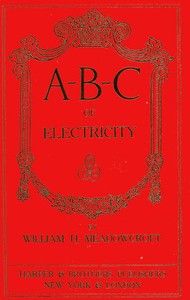
A-B-C of Electricity — Key Ideas to Explore
(0 User reviews)
124
Project Gutenberg
2014
Not confirmed
Electricity
Readers of public-domain and historical texts
Project Gutenberg digital edition
en
Edition facts
Words
26,179
Reading time
114 min
Text sections
3
The source record for A-B-C of Electricity — Key Ideas to Explore measures this digital text at 26,179 words, 1 hr 54 min estimated reading time, and 3 detected text sections.
The text analysis averages about 27.0 words per sentence, while the detected sections provide another way to judge how the source is divided.
Project Gutenberg metadata also associates the work with “Electricity,” connecting these edition facts with the source record’s subject description.
Source:
Project Gutenberg record #45955
Meadowcroft's 1915 primer explains electricity through direct address, analogies like rope friction, and close descriptions of arc and incandescent lamps, aiming at readers aged fourteen and up with no prior technical knowledge.
Editorial Edition Score
4.6/5
★★★★★
★★★★★
Calculated from edition completeness, EPUB availability, text structure and catalogue metadata. Not a user rating.
How this score is calculated
- Description quality20 pts
- Title & short description10 pts
- Source metadata20 pts
- Text length15 pts
- Chapters / structure15 pts
- EPUB file integrity20 pts
Total of 100 points, scaled to a 2.5-5.0 range. Editions with an empty description or a missing EPUB file are not scored.
Edition quality
Public-domain source text
Read the source text
The source text is kept in the dedicated reader, separate from this catalogue record and its commentary.
Meadowcroft addresses his reader directly as 'you' throughout, a choice that turns technical explanation into a spoken lesson. In the arc-lamp passage, he breaks down the current's path step by step: 'the electricity which is constantly being made fills the wires and acts as a pressure.' The prose mirrors the physical process it describes—current builds, encounters a gap, and must jump. This pedagogical voice, paired with homely analogies (a rope pulled through hands to illustrate resistance), defines the book's method.
The author's preface confirms the intended audience: 'young people of, say, fourteen years and upward' and adults who missed the recent electrical developments. He explicitly disclaims scientific ambition, calling the volume 'this little volume' and framing it as a bridge to more advanced works.
Direct Address and the Reader's Role
Meadowcroft consistently uses second-person pronouns and imperative constructions: 'Now you will remember that in the chapter on Magnetism we told you.' This is not a detached textbook but a guided tour. The author positions himself as a companion who has already explained the basics and now builds on them. The phrase 'we want you to understand more thoroughly' typifies the collaborative tone. Such diction choices lower the barrier for the intended novice reader, making abstract concepts like resistance tactile through the rope-pulling analogy.
Analogies as Explanatory Tools
The rope-friction analogy is the most vivid: 'if you were holding a rope tightly in your hands and some one pulled it through them quickly and suddenly, it would get very hot.' Meadowcroft extends the analogy to predict fire if the rope were drawn fast enough, directly mapping to the arc-lamp's light production. This choice reveals a preference for mechanical, everyday experiences over mathematical formulas. Elsewhere, he compares the dynamo's pressure to water in pipes, a standard analogy but executed with concrete detail about wires 'filled' with electricity.
Description of the Arc-Lamp's Operation
The arc-lamp explanation is the most technically detailed excerpt. Meadowcroft describes carbon 'pencils' brought together then separated, forcing the current to 'jump across' a gap. He specifies that the jump 'breaks off from one carbon a shower of tiny particles as fine as the finest dust, and makes them white hot.' The language is precise about scale ('fine as the finest dust') and effect ('dazzling light'). He also notes the practical limitation: carbon pencils last 'about eight or ten hours' before needing replacement. This blend of physical mechanism and real-world constraint typifies the book's approach.
The Incandescent Lamp as a Contrast
Meadowcroft introduces the incandescent lamp by contrasting it with the arc-lamp: 'the light is not produced by the combustion or wasting away of the carbon.' He describes the lamp's construction—a 'pear-shaped globe' containing a 'long U-shaped strip of carbon no thicker than an ordinary thread' made from carbonized bamboo cane. The shift from arc to incandescent allows him to explain a different principle: resistance without consumption. The bamboo origin is a specific historical detail, reflecting Edison's actual experiments. The description remains visual and material, avoiding abstract electrical theory.
Meadowcroft's diction—direct, analogical, and grounded in physical objects—makes this primer accessible without oversimplifying the underlying principles. Readers should attend to how he builds each explanation from a concrete image (rope, carbon dust, bamboo thread) before introducing the electrical concept. The book's value lies not in its completeness but in its method: it teaches by showing how to think about electricity in everyday terms.
Meadowcroft’s little primer, with its rope-friction and warm lamps, always felt like a hand reaching out across a century—patient, unhurried. Yet beneath that calm voice stirs the same wonder that crackles through Franklin’s older pages, Experiments and Observations on Electricity Made at Philadelphia in America — Context and Discussion. Both speak to a beginner’s quiet awe, as if learning were simply a friendly murmur between old friends.
There are no reviews for this eBook.
There are no comments for this eBook.
Reader reflection
Before you leave, reflect on the book
Use these questions to collect your thoughts before moving on.
Your progress
0
/
10
2
Did this book hold your interest?
3
Would you recommend this book to another reader?
4
What was the reading difficulty like?
5
How much did the book move you?
6
What did you think about the pace?
7
How understandable was the text?
8
How distinctive were its ideas or approach?
9
What changed or sharpened your thinking?
10
![Cover of The Complete Works in Philosophy, Politics and Morals of the late Dr. Benjamin Franklin, Vol. 2 [of 3] — Reading Companion](https://eatsb.com/storage/media/covers/pg48137.jpg)