1

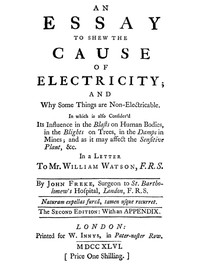
An Essay to Shew the Cause of Electricity; and Why Some Things are Non-Electricable. In Which Is Also Consider'd Its Influence in the Blasts on Human Bodies, in the — Themes and Context
(0 User reviews)
471
Project Gutenberg
2016
Not confirmed
Electricity -- Early works to 1850; Martin, Benjamin, 1705-1782. Essay on electricity
Readers of public-domain and historical texts
Project Gutenberg digital edition
en
Edition facts
Words
12,807
Reading time
56 min
Text sections
5
Before opening An Essay to Shew the Cause of Electricity; and Why Some Things are Non-Electricable. In Which Is Also Consider'd Its Influence in the Blasts on Human Bodies, in the — Themes and Context, the edition data offers a quick orientation: 12,807 words, 56 min estimated reading time, and 5 detected text sections.
The text analysis averages about 38.1 words per sentence, while the detected sections provide another way to judge how the source is divided.
Project Gutenberg metadata also associates the work with “Electricity -- Early works to 1850,” connecting these edition facts with the source record’s subject description.
Source:
Project Gutenberg record #52439
John Freke's 1746 essay proposes that electricity is caused by a universal fire, using conjectural reasoning to explain electrical phenomena, blights, blasts, and the sensitive plant's movement. The second edition includes an appendix and is addressed to William Watson, reflecting an 18th-century surgical and natural-philosophical perspective.
Editorial Edition Score
4.5/5
★★★★★
★★★★★
Calculated from edition completeness, EPUB availability, text structure and catalogue metadata. Not a user rating.
How this score is calculated
- Description quality20 pts
- Title & short description10 pts
- Source metadata20 pts
- Text length15 pts
- Chapters / structure15 pts
- EPUB file integrity20 pts
Total of 100 points, scaled to a 2.5-5.0 range. Editions with an empty description or a missing EPUB file are not scored.
Edition quality
Public-domain source text
Read the source text
The source text is kept in the dedicated reader, separate from this catalogue record and its commentary.
John Freke, surgeon to St. Bartholomew's Hospital and Fellow of the Royal Society, opens his 1746 essay with a dedicatory letter to Martin Folkes, President of the Royal Society, and a preface recounting how he first wrote his thoughts on electricity for private circulation. Encouraged by friends and a distinguished natural philosopher, he printed the work to share his conjectures. The essay's full title promises to show the cause of electricity and why some things are non-electricable, also considering its influence on human blasts, tree blights, mine damps, and the sensitive plant. This second edition includes an appendix, indicating Freke's engagement with ongoing debates in electrical philosophy.
A Conjectural Framework for Electrical Fire
Freke builds his argument on the premise that electricity arises from a universal fire, which he equates with the Anima Mundi of the ancients. He writes that this fire is equally dispersed in nature, with bodies receiving more or less depending on their capacity and location. The essay's reasoning is explicitly conjectural: Freke repeatedly uses phrases like "if you will suppose with me" and "as far as my Conjecture reaches." He does not claim experimental proof but rather offers a consistent explanatory system. For instance, he accounts for the sensitive plant's shrinking by proposing that the plant contains more of this fire than surrounding objects; upon touch, it imparts fire to the other body, becoming languid until it recovers from the air. This mechanism mirrors his explanation of electrical attraction and repulsion in non-living matter.
Analogies Between Plant and Animal Life
Freke extends his electrical theory to vegetation and animal life. He describes an experiment where a small tree placed on resin and electrified becomes turgid, erecting its leaves; touching a single leaf makes the whole tree languish, akin to the sensitive plant. He uses this to illustrate his conjecture. He also addresses the direction of farina fecundans (pollen) to the matrix (ovule), arguing that an attracting influence—the same electrical fire—guides it, otherwise fertilization would be left to chance. He cites a mule-flower bred between a pink and a sweet-william at Mr. Fairchild's garden in Hoxton as evidence that pollen from one plant can impregnate another. Turning to animal life, he observes that youth abounds with more spirits than age, linking vitality to the abundance of electrical fire.
Pace and Structure of Freke's Argument
The essay proceeds in a measured, cumulative manner. Freke first establishes his conjectural cause, then applies it to a series of phenomena: electrical experiments, plant physiology, and human health. The prose is methodical, with each new application introduced by phrases like "Having consider'd... I shall reflect a little further." The pace quickens in the appendix, where Freke responds to Benjamin Martin's Essay on Electricity, a contemporary work. The overall structure is that of a letter, addressed to William Watson, which gives it a personal, conversational tone. Freke's voice is that of a modest investigator: he hopes his work may "enlighten the Minds" of readers or "awaken the Attention of others" to give better reasons. This self-effacing stance contrasts with the boldness of his conjectures.
Readers should note that Freke's essay is a product of mid-18th-century natural philosophy, where speculation and observation were closely intertwined. The text rewards attention to its rhetorical structure: the way Freke builds from a single cause to a wide range of effects, always marking his claims as conjectural. The appendix, responding to Benjamin Martin, offers a glimpse into contemporary debate. For those interested in the history of electricity, this work illustrates how surgical and medical practitioners contributed to physical theory before the discipline became specialized.
Freke’s crackling fire, that invisible stir behind living things, always put me in mind of another shelf, where a quieter book waits for curious hands—The Library of Work and Play: Electricity and Its Everyday Uses — Reading Notes. Odd, how two centuries apart, both authors simply marvelled at the same bright, restless spark.
There are no reviews for this eBook.
There are no comments for this eBook.
Reader reflection
What did you think of this book?
Answer a few questions and save a private reflection on this device.
Your progress
0
/
10
2
Did this book hold your interest?
3
Would you recommend this book to another reader?
4
How demanding did the text feel?
5
Did the book deliver what you hoped for?
6
Is this a title worth rereading?
7
Would this book work well in a reading group?
8
Did the book offer a fresh perspective?
9
In one sentence, what did you learn?
10
![Cover of The Complete Works in Philosophy, Politics and Morals of the late Dr. Benjamin Franklin, Vol. 2 [of 3] — Reading Companion](https://eatsb.com/storage/media/covers/pg48137.jpg)