1

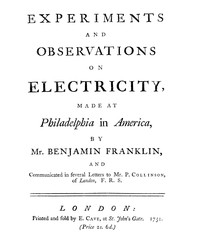
Experiments and Observations on Electricity Made at Philadelphia in America — Context and Discussion
(0 User reviews)
1518
Project Gutenberg
2014
Not confirmed
Electricity -- Early works to 1850
Readers of public-domain and historical texts
Project Gutenberg digital edition
en
Edition facts
Words
26,511
Reading time
116 min
Text sections
3
This digital edition of Experiments and Observations on Electricity Made at Philadelphia in America — Context and Discussion is described by source-level measurements including 26,511 words, 1 hr 56 min estimated reading time, and 3 detected text sections.
The text analysis averages about 31.9 words per sentence, while the detected sections provide another way to judge how the source is divided.
Project Gutenberg metadata also associates the work with “Electricity -- Early works to 1850,” connecting these edition facts with the source record’s subject description.
Source:
Project Gutenberg record #45515
Benjamin Franklin's 1751 collection of letters and papers on electricity, presenting his single-fluid theory, experiments with Leyden jars, and conjectures on lightning's electrical nature, as communicated to London's Royal Society.
Editorial Edition Score
4.6/5
★★★★★
★★★★★
Calculated from edition completeness, EPUB availability, text structure and catalogue metadata. Not a user rating.
How this score is calculated
- Description quality20 pts
- Title & short description10 pts
- Source metadata20 pts
- Text length15 pts
- Chapters / structure15 pts
- EPUB file integrity20 pts
Total of 100 points, scaled to a 2.5-5.0 range. Editions with an empty description or a missing EPUB file are not scored.
Edition quality
Public-domain source text
Read the source text
The source text is kept in the dedicated reader, separate from this catalogue record and its commentary.
This volume collects Benjamin Franklin's letters and papers on electricity, written in Philadelphia between 1747 and 1750 and sent to Peter Collinson in London. The preface explains that the material was never intended for publication; it was printed only after being shown to others “conversant in electrical disquisitions,” who urged its release. The result is a work that retains the informal, epistolary character of scientific correspondence, with Franklin proposing hypotheses, describing experiments, and refining his ideas in successive letters.
Franklin's central concept—that electricity is a single fluid that can be transferred between bodies, leaving one deficient (negative) and the other surcharged (positive)—emerges through concrete observations. He describes how a shock from a “large glass jar” passes through the body, and compares common matter to a “spunge” that absorbs electrical fluid. These analogies ground his theorizing in everyday experience.
From Private Amusement to Published Letters
The preface reveals that Franklin's experiments were originally “matters only of private amusement.” An unnamed editor assembled the letters and “detach'd pieces” without Franklin's prior permission, only informing him when the first sheets were already in press. Franklin then supplied “some farther remarks, together with a few corrections and additions,” placed at the end. This publication history shapes the text's structure: it is not a unified treatise but a series of communications, each responding to questions or reporting new findings. Readers encounter Franklin's ideas as they developed, with occasional afterthoughts and corrections appended.
The Electrical Fluid as a Universal Substance
Franklin's opening “Opinions and Conjectures” (1749) lays out his theory in numbered propositions. He defines electrical matter as “particles extreamly subtile” that can permeate even the densest metals. The particles repel each other but are “strongly attracted by all other matter.” This dual behavior explains why an electrified body's excess fluid forms an “electrical atmosphere” on its surface. Franklin then draws an extended analogy: common matter is “a kind of spunge to the electrical fluid,” absorbing it until saturated. The comparison is detailed—he considers pore size, attraction, and repulsion among fluid particles—showing his method of reasoning from familiar phenomena to invisible processes.
Speculative Uses and Cautions
Franklin acknowledges that “the beneficial uses of this electrical fluid in the creation, we are not yet well acquainted with,” though he suspects they are “very considerable.” He then speculates on the dangers of an excess: if the Earth contained as much electrical matter proportionally as a charged iron globe, “the particles of dust and other light matters” would repel each other, with potentially disruptive effects. This passage illustrates Franklin's willingness to extrapolate from laboratory experiments to cosmic scales, while remaining cautious about claiming certain knowledge. The conjectural tone is typical of the collection, which presents hypotheses as “suppositions and conjectures” rather than established facts.
Because the text is a compilation of letters, readers may find it helpful to track Franklin's evolving terminology—for instance, his shift from describing electricity as a fluid to using the terms “positive” and “negative.” The appended corrections and additions at the end should be consulted alongside the main letters, as they contain Franklin's later refinements. This edition reproduces the original 18th-century spelling and punctuation, which can occasionally obscure meaning but preserves the historical character of the work.
Franklin’s letters to London feel like watching a bright, patient mind feeling its way in the dark. That same quiet wonder lives in Faraday’s own notebooks, as if both men knew electricity was never quite theirs to command, only to befriend. A kinship of gentle curiosity, I think. Michael Faraday, His Life and Work — Themes and Context keeps such good company on my shelf.
There are no reviews for this eBook.
There are no comments for this eBook.
Reader reflection
What was your reading experience?
Capture what you thought, learned, and would like to remember.
Your progress
0
/
10
2
How did the book work for you overall?
3
Is this a title you would suggest to others?
4
Did the language feel accessible?
5
Did you gain anything practical from the text?
6
Is this a title worth rereading?
7
Did any part of the book feel personally relevant?
8
How did the reading compare with what you expected?
9
Which lesson or insight stayed with you?
10

![Cover of The Complete Works in Philosophy, Politics and Morals of the late Dr. Benjamin Franklin, Vol. 2 [of 3] — Reading Companion](https://eatsb.com/storage/media/covers/pg48137.jpg)