1

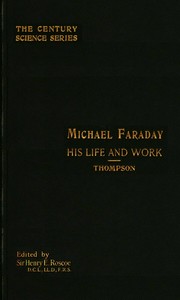
Michael Faraday, His Life and Work — Themes and Context
(0 User reviews)
287
Project Gutenberg
2021
Not confirmed
Faraday, Michael, 1791-1867; Electricity -- History
Readers of public-domain and historical texts
Project Gutenberg digital edition
en
Edition facts
Words
92,789
Reading time
404 min
Text sections
23
Michael Faraday, His Life and Work — Themes and Context can be approached with a clearer sense of reading commitment from its source measurements: 92,789 words, 6 hr 44 min estimated reading time, and 23 detected text sections.
The text analysis averages about 23.2 words per sentence, while the detected sections provide another way to judge how the source is divided.
Project Gutenberg metadata also associates the work with “Faraday, Michael, 1791-1867,” connecting these edition facts with the source record’s subject description.
Source:
Project Gutenberg record #65735
Silvanus P. Thompson's biography of Michael Faraday examines the scientist's life through his own words and experimental records, with particular attention to his evolving terminology and speculative leaps in electrical theory.
Editorial Edition Score
4.9/5
★★★★★
★★★★★
Calculated from edition completeness, EPUB availability, text structure and catalogue metadata. Not a user rating.
How this score is calculated
- Description quality20 pts
- Title & short description10 pts
- Source metadata20 pts
- Text length15 pts
- Chapters / structure15 pts
- EPUB file integrity20 pts
Total of 100 points, scaled to a 2.5-5.0 range. Editions with an empty description or a missing EPUB file are not scored.
Edition quality
Public-domain source text
Read the source text
The source text is kept in the dedicated reader, separate from this catalogue record and its commentary.
Silvanus P. Thompson opens his biography of Michael Faraday with a prefatory note that the three earlier biographies—by Bence Jones, Tyndall, and others—had long been out of print. This 1898 volume, part of the Century Science Series, aims to present Faraday's life and work with an emphasis on his scientific correspondence and experimental memoirs. Thompson, himself a physicist, frequently lets Faraday speak through his letters, revealing a scientist who wrestled with language as much as with nature. The narrative voice shifts between Thompson's measured exposition and Faraday's own vivid, sometimes playful prose, creating a layered account of discovery.
Faraday's Struggle with Scientific Nomenclature
One of the most striking features of the excerpts is Faraday's active engagement with the naming of new phenomena. In a letter to William Whewell, Faraday responds to proposed terms like 'inductric' and 'inducteous' with characteristic humility: 'I am rather in the dark as to whether this is the kind of relation which you want to indicate.' He admits his 'dulness' but also defends his own usage, noting that 'current' seems 'capable of jogging on very well from cathode to anode.' This exchange reveals a scientist who cared deeply about precision yet remained open to revision. Thompson preserves these linguistic negotiations, showing how Faraday's experimental work was inseparable from the challenge of describing it.
Speculative Leaps in the Later Memoirs
Thompson's account of the thirteenth memoir highlights Faraday's 'exceedingly striking speculation on the lateral or transverse effects of the current.' Faraday writes of 'a lateral tension or repulsion possessed by the lines of electric inductive action' and wonders whether the contraction of these lines during discharge might be 'identical with the attractions of similar currents.' Thompson notes that this vision 'eluded his grasp' until Maxwell gave it mathematical form. The biography captures Faraday's restless imagination—his instinctive sense that something more lay beneath the phenomena he could measure. Thompson does not overstate the achievement; he simply records the tentative language: 'May not this be an effect identical...?'
The Search for Displacement Currents
In the fourteenth memoir, Faraday describes a simple induction balance and then poses a question: what happens to insulators when magnetic forces vary? He suspects they must undergo 'some state or condition corresponding to the state that causes currents in metals.' He reports rotating non-conducting bodies near magnetic poles and 'causing powerful electric currents to be suddenly formed and to cease around and about insulators'—all to no avail. Thompson remarks that Faraday was 'looking for direct evidence of the existence of what Maxwell called “displacement currents.”' The passage is poignant: the experimenter's failure is recorded without apology, and Thompson's commentary connects it to later theory without claiming foresight.
Thompson's biography rewards readers who attend to the interplay between Faraday's experimental reports and his correspondence. The excerpts suggest a work that does not merely chronicle discoveries but examines how a scientist thinks on the page—tentative, precise, and occasionally visionary. Readers interested in the evolution of scientific language or the texture of nineteenth-century research will find particular value in the letters and memoir excerpts that Thompson weaves into his narrative.
Returning to Thompson’s Faraday, I lingered on his quiet delight in tracing unseen forces—those tentative words for electricity taking shape. It reminded me, strangely, of an old boy’s handbook sitting on my shelf, its diagrams almost childish, yet carrying the same wonder. Harper's Electricity Book for Boys — A Closer Reading holds that same earnest spark, a century later.
There are no reviews for this eBook.
There are no comments for this eBook.
Reader reflection
How did this book work for you?
Your answers remain private and are stored only in this browser.
Your progress
0
/
10
2
Was reading this book enjoyable?
3
How likely are you to recommend this book?
4
What was the reading difficulty like?
5
How clear did the writing feel?
6
Did you relate to its people, ideas, or situations?
7
Could you apply anything you learned?
8
Did the book offer a fresh perspective?
9
What changed or sharpened your thinking?
10

![Cover of The Complete Works in Philosophy, Politics and Morals of the late Dr. Benjamin Franklin, Vol. 2 [of 3] — Reading Companion](https://eatsb.com/storage/media/covers/pg48137.jpg)