1

Harper's Electricity Book for Boys — A Closer Reading
(0 User reviews)
138
Project Gutenberg
2021
Not confirmed
Electricity -- Juvenile literature
Readers of public-domain and historical texts
Project Gutenberg digital edition
en
Edition facts
Words
112,480
Reading time
490 min
Text sections
15
Before opening Harper's Electricity Book for Boys — A Closer Reading, the edition data offers a quick orientation: 112,480 words, 8 hr 10 min estimated reading time, and 15 detected text sections.
The text analysis averages about 21.6 words per sentence, while the detected sections provide another way to judge how the source is divided.
Project Gutenberg metadata also associates the work with “Electricity -- Juvenile literature,” connecting these edition facts with the source record’s subject description.
Source:
Project Gutenberg record #64592
A 1907 guide for boys to build batteries, magnets, induction coils, and dynamos, with precise ironworking instructions and a dictionary of electrical terms.
Editorial Edition Score
4.9/5
★★★★★
★★★★★
Calculated from edition completeness, EPUB availability, text structure and catalogue metadata. Not a user rating.
How this score is calculated
- Description quality20 pts
- Title & short description10 pts
- Source metadata20 pts
- Text length15 pts
- Chapters / structure15 pts
- EPUB file integrity20 pts
Total of 100 points, scaled to a 2.5-5.0 range. Editions with an empty description or a missing EPUB file are not scored.
Edition quality
Public-domain source text
Read the source text
The source text is kept in the dedicated reader, separate from this catalogue record and its commentary.
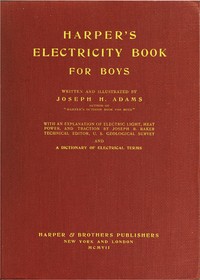
Harper's Electricity Book for Boys, written and illustrated by Joseph H. Adams and published in 1907, is a practical manual that teaches boys how to construct electrical devices from scratch. The book opens with a frontispiece of Thomas Edison dictating to his graphophone, signaling an emphasis on hands-on invention. Adams provides step-by-step instructions for making cells, batteries, switches, magnets, induction coils, and dynamos, often specifying exact dimensions and materials—such as "three-quarter-inch round iron" for cores and "band-iron five-eighths of an inch thick" for yokes. The text assumes access to a blacksmith shop for ironworking, reflecting the era's expectation that boys would use real tools and metalwork.
Building a Field-Magnet from Scratch
The excerpt detailing dynamo construction reveals the book's characteristic precision. Adams instructs the reader to cut two cores from three-quarter-inch round iron, each three and a half inches long, and thread them at both ends. A yoke is cut from band-iron five-eighths of an inch thick and one and a half inches wide, with holes bored two and three-quarters inches apart. The lugs—iron blocks one and a half by one and a half by two inches—are cut with a hack-saw and half-round file. Adams warns that iron or steel must not be used for the bearing strip, as these metals are susceptible to magnetism; instead, brass, copper, or German-silver is required. The armature must revolve within the field-lugs with only one-sixteenth of an inch clearance, demanding careful alignment.
The Role of the Blacksmith Shop
Adams repeatedly directs the reader to have iron parts made at a blacksmith shop, since "the various cutting, threading, and tapping operations call for the use of special iron-working tools." This reliance on professional metalwork underscores the book's assumption that its audience—American boys—had access to such workshops and could collaborate with skilled tradesmen. The instructions for a larger dynamo specify one-inch iron pipe for cores and cast-iron blocks for ends, which must be "made or cast from a pattern." The book thus bridges home workshop and industrial craft, teaching not only electrical theory but also practical metal fabrication.
A Dictionary and a Series Context
The title page announces that the book includes "a Dictionary of Electrical Terms" and is part of Harper's Practical Books for Boys series, which also includes outdoor, indoor, and machinery volumes. The copyright page lists Joseph B. Baker as contributor, providing "an Explanation of Electric Light, Heat Power, and Traction." This supplementary material suggests the book aims to be both a construction guide and a reference. The table of contents shows a progression from simple cells and batteries to complex dynamos, with chapters on push-buttons, switches, magnets, induction coils, annunciators, bells, and galvanometers. The book's structure mirrors a logical learning path, from basic components to complete machines.
Readers should approach this book as a period artifact of early twentieth-century technical education. The instructions assume a level of manual skill and access to tools that may be unfamiliar today. The detailed measurements and materials lists offer a window into the practical knowledge expected of a hobbyist in 1907. For modern readers, the book provides historical insight into how electricity was taught to young people before commercial kits became common.
There’s something touching in how that old manual treats electricity as a thing you could almost befriend—batteries and coils built with your own hands, then switched on with a kind of hope. Reading it, I found myself remembering Experiments and Observations Relative to the Influence Lately Discovered by M. Galvani and Commonly Called Animal Electricity — Story, Setting & Ideas, where the same spark was still a marvel, not yet a tool. Both feel like quiet letters from a younger century.
There are no reviews for this eBook.
There are no comments for this eBook.
Reader reflection
What did you think of this book?
Answer a few questions and save a private reflection on this device.
Your progress
0
/
10
2
What was your overall reaction to the book?
3
Would you pass this book on to a friend?
4
What was the reading difficulty like?
5
Which aspect of the book did you value most?
6
Was the book moving at the right speed?
7
Would this book work well in a reading group?
8
How useful did the reading feel?
9
Which lesson or insight stayed with you?
10

![Cover of The Complete Works in Philosophy, Politics and Morals of the late Dr. Benjamin Franklin, Vol. 2 [of 3] — Reading Companion](https://eatsb.com/storage/media/covers/pg48137.jpg)