1

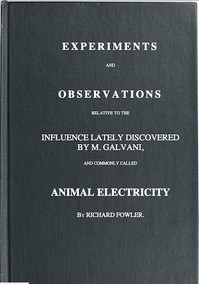
Experiments and Observations Relative to the Influence Lately Discovered by M. Galvani and Commonly Called Animal Electricity — Story, Setting & Ideas
(0 User reviews)
877
Project Gutenberg
2014
Not confirmed
Electrophysiology -- Early works to 1800; Galvani, Luigi, 1737-1798
Readers of public-domain and historical texts
Project Gutenberg digital edition
en
Edition facts
Words
29,413
Reading time
128 min
Text sections
9
For Experiments and Observations Relative to the Influence Lately Discovered by M. Galvani and Commonly Called Animal Electricity — Story, Setting & Ideas, the stored edition analysis reports 29,413 words, 2 hr 8 min estimated reading time, and 9 detected text sections.
The text analysis averages about 32.2 words per sentence, while the detected sections provide another way to judge how the source is divided.
Project Gutenberg metadata also associates the work with “Electrophysiology -- Early works to 1800,” connecting these edition facts with the source record’s subject description.
Source:
Project Gutenberg record #46820
Richard Fowler's 1793 experiments test Galvani's animal electricity using self-experimentation, including nasal silver rods and metal contacts on lips, to probe nerve-muscle connections and involuntary responses like pupil contraction.
Editorial Edition Score
4.6/5
★★★★★
★★★★★
Calculated from edition completeness, EPUB availability, text structure and catalogue metadata. Not a user rating.
How this score is calculated
- Description quality20 pts
- Title & short description10 pts
- Source metadata20 pts
- Text length15 pts
- Chapters / structure15 pts
- EPUB file integrity20 pts
Total of 100 points, scaled to a 2.5-5.0 range. Editions with an empty description or a missing EPUB file are not scored.
Edition quality
Public-domain source text
Read the source text
The source text is kept in the dedicated reader, separate from this catalogue record and its commentary.
Richard Fowler opens his 1793 treatise with a modest aim: to determine whether Galvani's newly discovered influence follows a known law of nature or constitutes a new one. Rather than claiming revolutionary conclusions, he positions his experiments as a tool for physiological investigation, noting that the influence detects small degrees of muscle contractile power without diminishing it—unlike electricity or other stimuli. The preface establishes a careful, empirical tone, with Fowler emphasizing that every observation was recorded instantly and often witnessed by colleagues, including Mr. George Hunter of York, whose assistance he gratefully acknowledges.
Self-Experimentation and the Nasal Nerve Route
Fowler’s most striking experiments involve his own body. To test whether Galvani’s influence could travel along a specific nerve, he inserted a silver rod as far as possible up his nose, aiming to arm the nasal branch of the fifth pair of nerves. By bringing this silver into contact with a piece of zinc placed on his tongue, he produced a flash in the eye—stronger, he claims, than when the eye itself was armed. This self-administered trial demonstrates his willingness to endure discomfort for empirical precision.
He then extended the method to study the human iris, an involuntary muscle. Citing physiologist Dr. Whytt’s earlier work with ammonia on a hydrocephalic boy, Fowler hypothesized that nerve-mediated stimulation could affect the heart similarly. With friends observing his pupil in dim light, he reported a distinct contraction each time the metals touched. The experiment required careful lighting and proper placement of the silver, but Fowler claims it seldom failed when conditions were met.
Unexpected Sensations and the Diffusion of Flash
Mr. George Hunter discovered that placing one metal high between the upper gum and lip, and the other similarly below, produced a flash not confined to the eye but diffused over the whole face. Fowler, repeating this, perceived a sense of warmth spreading over the entire upper surface of the tongue, from root to tip, at the moment of contact. Dr. Rutherford further noted that a flash occurs both at contact and separation, but not during sustained contact—a phenomenon Fowler likens to contractions in a frog’s leg when one metal is withdrawn.
These observations highlight the influence’s sensitivity to changes in the metallic circuit, not steady contact. Fowler uses them to argue for a free communication between nerves and muscles, though he stops short of claiming a complete understanding of the underlying mechanism.
Methodological Care and Physiological Implications
Throughout the excerpts, Fowler demonstrates a methodical approach: experiments were conducted in the presence of witnesses, and observations were recorded immediately. He acknowledges the difficulty of determining pupil contraction in strong light, adjusting conditions to ensure reliability. His reference to Dr. Whytt’s work on involuntary muscle responses shows he situates his findings within existing physiological debates, particularly regarding nerve influence on the heart.
Fowler’s primary lens is the relationship between Galvani’s influence and known electrical phenomena. He tests whether the effects are referable to electricity, but the excerpts do not reveal his final conclusion. The catalog subjects—electrophysiology and Galvani—align with the text’s focus, though the excerpts emphasize self-experimentation and sensory effects more than theoretical resolution.
Fowler’s work offers a firsthand account of early electrophysiological experimentation, grounded in meticulous self-observation and collaborative verification. Readers should note that the excerpts cover only the preface and part of Section I; the full text likely extends to further experiments and conclusions. The detailed descriptions of nasal and oral metal placements provide a concrete sense of 1790s investigative practices, while the unresolved question of whether the influence is electrical or novel invites continued scrutiny.
Reading Fowler's nasal rods made me remember the summer I pressed a lemon battery to my tongue, that sharp metallic tingle. It felt like touching a secret. Later, The Library of Work and Play: Electricity and Its Everyday Uses — Reading Notes offered a gentler version of that same wonder, explaining the spark in my hand without diminishing its mystery.
There are no reviews for this eBook.
There are no comments for this eBook.
Reader reflection
What was your reading experience?
Capture what you thought, learned, and would like to remember.
Your progress
0
/
10
2
Did this book hold your interest?
3
Would you recommend this book to another reader?
4
Did the language feel accessible?
5
Did the book deliver what you hoped for?
6
Was the book moving at the right speed?
7
Would you like to discuss this book with someone?
8
Did the book offer a fresh perspective?
9
What is the main idea you are taking away?
10


![Cover of The Complete Works in Philosophy, Politics and Morals of the late Dr. Benjamin Franklin, Vol. 2 [of 3] — Reading Companion](https://eatsb.com/storage/media/covers/pg48137.jpg)