1

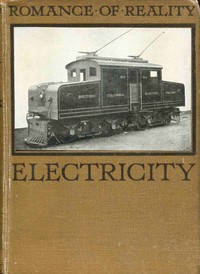
Electricity — Text and Context
(0 User reviews)
262
Project Gutenberg
2023
Not confirmed
Electricity
Readers of public-domain and historical texts
Project Gutenberg digital edition
en
Edition facts
Words
87,572
Reading time
381 min
Text sections
39
This digital edition of Electricity — Text and Context is described by source-level measurements including 87,572 words, 6 hr 21 min estimated reading time, and 39 detected text sections.
The text analysis averages about 24.6 words per sentence, while the detected sections provide another way to judge how the source is divided.
Project Gutenberg metadata also associates the work with “Electricity,” connecting these edition facts with the source record’s subject description.
Source:
Project Gutenberg record #72062
W. H. McCormick's 1915 survey of electrical science, from early machines to wireless telegraphy, emphasizes practical applications and historical development. The text balances technical explanation with accessible analogies, such as comparing a telephone to a string toy.
Editorial Edition Score
4.9/5
★★★★★
★★★★★
Calculated from edition completeness, EPUB availability, text structure and catalogue metadata. Not a user rating.
How this score is calculated
- Description quality20 pts
- Title & short description10 pts
- Source metadata20 pts
- Text length15 pts
- Chapters / structure15 pts
- EPUB file integrity20 pts
Total of 100 points, scaled to a 2.5-5.0 range. Editions with an empty description or a missing EPUB file are not scored.
Edition quality
Public-domain source text
Read the source text
The source text is kept in the dedicated reader, separate from this catalogue record and its commentary.
W. H. McCormick's Electricity, first published in 1915, opens with a preface thanking numerous industrial firms and specialists, signaling its grounding in contemporary engineering practice. The book's structure—moving from the birth of electrical science through machines, atmospheric electricity, currents, accumulators, magnets, dynamos, lighting, heating, and telegraphy—reflects a systematic, applied approach. Notably, the author includes a chapter on electro-culture, indicating an interest in agricultural uses. The text frequently uses analogies to everyday objects, such as comparing a toy string telephone to explain sound transmission, making complex ideas tangible.
From Thimble Cells to Siphon Recorders
McCormick's descriptions of telegraphic apparatus reveal a fascination with miniaturization and sensitivity. He notes that a voltaic cell made from a lady's silver thimble, a few drops of acidulated water, and a small zinc rod can transmit a message across the Atlantic. The mirror receiver, weighing only two or three grains, responds to such feeble currents. For recording, the siphon recorder uses capillary action and electrostatic attraction to produce a wavy line on paper. McCormick also mentions a later improvement by Cuttriss, who solved the problem of damp weather affecting the siphon by keeping it in constant vibration. These details show the rapid refinement of telegraphic technology.
Sound, String, and the Telephone
The chapter on the telephone begins with a simple toy: a string passed through cardboard boxes. McCormick uses this to explain sound propagation through solids, noting that sound travels better through solids than air. He then describes the tuning fork's vibrations disturbing air particles, creating sound waves. This analogy bridges the familiar and the technical. The text implies that understanding the toy's mechanism is more instructive than a complex device, reflecting McCormick's pedagogical strategy. He emphasizes that the same principles—minute impulses passed from particle to particle—apply to both the string telephone and more advanced instruments.
Practical Partnerships and Industrial Context
The preface lists over a dozen firms that provided information, including the Chloride Electrical Storage Co., Marconi's Wireless Telegraph Co., and Kodak Ltd. This extensive acknowledgment situates the book within a network of industrial research and development. McCormick also thanks individuals for contributions on electro-culture, telegraphy, and telephony. The book's content, such as chapters on electric power stations and locomotion, reflects the early 20th-century expansion of electrical infrastructure. The author's reliance on company expertise and specialist readers suggests the intended audience includes engineers and technically minded laypeople.
McCormick's Electricity rewards readers who attend to its concrete examples and historical context. The book's strength lies in showing how theoretical principles manifest in working devices, from thimble cells to siphon recorders. Readers interested in the interplay between scientific discovery and industrial application will find this a valuable snapshot of electrical technology on the eve of World War I.
In Electricity — Text and Context, McCormick’s gentle analogy—the telephone as a string toy—always reminds me how wonder survives even as we name its parts. That quiet faith in a boy’s hands, tinkering with wires, echoes in Harper's Electricity Book for Boys — A Closer Reading. They share a patient, humming patience, as if each page simply waited for the next curious mind.
There are no reviews for this eBook.
There are no comments for this eBook.
Reader reflection
Your personal reading reflection
Build a private reading journal entry for this title.
Your progress
0
/
10
2
How much did you enjoy the reading experience?
3
How likely are you to recommend this book?
4
How easy was the book to follow?
5
How personally connected did you feel to the book?
6
How useful did the reading feel?
7
Did the book offer a fresh perspective?
8
How strongly did the book affect you emotionally?
9
What is the main idea you are taking away?
10


![Cover of The Complete Works in Philosophy, Politics and Morals of the late Dr. Benjamin Franklin, Vol. 2 [of 3] — Reading Companion](https://eatsb.com/storage/media/covers/pg48137.jpg)