1

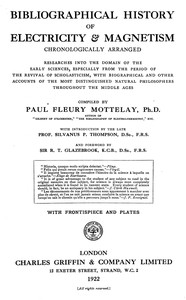
Bibliographical history of electricity & magnetism, chronologically arranged — Text and Context
(0 User reviews)
733
Project Gutenberg
2024
Not confirmed
Electricity -- History; Science, Medieval; Magnetism -- History; Electricity -- History -- Bibliography; Magnetism -- History -- Bibliography
Readers of public-domain and historical texts
Project Gutenberg digital edition
en
Edition facts
Words
305,468
Reading time
1329 min
Text sections
62
Before opening Bibliographical history of electricity & magnetism, chronologically arranged — Text and Context, the edition data offers a quick orientation: 305,468 words, 22 hr 9 min estimated reading time, and 62 detected text sections.
The text analysis averages about 13.3 words per sentence, while the detected sections provide another way to judge how the source is divided.
Project Gutenberg metadata also associates the work with “Electricity -- History,” connecting these edition facts with the source record’s subject description.
Source:
Project Gutenberg record #74764
Paul Fleury Mottelay's 1922 bibliography traces 4,458 years of writings on electricity and magnetism, from Chinese compass lore to Faraday's 1821 motor. The work's voice shifts from medieval scholasticism to 19th-century experimental reports, with entries varying from terse citations to detailed accounts of contested theories.
Editorial Edition Score
4.9/5
★★★★★
★★★★★
Calculated from edition completeness, EPUB availability, text structure and catalogue metadata. Not a user rating.
How this score is calculated
- Description quality20 pts
- Title & short description10 pts
- Source metadata20 pts
- Text length15 pts
- Chapters / structure15 pts
- EPUB file integrity20 pts
Total of 100 points, scaled to a 2.5-5.0 range. Editions with an empty description or a missing EPUB file are not scored.
Edition quality
Public-domain source text
Read the source text
The source text is kept in the dedicated reader, separate from this catalogue record and its commentary.
Mottelay's compilation spans from 2637 B.C., when Emperor Hoang-Ti is said to have used a compass for troop direction, to Christmas Day 1821, when Faraday first made a wire rotate in a magnetic field. The early centuries are passed over quickly, with Homer's Odyssey cited, but the pace slows dramatically as the work approaches the 18th and 19th centuries. Entries grow from brief mentions to multi-paragraph discussions of individual researchers, their methods, and the reception of their ideas.
The compiler's voice is evident in evaluative phrases such as 'the superior manner in which all his observations were carried on' and in judgments about who deserves credit for a theory. The work is not a neutral list but an argument for the importance of tracing ideas to their 'nascent state,' as J. Clerk Maxwell's epigraph advises.
From Ancient Anecdotes to Scholastic Debates
The opening sections cover millennia in a few pages. Mottelay relies on secondary sources and legendary accounts, such as the Chinese emperor's compass. The language is summary and allusive: Homer is quoted, but no detailed analysis of ancient texts is given. The pace is brisk, with entries often consisting of a name, a date, and a single sentence.
As the work moves into the medieval period, the voice shifts. The subtitle promises 'researches into the domain of the early sciences, especially from the period of the revival of scholasticism.' Here, the entries become more substantive, citing manuscript sources like St. Augustine's La Cité de Dieu from a manuscript in the Musée de Chantilly. The compiler begins to weigh conflicting claims and to note the influence of Arabic scholars.
The structure remains chronological, but the density of information increases. Readers will notice that the early sections function as a rapid prelude, setting the stage for the more granular treatment of later centuries.
The 19th-Century Entries: Contested Theories and Detailed Accounts
By the time the work reaches the 1800s, the entries have expanded into mini-essays. The entry for G. F. Parrot (1802) runs several paragraphs, describing his chemical theory of the voltaic pile, his attempt to 'demolish completely the theories of Volta,' and his proposal for 'inoculating the clouds with thunder and lightning, by projecting bombs.' The language is evaluative: Parrot's facts 'would have ordinarily created a disturbing influence' but were overshadowed by Volta's supporters.
Mottelay includes references to multiple journals—Gilbert's Annalen, Annales de Chimie, the Mem. Acad. Petropol.—and even a report on telegraphs for the United States. The voice is that of a scholarly advocate, arguing for the recognition of overlooked figures. The entry for Berzelius (1802–1806) is similarly detailed, noting his 'Physical Researches on the Effect' and his status as 'one of the greatest of modern chemists.'
These later sections are where the work's true character emerges: not a dry bibliography but a narrative of scientific priority and controversy, told through the accumulation of citations and biographical sketches.
The Compiler's Voice and the Structure of Authority
Mottelay's editorial hand is visible throughout. He introduces entries with phrases like 'it must be admitted that' and 'the superior manner in which.' He quotes epigraphs from Pliny, Virgil, and Maxwell, framing the work as a defense of historical study. The foreword by Sir Richard Glazebrook notes that the volume 'has a tragic story,' referring to the deaths of both the introducer Silvanus Thompson and Mottelay himself before publication.
The work's structure—chronological but with uneven pacing—reflects the compiler's priorities. Early centuries are 'passed over quickly,' while the 19th century receives exhaustive treatment. The entries are not uniform; some are mere lines, others run to pages. This variation in length and detail creates a rhythm that rewards browsing: a reader can dip into the 1802 entry for Parrot and find a self-contained story of a theory that 'attracted comparatively little attention.'
The bibliography is thus also a history of scientific reputation, showing how some ideas gain traction while others are forgotten. Mottelay's voice, though rarely first-person, is consistently judgmental, making the work a personal as well as a scholarly document.
Readers approaching this 305,000-word compilation should treat it as a guided tour rather than a neutral reference. The chronological arrangement invites comparison between eras, but the uneven pace means that some centuries are glimpsed only in passing. Pay attention to the evaluative language and the choice of which figures receive extended treatment; these reveal Mottelay's own convictions about the development of electrical science. The work is best used as a starting point for tracing specific ideas or controversies, with the understanding that the compiler's voice is never far from the surface.
Flipping through Mottelay's bibliography, I lingered on those early entries, where electricity still felt like weather and whispers. It made me think of a quieter, stranger book from the same lineage, one that ponders why things cannot hold the charge at all. This one—An Essay to Shew the Cause of Electricity; and Why Some Things are Non-Electricable. In Which Is Also Consider'd Its Influence in the Blasts on Human Bodies, in the — Themes and Context—carries the same patient bafflement, as if the mystery itself was the friendliest companion.
There are no reviews for this eBook.
There are no comments for this eBook.
Reader reflection
Your personal reading reflection
Build a private reading journal entry for this title.
Your progress
0
/
10
2
How did the book work for you overall?
3
How likely are you to recommend this book?
4
What was the reading difficulty like?
5
Did anything about the book feel genuinely new?
6
Which part made the strongest impression?
7
How useful did the reading feel?
8
Could you follow the author’s main argument?
9
What did this book teach you most?
10




![Cover of The Complete Works in Philosophy, Politics and Morals of the late Dr. Benjamin Franklin, Vol. 2 [of 3] — Reading Companion](https://eatsb.com/storage/media/covers/pg48137.jpg)