1

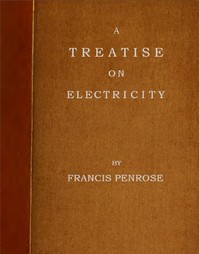
A Treatise on Electricity Wherein its various phænomena are accounted for, and the cause of the attraction and gravitation of solids, assigned. To which is added, a — Inside the Classic
(0 User reviews)
2349
Project Gutenberg
2019
Not confirmed
Electricity -- Early works to 1850; Electrotherapeutics -- Early works to 1800
Readers of public-domain and historical texts
Project Gutenberg digital edition
en
Edition facts
Words
11,954
Reading time
52 min
Text sections
2
A Treatise on Electricity Wherein its various phænomena are accounted for, and the cause of the attraction and gravitation of solids, assigned. To which is added, a — Inside the Classic can be approached with a clearer sense of reading commitment from its source measurements: 11,954 words, 52 min estimated reading time, and 2 detected text sections.
The text analysis averages about 37.7 words per sentence, while the detected sections provide another way to judge how the source is divided.
Project Gutenberg metadata also associates the work with “Electricity -- Early works to 1850,” connecting these edition facts with the source record’s subject description.
Source:
Project Gutenberg record #60392
Francis Penrose's 1752 treatise challenges Newtonian attraction by arguing that atmospheric pressure, not inherent gravity, holds solids together and causes electrical phenomena, drawing on experiments with air pumps and polished slabs.
Editorial Edition Score
4.5/5
★★★★★
★★★★★
Calculated from edition completeness, EPUB availability, text structure and catalogue metadata. Not a user rating.
How this score is calculated
- Description quality20 pts
- Title & short description10 pts
- Source metadata20 pts
- Text length15 pts
- Chapters / structure15 pts
- EPUB file integrity20 pts
Total of 100 points, scaled to a 2.5-5.0 range. Editions with an empty description or a missing EPUB file are not scored.
Edition quality
Read the Text
The text of this e-book has been preserved in its original form, including inconsistent archaic spelling and capitalisation, and use of italics.
The cover image of the book was created by the transcriber and is placed in the public domain.
Its various _phænomena_ are accounted for, and the cause of the _attraction_ and _gravitation_ of solids, assigned.
A short account, how the electrical _effluvia_ act upon the animal frame, and in what disorders the same may probably be applied with success, and in what not.
By FRANCIS PENROSE Surgeon at _Bicester_.
They who are universally allowed the very greatest, and wisest of men, have been, and still are, intent upon the making of _observations_, and _experiments_: and surely that must be in order to some further end. These would be vain, and wholely useless, were not some reflections made, some conclusions drawn, some theory or hypothesis raised from them.
_Woodward_’s state of _physick_ and of _diseases_, p. 55.
Printed at the THEATRE for SACKVILLE PARKER, Bookseller at _Oxford_, and W. OWEN, at _Homer’s Head, Temple-Bar, London_. MD CC LII.
The many surprising effects of _electricity_, and the great cures performed by it, one would imagine, should awaken the attention of all philosophers and physicians; but as these cures have been effected by random experiments, every body has admired, but no body seems to have considered how, or by what means, they were performed. Whence
Notwithstanding all these surprising _phænomena_, from which many have entertained hopes of a great addition to the healing art; yet not one tolerable account has been given, how, or from what cause, these _phænomena_ proceeded; except what has been done by Mr. _Freke_, surgeon to _Bartholomew hospital_; whose admirable piece shews the great penetration of its worthy author, with whom I shall join in thinking “it may possibly be the beginning of much good.”
One would think, this silence, on so interesting a subject, _in this enlightened age_, can proceed from nothing but a prejudice in favour of wrong principles of philosophy: That this is certainly the taste of the present age, M. _Freke_ seems very well convinced; for, at the end of his pamphlet, he takes notice of a show-man, who, “having published some experiments in electricity, and hearing that Mr. _Freke_’s piece was publishing, own’d, he was much affrightened, because of the hard fate, as he said, of his booksellers; but, before he had read two pages, he likewise owned he had recovered his spirits, when he found Mr. _Freke_ pretended to think for himself, and did not let Sr. _Isaac Newton_ think for him.”
Now, if all persons would take the same freedom of thinking for themselves, as Mr. _Freke_ has done, I doubt not but we should soon be as much ashamed of mentioning the _attraction_ of _gravitation_, and the _attraction_ of _cohesion_ &c. as we now are of the _occult qualities_ of the ancient philosophers; and should perhaps, then agree with him, when, speaking of electricity, he says, that “it is a subject which can, with more nobleness and dignity, employ the mind of man, than any he can think of, relating to the sublunary part of the world. For by it you may be acquainted with the immediate officer of God Almighty, which he seems to send to all things living: Nay, this power, (according to his conception,) seems to be the cause, under HIM, both of life and death. And when it may be more fully understood, it may afford us means, whereby we may be better enabled to reason more intelligibly, than now we can, concerning various operations in nature.” Therefore,
In the following essay, I shall endeavour to shew,
I. How, and from whence, this electrical fire and force are produced; in doing of which I shall make some observations, in order to shew that we may form a more exact idea of most of the great operations of that complete machine, the universe, from electrical experiments, than can be attained by any other means: I shall also produce some experiments which demonstrate, that the terraqueous globe has no _attraction_; nor a solid body, falling towards the earth, any _gravitation_; after which, I shall bring other experiments to prove what is the cause of _solidity_, and by what means bodies _gravitate_ towards the earth.
II. How this electrical fire and force act upon the animal frame, and in what disorders they are likely to be of benefit, and in what not.
I. We are certain, that this electrical fire is produced, either from the glass globe, or the air that surrounds it. As to the glass globe, Mr. _Freke_ has fully proved it cannot proceed from that; “Because nothing, we know of, can send out of it a quantity of matter, but there must be less of
Francis Penrose, a surgeon from Bicester, opens his 1752 treatise by lamenting that despite the surprising effects of electricity and the cures performed by it, no one has given a tolerable account of how these phenomena proceed—except Mr. Freke, who dared to think for himself rather than let Sir Isaac Newton think for him. Penrose adopts this same freedom, aiming to show that the firmness of bodies and their descent toward the earth depend not on attraction or gravitation but on the pressure of the atmosphere.
A Challenge to Newtonian Attraction
Penrose directly confronts the prevailing theory of attraction, arguing that the solidity of bodies is caused by the pressure of the air or atmosphere, not by any inherent attractive force. He cites experiments with two marble slabs that, when polished and placed together, require great force to separate—a force he attributes to the pressure of the air, since removing the air with an air pump causes them to separate immediately. He further supports this with Hauksbee's experiment using brass hemispheres, where extracting the air required 140 pounds to pull them apart. Penrose insists that if we considered that the air presseth equally every way, not just downwards, we would not have overlooked this force.
The Role of Pores and Heat
Penrose explains that the firmness of bodies depends on the make and size of their pores: bodies with smallest pores are acted upon with greater power, while those with larger pores admit light and common air. He then discusses how heat expands solids, citing the example of an iron rod that becomes bigger and longer when hot, and Boerhaave's opinion that cold consolidates firm bodies by bringing matter into a less compass. This expansion and contraction, Penrose argues, further demonstrates that cohesion is not due to attraction but to external pressure.
Electrical Attraction as Atmospheric Pressure
Having dismissed attraction and gravitation, Penrose turns to electricity to explain how heavy bodies descend toward the earth. He aligns with Hauksbee's account: if by heat and rarefaction from attrition the medium near the glass becomes specifically lighter, then the denser remoter air presses in to keep the balance—this is what we call electrical attraction. Penrose extends this reasoning to the earth's attraction, suggesting that the descent of bodies is performed in the same manner as the attraction of the glass globe in electricity. The treatise thus unifies terrestrial gravity and electrical phenomena under a single mechanical cause.
Medical Applications and the Animal Frame
The full title promises a short account of how electrical effluvia act upon the animal frame and in what disorders they may be applied with success. While the excerpts do not reveal the details of this medical section, Penrose's opening remarks indicate that great cures have been performed by random experiments, and he aims to provide a rational basis for such treatments. His background as a surgeon suggests a practical orientation, and the treatise likely applies his atmospheric theory to explain how electricity affects the body, possibly influencing conditions where the balance of internal air or pressure is disrupted.
Penrose's treatise is a tightly argued work that uses a single principle—atmospheric pressure—to account for solidity, gravity, and electrical attraction. Readers should attend to how he moves from mechanical experiments with air pumps and polished surfaces to the behavior of the glass globe, and finally to the human body. The excerpts show a writer who prizes independent thought and empirical demonstration over deference to authority, making this a revealing document of mid-18th-century scientific reasoning.
I finished Penrose's little treatise a few weeks ago and kept thinking about how he watched polished slabs cling together under a vacuum, convinced it was air's weight, not some hidden pull. That stubborn, gentle insistence reminded me of something I found later, this Bibliographical history of electricity & magnetism, chronologically arranged — Text and Context, which quietly traces all those old guesses and corrections. It felt like sitting with someone’s careful notes.
There are no reviews for this eBook.
There are no comments for this eBook.
Reader reflection
How did this book work for you?
Your answers remain private and are stored only in this browser.
Your progress
0
/
10
2
How did the book work for you overall?
3
Would you recommend this book to another reader?
4
What was the reading difficulty like?
5
Would this book work well in a reading group?
6
What was the strongest part of the book?
7
Did you gain anything practical from the text?
8
How original did the book feel?
9
Which lesson or insight stayed with you?
10

![Cover of The Complete Works in Philosophy, Politics and Morals of the late Dr. Benjamin Franklin, Vol. 2 [of 3] — Reading Companion](https://eatsb.com/storage/media/covers/pg48137.jpg)