1

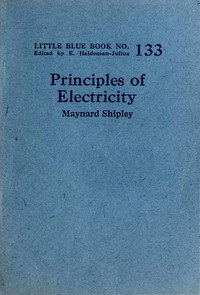
Principles of electricity — Key Ideas to Explore
(0 User reviews)
676
Project Gutenberg
2025
Not confirmed
Electricity
Readers of public-domain and historical texts
Project Gutenberg digital edition
en
Edition facts
Words
17,929
Reading time
78 min
Text sections
10
Principles of electricity — Key Ideas to Explore can be approached with a clearer sense of reading commitment from its source measurements: 17,929 words, 1 hr 18 min estimated reading time, and 10 detected text sections.
The text analysis averages about 22.6 words per sentence, while the detected sections provide another way to judge how the source is divided.
Project Gutenberg metadata also associates the work with “Electricity,” connecting these edition facts with the source record’s subject description.
Source:
Project Gutenberg record #75464
Maynard Shipley's 1925 primer opens with the layman's question 'What is electricity?' and traces theories from Thales to J.J. Thomson, using historical experiments and analogies to explain magnetic phenomena, electron theory, and wireless telegraphy.
Editorial Edition Score
4.7/5
★★★★★
★★★★★
Calculated from edition completeness, EPUB availability, text structure and catalogue metadata. Not a user rating.
How this score is calculated
- Description quality20 pts
- Title & short description10 pts
- Source metadata20 pts
- Text length15 pts
- Chapters / structure15 pts
- EPUB file integrity20 pts
Total of 100 points, scaled to a 2.5-5.0 range. Editions with an empty description or a missing EPUB file are not scored.
Edition quality
Public-domain source text
Read the source text
The source text is kept in the dedicated reader, separate from this catalogue record and its commentary.
Maynard Shipley's Principles of Electricity (1925) opens by confronting a question many textbooks sidestep: 'What is electricity?' The author immediately aligns the layman's curiosity with the physicist's own uncertainty, noting that asking about electricity's ultimate nature is like asking 'What is matter?'—a question common sense thinks it has answered. Shipley then reaches back to Thales, who called amber elektron and saw in magnetism a 'soul of the universe' that 'endows all things with motion.' This historical framing sets the tone for a work that treats electrical theory as an evolving conversation, not a settled doctrine.
From Amber to Electrons: The Historical Thread
Shipley devotes considerable space to the history of electrical ideas, weaving together ancient observation, Enlightenment experiment, and early twentieth-century theory. He recounts Thales's recognition that rubbed amber attracts light objects, then moves through Franklin's one-fluid theory, the torsion-balance measurements of Æpinus and Coulomb, and the nineteenth-century work of Ampère and Cavendish. The narrative is punctuated by footnotes referencing contemporary sources such as J. H. Jeans's Electricity and Magnetism (1911) and Sydney G. Starling's Electricity (1922). Shipley does not merely list names; he shows how each investigator's model—whether one-fluid or two-fluid—shaped the questions later physicists would ask. The reader is left with a clear sense that today's electron theory emerged from a long chain of partial answers.
The Electron as the 'True Atom of Electricity'
A central claim of the book is that the electron is 'the true atom of electricity.' Shipley explains that negative electrification is simply a collection of negative corpuscles or unit charges, while positive electrification corresponds to a deficit of these corpuscles. He quotes J. J. Thomson's Corpuscular Theory of Matter (1906) to support the view that 'the transference of electrification from one place to another is effected by this motion of corpuscles.' Shipley acknowledges that positive electricity has never been isolated, unlike negative electrons, and that the one-fluid versus two-fluid debate remains unresolved—citing Frederick Soddy's 1912 Matter and Energy to underscore the fundamental ignorance that persists. This cautious, evidence-based approach distinguishes the book from more dogmatic primers of its era.
Magnetism, Energy Conversion, and Practical Application
Chapter 5, 'Modern Magnetic Theory,' demonstrates how magnetism is converted into electricity through rotating coils cutting lines of magnetic force. Shipley traces the energy chain from gravity (falling water) or chemical energy (coal oxidation) to heat, steam, piston motion, and finally electrical generation. The discussion is grounded in concrete examples: the dynamo, the overhead wire powering a streetcar, and the incandescent lamp. Shipley also touches on wireless telegraphy, though the excerpts provide only the chapter title. Throughout, he maintains a distinction between what is known experimentally and what remains hypothetical, a stance that aligns with the book's subtitle-like focus on 'principles' rather than exhaustive technical detail.
Shipley's Principles of Electricity is best read as a historical and conceptual introduction, not a laboratory manual. Its value lies in the way it situates early twentieth-century electron theory within a longer tradition of scientific inquiry, from Thales to Thomson. Readers interested in the development of electrical ideas—especially the shift from fluid models to particle theories—will find a concise, well-referenced account that does not oversimplify the unresolved questions.
Reading Principles of Electricity, I remembered sitting beside my father as he showed me a crystal radio set, and how that feeling of invisible sparks traveling through air reappeared years later in The Library of Work and Play: Electricity and Its Everyday Uses — Reading Notes. Both books made the unseen seem gentle, almost domestic, like learning to hear a whisper from far away.
There are no reviews for this eBook.
There are no comments for this eBook.
Reader reflection
How will you remember this book?
Save your reaction, strongest insight, and memorable passage.
Your progress
0
/
10
2
How did the book work for you overall?
3
Is this a title you would suggest to others?
4
How demanding did the text feel?
5
Did you relate to its people, ideas, or situations?
6
How distinctive were its ideas or approach?
7
How strongly did the book affect you emotionally?
8
Could you apply anything you learned?
9
Which lesson or insight stayed with you?
10
![Cover of The Complete Works in Philosophy, Politics and Morals of the late Dr. Benjamin Franklin, Vol. 2 [of 3] — Reading Companion](https://eatsb.com/storage/media/covers/pg48137.jpg)