1

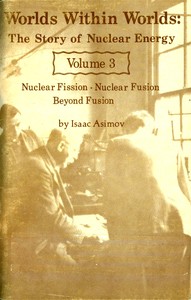
Worlds Within Worlds: The Story of Nuclear Energy, Volume 3 (of 3) Nuclear Fission; Nuclear Fusion; Beyond Fusion — Key Ideas to Explore
(0 User reviews)
55
Project Gutenberg
2015
Not confirmed
Nuclear energy -- Popular works
Readers of public-domain and historical texts
Project Gutenberg digital edition
en
Edition facts
Words
17,193
Reading time
75 min
Text sections
3
This digital edition of Worlds Within Worlds: The Story of Nuclear Energy, Volume 3 (of 3) Nuclear Fission; Nuclear Fusion; Beyond Fusion — Key Ideas to Explore is described by source-level measurements including 17,193 words, 1 hr 15 min estimated reading time, and 3 detected text sections.
The text analysis averages about 19.3 words per sentence, while the detected sections provide another way to judge how the source is divided.
Project Gutenberg metadata also associates the work with “Nuclear energy -- Popular works,” connecting these edition facts with the source record’s subject description.
Source:
Project Gutenberg record #49821
Isaac Asimov explains nuclear fission, fusion, and the challenges of controlled fusion power, using historical milestones and clear analogies to guide readers through the science.
Editorial Edition Score
4.5/5
★★★★★
★★★★★
Calculated from edition completeness, EPUB availability, text structure and catalogue metadata. Not a user rating.
How this score is calculated
- Description quality20 pts
- Title & short description10 pts
- Source metadata20 pts
- Text length15 pts
- Chapters / structure15 pts
- EPUB file integrity20 pts
Total of 100 points, scaled to a 2.5-5.0 range. Editions with an empty description or a missing EPUB file are not scored.
Edition quality
Public-domain source text
Read the source text
The source text is kept in the dedicated reader, separate from this catalogue record and its commentary.
Isaac Asimov opens this third volume by contrasting the public's wonder at atomic power with earlier technological marvels like the steam engine and radio. The tone is set by the Atomic Energy Commission's foreword, which frames nuclear energy as a civic responsibility. Asimov's own introduction, written in 1972, emphasizes the seemingly limitless potential of the atom since 1939. The volume then moves directly into the science, beginning with fission and its practical applications, before tackling the more elusive goal of controlled fusion.
From Fission to Fusion: A Shift in Scale
The excerpts show a clear structural pivot: the first half of the volume focuses on nuclear fission—its discovery, chain reactions, and use in bombs and reactors. Asimov explains fission with concrete examples, such as the energy released per pound of uranium compared to coal. The later sections turn to fusion, where the scale shifts dramatically. The sun becomes the model: a “vast fusion furnace 866,000 miles across” that releases energy at a steady rate. Asimov contrasts this with the explosive release of a thermonuclear bomb, emphasizing that controlled fusion requires a different approach entirely.
The Temperature Barrier
Asimov identifies the central obstacle to controlled fusion: achieving the necessary temperatures. He cites Enrico Fermi's 1944 calculation that hydrogen-3 fusion with hydrogen-2 would require 50,000,000°C, and hydrogen-2 alone would need 400,000,000°C. These numbers are presented without hype, grounding the reader in the practical difficulty. The text notes that the sun operates at a mere 15,000,000°C, but its gravitational field provides the necessary density. On Earth, without that gravity, physicists must aim for much higher temperatures in thin gas—a trade-off Asimov explains clearly.
The Thermonuclear Bomb as a Stepping Stone
Asimov does not shy away from the military origins of fusion research. He describes how an exploding fission bomb could ignite a fusion reaction, creating a thermonuclear bomb thousands of times more powerful than the Hiroshima bomb. The first such device was tested by the United States in 1952, followed quickly by the Soviet Union. Yet Asimov immediately pivots to the dangers of atmospheric testing, noting that radioactive fallout “spreads over the world and may do slow but cumulative damage.” This sets up the need for controlled fusion as a peaceful alternative.
Controlled Fusion: The Ideal and the Catch
The final section of the excerpts lays out the promise of controlled fusion: an inexhaustible fuel supply (deuterium from water), automatic safety (cutting off deuterium stops the reaction instantly), and manageable waste products (only hydrogen-3 and neutrons). But Asimov undercuts this optimism with a single word: “catch.” The catch is that no practical method exists to start the fusion process at the required temperatures without a fission bomb. The sun's gravitational control is impossible to replicate on Earth, leaving physicists to pursue alternative confinement methods—a challenge that remains unsolved in the excerpts.
Asimov's narrative arc in this volume moves from the achieved (fission) to the aspirational (fusion), always grounding speculation in physical limits. Readers should note how he uses historical dates—1939, 1945, 1952—to anchor the timeline, and how he repeatedly returns to the sun as a benchmark. The excerpts end before any discussion of magnetic or inertial confinement, so the story of controlled fusion is left incomplete. This makes the volume a snapshot of the state of the art in 1972, not a prediction of future success.
I often find myself drifting between these shelves, fingers resting on Asimov’s gentle explanations of worlds within atoms, then wandering to The logic of modern physics — Themes and Context. Both share a patient humility before the immense. Neither shouts; they simply hold a lantern to what we cannot see, asking only that we stop and wonder with them.
There are no reviews for this eBook.
There are no comments for this eBook.
Reader reflection
Before you leave, reflect on the book
Use these questions to collect your thoughts before moving on.
Your progress
0
/
10
2
Was reading this book enjoyable?
3
Would you recommend this book to another reader?
4
What was the reading difficulty like?
5
How much did the book move you?
6
How well did it match your expectations?
7
Did the book give you something worth debating?
8
Could you see yourself revisiting this book?
9
What did this book teach you most?
10