1

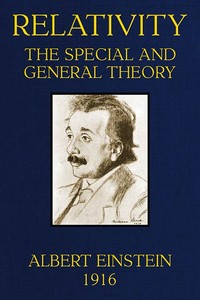
Relativity: The Special and General Theory — Inside the Classic
(0 User reviews)
280
Project Gutenberg
2009
Not confirmed
Relativity (Physics)
Readers of public-domain and historical texts
Project Gutenberg digital edition
en
Edition facts
Words
34,677
Reading time
151 min
Text sections
38
Before opening Relativity: The Special and General Theory — Inside the Classic, the edition data offers a quick orientation: 34,677 words, 2 hr 31 min estimated reading time, and 38 detected text sections.
The text analysis averages about 26.6 words per sentence, while the detected sections provide another way to judge how the source is divided.
Project Gutenberg metadata also associates the work with “Relativity (Physics),” connecting these edition facts with the source record’s subject description.
Source:
Project Gutenberg record #30155
Einstein's 1916 exposition of special and general relativity, written for readers with some scientific background. The text progresses from coordinate systems to curved spacetime, using thought experiments and mathematical derivations.
Editorial Edition Score
4.8/5
★★★★★
★★★★★
Calculated from edition completeness, EPUB availability, text structure and catalogue metadata. Not a user rating.
How this score is calculated
- Description quality20 pts
- Title & short description10 pts
- Source metadata20 pts
- Text length15 pts
- Chapters / structure15 pts
- EPUB file integrity20 pts
Total of 100 points, scaled to a 2.5-5.0 range. Editions with an empty description or a missing EPUB file are not scored.
Edition quality
Public-domain source text
Read the source text
The source text is kept in the dedicated reader, separate from this catalogue record and its commentary.
Einstein opens with a preface and a table of contents that reveals a deliberate structure: Part I on special relativity, Part II on general relativity, and Part III on cosmological considerations. The first chapter, 'Physical Meaning of Geometrical Propositions,' immediately grounds the discussion in practical measurement, asking what it means to verify a geometrical proposition physically. This sets the tone for a work that constantly checks abstract theory against empirical reality.
The translator, Robert W. Lawson, notes that this edition includes revisions and appendices, including a derivation of the Lorentz transformation and a summary of experimental confirmations. Readers should note that Einstein assumes familiarity with classical mechanics and basic physics; the book is not a popularization but a rigorous, though non-mathematical, account.
From Coordinate Systems to the Principle of Relativity
The early chapters build a foundation by examining how we describe motion. Einstein introduces the Galileian system of coordinates and the classical principle of relativity, which states that the laws of mechanics are the same in all uniformly moving frames. He then confronts a problem: the law of propagation of light (constant speed) seems incompatible with this principle. This tension drives the entire special theory.
Key passages show Einstein’s method: he takes a familiar concept—like simultaneity—and shows it is not absolute but depends on the observer's reference frame. The thought experiment with moving trains and light signals is used to illustrate that two events simultaneous in one frame may not be in another. This is not a mere paradox but a logical consequence of the constancy of light speed.
Readers should pay attention to how Einstein defines terms like 'time' and 'distance' operationally, by specifying how they are measured. This operational approach is central to his argument.
The Lorentz Transformation and Its Consequences
Chapter XI introduces the Lorentz transformation, the mathematical tool that reconciles the principle of relativity with the constancy of light. Einstein shows how this transformation leads to length contraction and time dilation. He does not present the full derivation in the main text but provides a simple derivation in Appendix I.
One striking result is that measuring-rods and clocks behave differently when in motion. Einstein uses the example of a rod moving parallel to its length: an observer at rest sees it shorter than an observer moving with it. Similarly, a moving clock runs slow. These effects are not illusions but real, confirmed by experiment.
The chapter on the addition of velocities discusses the Fizeau experiment, which measured the speed of light in moving water. Einstein shows that the Lorentz transformation predicts the observed result, while classical addition does not. This is a concrete example of the theory’s heuristic value.
From Special to General Relativity: The Gravitational Field
Part II begins by noting the limitations of special relativity: it applies only to uniformly moving frames. Einstein argues that a truly general theory must include accelerated motion and gravity. He introduces the equivalence principle: a uniformly accelerated frame is indistinguishable from a uniform gravitational field. This is illustrated with the famous 'chest' thought experiment—a person in an accelerating box feels a force like gravity.
From this, Einstein derives that light must bend in a gravitational field. He calculates that light grazing the sun should be deflected by 1.7 seconds of arc, and notes that this prediction can be tested during a solar eclipse. The text includes a footnote referencing the 1919 expeditions that confirmed this deflection.
Einstein also discusses the behavior of clocks and measuring-rods on a rotating disk, showing that Euclidean geometry does not hold in a gravitational field. This leads to the concept of curved spacetime.
Non-Euclidean Geometry and the Structure of the Universe
Chapters XXIV–XXVII develop the idea that the space-time continuum of general relativity is not Euclidean. Einstein introduces Gaussian coordinates as a way to describe curved surfaces, and explains that in a gravitational field, the geometry of space is non-Euclidean. He compares this to the geometry on a sphere, where the sum of angles in a triangle exceeds 180 degrees.
Part III extends these ideas to cosmology. Einstein discusses Newton’s theory and its difficulties, such as why the universe does not collapse under gravity. He then presents the possibility of a finite but unbounded universe, using the analogy of a sphere’s surface. The final chapter outlines the structure of space according to general relativity, suggesting that the universe may be closed and static.
These sections are more speculative and less detailed than the earlier parts. Readers should note that Einstein’s cosmological model has since been superseded by the expanding universe, but the conceptual framework remains influential.
This edition includes four appendices that supplement the main text: a simple derivation of the Lorentz transformation, a discussion of Minkowski’s four-dimensional space, a summary of experimental confirmations (including the perihelion of Mercury and light deflection), and a note on the structure of space. Readers new to relativity may benefit from reading the appendices alongside the relevant chapters. Einstein’s style is direct and logical, but the concepts are deep; rereading key passages is often necessary.
That rainy afternoon, I kept returning to Einstein's patient thought experiments, the way he folded space into a whisper. Finishing felt like leaving a quiet room. Later, almost by accident, I found Sidelights on Relativity — Context and Discussion on a shelf, and it felt like the same room, seen from another door.
There are no reviews for this eBook.
There are no comments for this eBook.
Reader reflection
Your personal reading reflection
Build a private reading journal entry for this title.
Your progress
0
/
10
2
How did the book work for you overall?
3
How likely are you to recommend this book?
4
How much effort did this book require?
5
How clearly were the main ideas presented?
6
How would you rate its originality?
7
Could you apply anything you learned?
8
Did you relate to its people, ideas, or situations?
9
What is the main idea you are taking away?
10