1

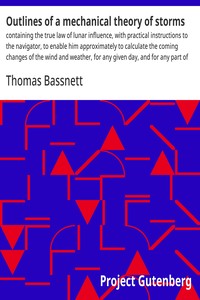
Outlines of a mechanical theory of storms — Background and Themes
(0 User reviews)
2079
Project Gutenberg
2006
Not confirmed
Weather
Readers of public-domain and historical texts
Project Gutenberg digital edition
en
Edition facts
Words
78,793
Reading time
343 min
Text sections
9
Before opening Outlines of a mechanical theory of storms — Background and Themes, the edition data offers a quick orientation: 78,793 words, 5 hr 43 min estimated reading time, and 9 detected text sections.
The text analysis averages about 28.1 words per sentence, while the detected sections provide another way to judge how the source is divided.
Project Gutenberg metadata also associates the work with “Weather,” connecting these edition facts with the source record’s subject description.
Source:
Project Gutenberg record #18791
This editorial note examines the structure and imagery in Bassnett's 1854 work, focusing on his mechanical theory of storms, lunar influence, and magnetic phenomena, using excerpts to trace his argumentative patterns and recurring motifs.
Editorial Edition Score
4.7/5
★★★★★
★★★★★
Calculated from edition completeness, EPUB availability, text structure and catalogue metadata. Not a user rating.
How this score is calculated
- Description quality20 pts
- Title & short description10 pts
- Source metadata20 pts
- Text length15 pts
- Chapters / structure15 pts
- EPUB file integrity20 pts
Total of 100 points, scaled to a 2.5-5.0 range. Editions with an empty description or a missing EPUB file are not scored.
Edition quality
Public-domain source text
Read the source text
The source text is kept in the dedicated reader, separate from this catalogue record and its commentary.
Thomas Bassnett's Outlines of a Mechanical Theory of Storms (1854) opens with a bold claim: that storms obey a mechanical law tied to lunar influence, a proposition he defends by weaving together gravitation, ether, and magnetism. The book's structure is itself a kind of vortex, spiraling from first principles through specific storm records to magnetic anomalies. Bassnett repeatedly invokes the image of a "radial stream" striking a "circular current," a visual that recurs across sections to explain everything from wind shifts to compass declination. This note traces how the work's architecture and recurring figures—vortices, ethereal currents, and the moon's axis—shape its argument.
A System Built on Vortices
The book's opening section establishes a cosmological framework: the solar system began in a "primordial condition," and gravitation alone is insufficient—Bassnett posits an "ethereal medium" in motion that forms vortices. This is not a mere metaphor; he treats vortices as physical entities that displace the earth's axis under lunar influence. The structure here is deductive: first principles (the nature of ether, ponderosity of matter) lead to a "new principle developed," then to applications like Hutton's rain theory. Bassnett's prose moves from the abstract to the concrete, but the excerpts show he never fully defines the ether's properties—he asserts its motion and leaves details vague. The recurring phrase "medium of space" appears as a placeholder for an unobserved mechanism, a pattern that persists throughout.
Storm Narratives as Evidence
In the second section, Bassnett shifts to case studies: the "Milwaukie storm," "New York storm," "Ottawa storm," and "Liverpool storm." These are not described in narrative detail but are invoked as data points, each tied to a lunar position. The structure is list-like, almost tabular, with the storms named in a recurring order. Bassnett's method is to assert a correlation between moon phase and storm occurrence, but the excerpts offer no meteorological specifics—only the names and a reference to a "record of the weather." This pattern of naming without describing recurs, suggesting the storms function as rhetorical anchors rather than empirical proofs. The reader is left to infer the connection from the author's confidence alone.
Magnetic Deflection and the Cape Anomaly
The later excerpts turn to magnetism, where Bassnett's argument becomes most intricate. He claims the magnetic needle's daily variation—deflecting eastward in the morning in the northern hemisphere, westward in the southern—is "a positive demonstration" of his theory. The key image is the "radial stream" of solar heat striking the earth's circular currents, deflecting them. He then highlights Colonel Sabine's discovery of opposite deflections at the Cape of Good Hope during equinoxes, calling it "a still more capital feature." Bassnett explains this by the Cape's large magnetic declination (30° west) and the sun's changing declination. The structure here is layered: a general rule, then an exception that confirms the rule. His reasoning is geometric, relying on angles and latitudes, but the excerpts show he assumes the magnetic equator, not the geographical one, divides the hemispheres—a crucial and unproven premise.
Magnetic Storms and Unseen Forces
Bassnett introduces "magnetic storms" as irregular fluctuations caused by the moon's vortices passing over a location. He cites an example: on September 25, 1841, a magnetic storm was observed simultaneously in Toronto and at the Cape of Good Hope. Yet he immediately cautions that "the extent of these storms has been over estimated." This hedging reveals a tension in his structure: he needs large-scale phenomena to support his theory but also wants to limit their scope to fit his mechanical model. The recurring image of the vortex—a localized, rotating disturbance—serves both purposes. Bassnett's language here is tentative: the vortices' force "is proved to be of variable force," but whether due to "atmospheric conditions" or "increased activity of the ethereal medium" is "immaterial." This ambiguity is characteristic; he often asserts a mechanism without specifying its nature.
Bassnett's work is best approached as a system of analogies: vortices, currents, and streams are his building blocks, applied to weather, magnetism, and lunar motion alike. The excerpts reveal a writer who argues by assertion and geometric reasoning rather than by presenting raw data. Readers should attend to how he moves between scales—from the cosmic ether to a single storm—and note where he relies on unobserved entities. The book rewards those who trace its recurring images, but its claims remain speculative, grounded more in rhetorical structure than in empirical demonstration.
Reading about Bassnett’s storm theories reminded me of sitting in my grandfather’s study, where I once found The natural and artificial disintegration of the elements An address by Professor Sir Ernest Rutherford — Background and Themes. Both books share that same humbling sensation—of peering into hidden machinery behind ordinary weather, or ordinary matter. I recall feeling small, yet quietly pleased, as if nature had whispered a secret just for me.
There are no reviews for this eBook.
There are no comments for this eBook.
Reader reflection
What did you think of this book?
Answer a few questions and save a private reflection on this device.
Your progress
0
/
10
2
What was your overall reaction to the book?
3
Would you pass this book on to a friend?
4
Did the language feel accessible?
5
Would you start a conversation about this book?
6
How would you rate its originality?
7
Was the book what you thought it would be?
8
Would you read this book again?
9
What changed or sharpened your thinking?
10