1

The logic of modern physics — Themes and Context
(0 User reviews)
219
Project Gutenberg
2023
Not confirmed
Physics -- Philosophy
Readers of public-domain and historical texts
Project Gutenberg digital edition
en
Edition facts
Words
63,938
Reading time
278 min
Text sections
7
The source record for The logic of modern physics — Themes and Context measures this digital text at 63,938 words, 4 hr 38 min estimated reading time, and 7 detected text sections.
The text analysis averages about 31.4 words per sentence, while the detected sections provide another way to judge how the source is divided.
Project Gutenberg metadata also associates the work with “Physics -- Philosophy,” connecting these edition facts with the source record’s subject description.
Source:
Project Gutenberg record #70620
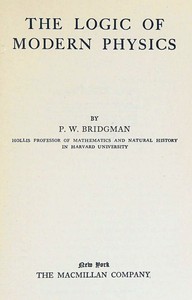
Bridgman's 1927 work reexamines physical concepts through an operational lens, arguing that meaning is tied to experimental operations. The preface and introduction set an empiricist stance, while later chapters apply this to thermodynamics and quantum phenomena, revealing a tension between foundational principles and experimental evidence.
Editorial Edition Score
4.7/5
★★★★★
★★★★★
Calculated from edition completeness, EPUB availability, text structure and catalogue metadata. Not a user rating.
How this score is calculated
- Description quality20 pts
- Title & short description10 pts
- Source metadata20 pts
- Text length15 pts
- Chapters / structure15 pts
- EPUB file integrity20 pts
Total of 100 points, scaled to a 2.5-5.0 range. Editions with an empty description or a missing EPUB file are not scored.
Edition quality
Public-domain source text
Read the source text
The source text is kept in the dedicated reader, separate from this catalogue record and its commentary.
Bridgman begins his preface by acknowledging his background as an experimenter, not a philosopher, and frames the book as a response to a long-felt need to clarify the foundations of physical thought. He cites Clifford, Stallo, Mach, and Poincaré as predecessors but argues that new discoveries in relativity and quantum theory demand a fresh examination. The introduction identifies a shift in physicists' attitude toward interpretation, emphasizing that concepts must be defined by the operations used to measure them. This operational approach is the book's central thread.
An Empiricist Stance from the Start
The preface reveals Bridgman's deliberate choice of empiricism as his fundamental attitude, a stance he claims is now justified by prior inquiries into the physiological origins of space, time, and mechanics. He notes that he has not read the earlier essays by Clifford, Stallo, Mach, or Poincaré in several years, yet acknowledges that some ideas may have been assimilated unconsciously. This admission signals that his work is not a direct critique but an independent re-examination. The introduction sharpens this focus: Bridgman observes that physicists increasingly recognize that the world of experiment is not directly accessible without interpretive frameworks. He argues that concepts like space, time, and causality must be redefined in terms of actual experimental procedures, a theme that recurs throughout the excerpts.
Questioning Conservation in Quantum Contexts
In Chapter VIII, Bridgman engages with contemporary debates about conservation laws. He notes that some quantum phenomena had led physicists to consider giving up conservation in detail, retaining it only statistically. However, he points to the Compton experiments (citing Bothe and Geiger, and Compton himself) as providing evidence for conservation in elementary quantum processes. Yet he acknowledges that other quantum events, such as an electron jumping between orbits, remain experimentally inaccessible, forcing a statistical treatment. Bridgman speculates that this situation is temporary, but he does not assert certainty. He concludes that energy may not be as fundamental as traditionally thought, but rather a consequence of deeper properties. This section shows his method: weighing experimental evidence against theoretical principles without dogmatic commitment.
Temperature as a Case Study in Operational Definition
In the thermodynamics chapter, Bridgman examines the concept of temperature as a prime example of operational definition. He traces its origin to physiological sensation, analogous to the mechanical concept of force, and shows how it can be made precise through the notion of equilibrium states. He describes the experimental fact that a small body placed in a large system quickly reaches a steady condition, which allows temperature to be defined by the behavior of thermometric substances. This approach mirrors his broader operationalist philosophy: a concept's meaning is given by the set of operations used to measure it. By grounding temperature in observable equilibration, Bridgman demonstrates how even a seemingly intuitive concept can be refined without losing connection to experiment.
The Role of the Reader: Following the Argument
Bridgman's text is dense with references to specific experiments and theories of the 1920s, such as the Compton effect and quantum mechanics. Readers unfamiliar with these may find the technical passages challenging, but the core argument remains accessible: physical concepts must be tied to operations. The excerpts show a pattern: Bridgman states a general principle, then tests it against recent experimental findings, often concluding that the principle needs revision. He does not shy away from uncertainty, as when he notes that radioactive disintegration might be a matter of chance. His tone is cautious and analytical, avoiding sweeping claims. The book rewards careful reading, as each chapter builds on the operational method introduced at the start.
Bridgman's operationalism is not a rigid doctrine but a tool for critique. Readers should pay attention to how he applies it to different domains—mechanics, thermodynamics, quantum theory—and note where he leaves questions open. The excerpts suggest that the book is as much about method as about conclusions. For a first reading, focus on the preface and introduction to grasp the operational stance, then see how it plays out in later chapters. The value lies not in final answers but in the process of re-examining what we mean by physical concepts.
Bridgman’s insistence that a concept lives only in its operations reminded me of an old shelf companion, where Einstein’s own gentle redefinition of space and time unfolds with similar patience—The Meaning of Relativity Four lectures delivered at Princeton University, May, 1921 — A Closer Reading. They whisper to each other across decades, each trusting the experiment more than the axiom.
There are no reviews for this eBook.
There are no comments for this eBook.
Reader reflection
What did you think of this book?
Answer a few questions and save a private reflection on this device.
Your progress
0
/
10
2
Did this book hold your interest?
3
How likely are you to recommend this book?
4
How demanding did the text feel?
5
How much did the book move you?
6
Did the book deliver what you hoped for?
7
What did you appreciate most?
8
How would you rate its originality?
9
Which lesson or insight stayed with you?
10