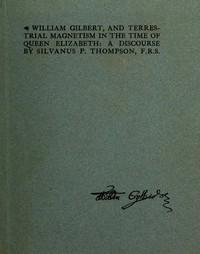
Silvanus P. Thompson, a physicist and historian of science, delivered this discourse in 1903 before the Royal Geographical Society on the tercentenary of Queen Elizabeth's death. The text is not a biography but a focused argument for Gilbert's place among Elizabethan luminaries, emphasizing his experimental method over inherited lore. Thompson draws on a wide range of contemporary sources—from Peter Peregrinus (1269) to Simon Stevin (1599)—to reconstruct the state of magnetic knowledge before Gilbert. The discourse itself is a performance of scholarly synthesis, weaving together navigational practice, instrument-making, and the gradual recognition of magnetic variation.
The State of Magnetic Knowledge Before Gilbert
Thompson catalogs the pre-Gilbertian understanding of magnetism with notable precision. He cites the pivoted needle described by Peter Peregrinus in 1269 and the earliest known compass card, attributed to Jachobus Giraldis in 1426, held in the Biblioteca Marciana in Venice. The discourse lists over a dozen sixteenth-century works—by Olaus Magnus, Pedro de Medina, Martinus Cortes, Robert Norman, William Borough, and others—that documented the loadstone and compass. Thompson notes that early compass needles in Middle Europe pointed so nearly true north that deviation was often ignored or ascribed to error. Only later did makers set needles askew to account for variation at their place of origin. This historical layering shows that Gilbert inherited a field rich in empirical data but lacking a unifying theory.
Gilbert's Experimental Method and the Terrestrial Model
Thompson credits Gilbert with a 'magnificent generalization' from small-scale models to the Earth itself, supported by experimental researches. Gilbert created the science of terrestrial magnetism by treating the Earth as a giant magnet—a hypothesis he tested with a spherical loadstone, the terrella. Thompson acknowledges that Gilbert fell into 'sundry errors of detail' due to imperfect data, but insists that his method of philosophizing enabled later corrections. The discourse praises Gilbert for rescuing magnetism from 'pedantry and charlatanry,' a phrase that captures Thompson's view of pre-scientific natural philosophy. The emphasis falls not on Gilbert's conclusions but on his approach: systematic experiment over received authority.
The Scant Remains of Gilbert's Life and Work
Thompson laments how little is known of Gilbert's personality. A brief biography by Fuller survives in his Worthies, and Dryden and the epigrammatist Owen celebrated him in verse. Gilbert's portrait, which hung in the Schools Gallery at Oxford for nearly two hundred years, disappeared a century before Thompson wrote, leaving only a poor engraving. Thompson notes that Gilbert may be one of four physicians depicted in Camden's funeral procession cartoon of Queen Elizabeth, now in the British Museum. Of Gilbert's handwriting, not a trace was known until about five years before the discourse, when a signature was found in the Record Office; subsequently four more signatures turned up in St. John's College books, and a volume of Aristotle with Gilbert's marginal notes came to light. His will survives only as a copy at Somerset House. His collection of minerals, loadstones, maps, books, manuscripts, and correspondence with Sarpi and Sagredo—bequeathed to the College of Physicians—perished in the Great Fire of London.
Thompson's Rhetorical Strategy and Historical Context
Thompson structures the discourse as a vindication of Gilbert's scientific method, but he also embeds a lament for lost material culture. The description of Gilbert's Colchester house—'the quaint old house where he lived'—and the mural tablet in Holy Trinity Church serve as anchors for a narrative that otherwise floats on intellectual achievement. Thompson's own voice is that of a fellow scientist defending a predecessor against neglect. He explicitly joins Gilbert's name to those of Elizabethan explorers, poets, and dramatists, arguing that science deserves equal recognition. The discourse was delivered at the Royal Geographical Society, a venue that underscores the navigational implications of Gilbert's work. Thompson's closing claim—that Gilbert's true monument is his treatise—echoes the humanist trope of the book as lasting memorial, but it is grounded in the specific losses he has catalogued.
Thompson's discourse is best read as a period piece: a Edwardian scientist's effort to secure Gilbert's reputation within a national pantheon. Readers interested in the history of scientific method will find a clear case study of how experimental reasoning was articulated around 1600. Those drawn to material history will note the poignant inventory of what has been lost. The text itself, printed by the Chiswick Press, carries the physical dignity of a commemorative lecture. Approach it as an argument, not an encyclopedia, and attend to the ways Thompson selects and frames his evidence.
Gilbert’s strange legacy—how little we know of the man behind such a monumental idea—stuck with me long after I closed that old discourse. It made me think about how we live with unseen forces, tracked only by their effects. That same quiet awe surfaced again in Atoms, Nature, and Man: Man-made Radioactivity in the Environment — Key Ideas to Explore, where invisible changes leave their gentle, lasting mark on everything.