1

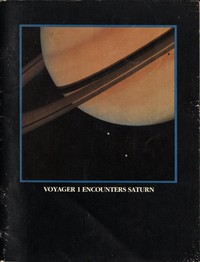
Voyager 1 Encounters Saturn — A Closer Reading
(0 User reviews)
915
Project Gutenberg
2017
Not confirmed
Saturn probes; Voyager Project; Saturn (Planet) -- Photographs from space
Readers of public-domain and historical texts
Project Gutenberg digital edition
en
Edition facts
Words
9,287
Reading time
41 min
Text sections
2
This digital edition of Voyager 1 Encounters Saturn — A Closer Reading is described by source-level measurements including 9,287 words, 41 min estimated reading time, and 2 detected text sections.
The text analysis averages about 22.1 words per sentence, while the detected sections provide another way to judge how the source is divided.
Project Gutenberg metadata also associates the work with “Saturn probes,” connecting these edition facts with the source record’s subject description.
Source:
Project Gutenberg record #56205
This NASA publication documents Voyager 1's 1980 Saturn encounter through annotated photographs and mission summaries, emphasizing the spacecraft's trajectory, ring-plane crossing, and discoveries of new moons and atmospheric structures.
Editorial Edition Score
4.5/5
★★★★★
★★★★★
Calculated from edition completeness, EPUB availability, text structure and catalogue metadata. Not a user rating.
How this score is calculated
- Description quality20 pts
- Title & short description10 pts
- Source metadata20 pts
- Text length15 pts
- Chapters / structure15 pts
- EPUB file integrity20 pts
Total of 100 points, scaled to a 2.5-5.0 range. Editions with an empty description or a missing EPUB file are not scored.
Edition quality
Public-domain source text
Read the source text
The source text is kept in the dedicated reader, separate from this catalogue record and its commentary.
The publication opens with a foreword by NASA Administrator Robert A. Frosch, who frames the Voyager 1 encounter as both a scientific and aesthetic event: the images are described as being "of great beauty as well as great scientific interest." This dual emphasis—on data and on visual spectacle—shapes the entire work. The text is structured as a chronological mission report, moving from launch through the encounter period (August 22 to December 19, 1980), with a focus on the spacecraft's precise navigation and the technical challenges of imaging Saturn and its moons.
The narrative is driven by the spacecraft's changing perspective: as Voyager 1 approaches Saturn, the camera can no longer capture the planet in a single frame, forcing a shift to mosaics. This structural detail—the transition from single images to composite views—mirrors the increasing complexity of the data being gathered.
A Trajectory of Precision
The encounter narrative is built around three critical targeting requirements: a close flyby of Titan, a precise timing window for radio occultation, and a safe path through the E-Ring at Dione's orbit. These objectives are presented not as abstract goals but as concrete constraints that shaped the mission. The text notes that small trajectory trim maneuvers were executed on October 11 and November 6, 1980, to ensure the spacecraft hit its marks. This attention to navigational detail gives the reader a sense of the engineering precision required to explore the outer solar system.
The flight path itself becomes a structural element: Voyager 1 approached Saturn from the ecliptic plane, then dipped below the ring plane before being hurled upward by Saturn's gravity. This vertical movement—down through the ring plane, then up and out of the solar system—is described with a sense of momentum. The spacecraft's trajectory is not just a path but a narrative arc, ending with its departure "above and out of the solar system."
The Visual Harvest: From Single Frames to Mosaics
The publication's photographic record is organized by distance and scale. Early images, taken from millions of kilometers away, show Saturn and its moons as small bodies against black space. As the spacecraft closes in, the text describes a shift: by October 24, 1980, the narrow-angle camera could no longer capture the planet in a single picture, and "a period of multiple images or mosaics began." By November 2, even four-picture mosaics were insufficient. This progression from simple to composite images mirrors the growing complexity of the encounter.
The captions for each photograph include the date and the distance from the spacecraft to the planet or satellite, reinforcing the sense of a journey measured in kilometers. The cover image—Saturn with Tethys and Dione, and Tethys's shadow cast onto the cloudtops—is a striking example of how the publication uses visual evidence to convey both scientific data and aesthetic impact. The shadow is not just a feature; it is a clue to the relative positions of the bodies.
Recurring Motifs: Light, Shadow, and Scale
Throughout the text, the interplay of light and shadow serves as a recurring motif. The foreword mentions the shadow of Tethys on Saturn's cloudtops; the encounter description notes that the spacecraft's signals passed through the gap between Saturn and its rings during occultation. These moments of shadow and light are not merely descriptive—they are integral to the mission's science. The occultation experiment, for instance, used the spacecraft's radio signal to probe the ring structure.
Scale is another persistent theme. The text repeatedly emphasizes distances: 124,000 kilometers from the cloudtops, 1.6 million kilometers from Titan, 109 million kilometers at the start of the encounter. These numbers are not dry facts; they underscore the vastness of the solar system and the technological achievement of sending a 25-watt transmitter across a billion miles. The phrase "a billion miles of interplanetary space" appears in the foreword, setting a tone of awe that is tempered by the precise, technical language of the mission report.
The Unseen: What the Text Leaves Out
While the publication is rich in visual and technical detail, it is notably sparse on narrative interpretation. The text does not speculate on the implications of the discoveries—it simply presents them. For example, the discovery of three new moons is mentioned in the foreword but not elaborated upon in the main body. The reader is left to infer the significance from the context of the encounter.
Similarly, the scientific highlights section lists findings under headings like "Saturn," "Rings," and "Titan," but the accompanying text is brief and factual. The publication assumes a reader who is already interested in the mission and does not provide background on why these findings matter. This restraint gives the work a documentary quality: it is a record of what was observed, not a story about what it means. The absence of interpretation is itself a structural choice, emphasizing the raw data over the narrative.
Readers approaching this publication should expect a document that prioritizes visual evidence and technical precision over narrative flow. The photographs are the primary text; the written passages serve as captions and context. To get the most from this work, pay attention to the distances and dates in the captions—they chart the spacecraft's approach and retreat. The publication is best read as a companion to the images, letting the visual record of Saturn's rings, moons, and atmosphere speak for itself.
I’ve often held that NASA volume, tracing Voyager’s lonely arc past Saturn, and thought of how it, too, sought hidden structures—moons, rings, unseen forces. Another old friend sits nearby, The Natural Philosophy of William Gilbert and His Predecessors — Background and Themes, where a quieter explorer mapped magnetic pulls. Both whisper: we learn best by attending to what draws us.
There are no reviews for this eBook.
There are no comments for this eBook.
Reader reflection
How did this book work for you?
Your answers remain private and are stored only in this browser.
Your progress
0
/
10
2
Was reading this book enjoyable?
3
How likely are you to recommend this book?
4
How much effort did this book require?
5
Did the story or argument move comfortably?
6
How closely did the book connect with your experience?
7
Do you expect to return to this book?
8
How useful did the reading feel?
9
What is the main idea you are taking away?
10