1

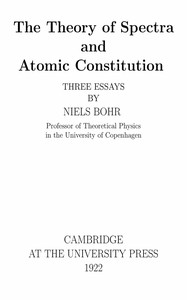
The Theory of Spectra and Atomic Constitution: Three Essays — Reading Companion
(0 User reviews)
2153
Project Gutenberg
2014
Not confirmed
Quantum theory; Spectrum analysis; Hydrogen; Atomic theory
Readers of public-domain and historical texts
Project Gutenberg digital edition
en
Edition facts
Words
51,094
Reading time
223 min
Text sections
16
The Theory of Spectra and Atomic Constitution: Three Essays — Reading Companion can be approached with a clearer sense of reading commitment from its source measurements: 51,094 words, 3 hr 43 min estimated reading time, and 16 detected text sections.
The text analysis averages about 33.4 words per sentence, while the detected sections provide another way to judge how the source is divided.
Project Gutenberg metadata also associates the work with “Quantum theory,” connecting these edition facts with the source record’s subject description.
Source:
Project Gutenberg record #47464
Niels Bohr's three essays trace the development of quantum theory applied to atomic structure, from hydrogen's spectrum to the correspondence principle, using specific formulas and experimental evidence without claiming complete explanations.
Editorial Edition Score
4.8/5
★★★★★
★★★★★
Calculated from edition completeness, EPUB availability, text structure and catalogue metadata. Not a user rating.
How this score is calculated
- Description quality20 pts
- Title & short description10 pts
- Source metadata20 pts
- Text length15 pts
- Chapters / structure15 pts
- EPUB file integrity20 pts
Total of 100 points, scaled to a 2.5-5.0 range. Editions with an empty description or a missing EPUB file are not scored.
Edition quality
Bohr's preface frames the three essays as stages in applying quantum theory to atomic structure, noting that the theory does not attempt an 'explanation' in the usual sense but rather establishes connections between unexplained facts. The first essay, from a 1913 address, already contains the germ of the correspondence principle later developed in the second essay. Readers will encounter a consistent emphasis on formal relationships over mechanistic description.
From Hydrogen to Helium: A Surprising Similarity
Bohr illustrates how the theory predicts that the spectrum of ionized helium should resemble that of hydrogen, with a formula differing only by a factor of four. He calls this 'intimate connection between the properties of two elements' an immediate expression of the nuclear atom's simple structure. The excerpt shows Bohr using specific numerical relations to argue from theory to observation, noting that the helium spectrum was later obtained from pure helium. This section demonstrates his method of deriving testable predictions from quantum postulates.
Moseley's X-Ray Spectra and Atomic Number
Bohr presents Moseley's discovery that X-ray spectra vary simply with atomic number, which he interprets as confirming that atomic number equals the number of electrons. He reproduces Moseley's formula for the strongest line in the most penetrating group, writing it with a constant from the hydrogen spectrum. Bohr emphasizes the 'great significance' of this discovery while noting the difficulty in understanding the similarity between hydrogen and X-ray spectra. The discussion ties experimental results directly to the theoretical framework of stationary states.
Sommerfeld's Fine Structure and Quantum Numbers
Bohr introduces Sommerfeld's theory of fine structure, where relativistic mass variation causes the electron orbit to precess, requiring two quantum numbers. He distinguishes the 'principal quantum number' from a second number, noting that the former determines energy to a close approximation. This section shows Bohr incorporating refinements while maintaining the core idea of stationary states characterized by integers. The excerpt reveals how the theory evolved from a single quantum number to a more complex scheme without abandoning its foundational principles.
The Correspondence Principle as a Guiding Idea
Bohr's preface describes the correspondence principle as a formal link between classical electrodynamics and quantum theory, first appearing in the deduction of the hydrogen spectrum constant. The second essay's second part surveys results from this development, attempting to elucidate problems using the principle. Readers see Bohr treating the principle not as a derivation but as a heuristic that connects otherwise disparate conceptions. The excerpts consistently avoid claiming full explanation, instead emphasizing the establishment of formal connections.
These essays reward attention to how Bohr moves between specific formulas and broad interpretive principles. The recurring phrase 'does not attempt an explanation' signals his epistemological caution. Readers should note how each essay builds on the previous one, with later sections referencing earlier results. The correspondence principle emerges gradually rather than being announced fully formed.
That rainy afternoon, Bohr’s essays left me with the quiet weight of how each spectral line carries a tentative story. Mulling over the correspondence principle, my fingers wandered to a slimmer volume on the shelf: Careers in Atomic Energy — Reading Companion. It felt less like physics and more like a human footnote to all those borrowed formulas.
There are no reviews for this eBook.
There are no comments for this eBook.
Reader reflection
Take a moment to reflect on this book
Create a short personal record of your experience with this book.
Your progress
0
/
10
2
How did the book work for you overall?
3
Is this a title you would suggest to others?
4
How demanding did the text feel?
5
Did the book give you something worth debating?
6
Which part made the strongest impression?
7
How original did the book feel?
8
How did the pace of the book feel?
9
In one sentence, what did you learn?
10