1

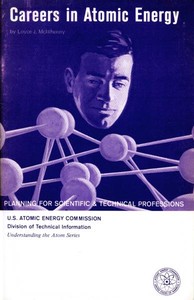
Careers in Atomic Energy — Reading Companion
(0 User reviews)
487
Project Gutenberg
2013
Not confirmed
Nuclear physics -- Vocational guidance
Readers of public-domain and historical texts
Project Gutenberg digital edition
en
Edition facts
Words
10,026
Reading time
44 min
Text sections
2
Careers in Atomic Energy — Reading Companion can be approached with a clearer sense of reading commitment from its source measurements: 10,026 words, 44 min estimated reading time, and 2 detected text sections.
The text analysis averages about 17.1 words per sentence, while the detected sections provide another way to judge how the source is divided.
Project Gutenberg metadata also associates the work with “Nuclear physics -- Vocational guidance,” connecting these edition facts with the source record’s subject description.
Source:
Project Gutenberg record #42626
A 1964 U.S. Atomic Energy Commission booklet guiding students toward careers in nuclear science, emphasizing interdisciplinary work and practical preparation. The author, an English graduate turned technical editor, writes with direct, encouraging prose, listing specific federal labs and fields from physics to technical writing.
Editorial Edition Score
4.5/5
★★★★★
★★★★★
Calculated from edition completeness, EPUB availability, text structure and catalogue metadata. Not a user rating.
How this score is calculated
- Description quality20 pts
- Title & short description10 pts
- Source metadata20 pts
- Text length15 pts
- Chapters / structure15 pts
- EPUB file integrity20 pts
Total of 100 points, scaled to a 2.5-5.0 range. Editions with an empty description or a missing EPUB file are not scored.
Edition quality
Public-domain source text
Read the source text
The source text is kept in the dedicated reader, separate from this catalogue record and its commentary.
Loyce J. McIlhenny, an English graduate who worked as a technical editor at the Oak Ridge Institute of Nuclear Studies, wrote this 1964 booklet for the U.S. Atomic Energy Commission's Understanding the Atom Series. The text addresses students directly—"A student—YOU—can find your career in atomic energy"—and frames nuclear science not as a separate field but as a dimension of every scientific discipline. McIlhenny's voice is brisk and practical, moving quickly from a list of applications (physicians treating disease, botanists using radioactivity) to concrete advice on college preparation, scholarships, and job locations. The prose avoids technical jargon, aiming instead to demystify the path into a field then still new to many readers.
A Direct Address to the Student Reader
McIlhenny establishes an immediate, personal tone by using the second person throughout. The opening paragraph declares that "virtually every aspect of science is concerned in some way with the atom," then catalogs examples—physicians, mechanical engineers, botanists, chemists—before landing on "YOU." This rhetorical strategy positions the reader as an active participant rather than a passive learner. The author reinforces this by including a section titled "The Time to Begin" and another on "College: Is It a Necessity?" which answer common anxieties about cost and duration. The language is encouraging but not effusive: "It is difficult, undesirable, and usually impossible, for a scientist to confine himself to his own field." The effect is that of a knowledgeable mentor offering frank, structured guidance.
Interdisciplinary Work as a Core Theme
A recurring argument in the booklet is that atomic energy dissolves traditional disciplinary boundaries. McIlhenny writes that a chemist may become a physical chemist, a physicist a chemical physicist, and that mechanical engineers often find themselves doing electrical or nuclear engineering. She extends the point to space exploration: physicists, chemists, and physicians now solve reentry problems and test weightlessness. The text even speculates that "the botanist who today is totally concerned with the flora of earth will tomorrow find himself fingering a bit of fungus from Mars." This emphasis on flexibility and cross-training reflects the era's rapid technological change and serves as a practical selling point for students uncertain about committing to a single specialty.
Concrete Job Locations and the Role of the Technical Writer
McIlhenny devotes a section to "Location of the Atomic Scientist," listing specific federal laboratories—Ames, Argonne, Berkeley, Brookhaven, Hanford, Los Alamos, Oak Ridge, Savannah River—and describing opportunities in private industry, universities, and hospitals. She also highlights the health physicist as a key safety figure and the technical writer or editor, a role she knew firsthand. The writer "translates the notebooks of the scientist into reports" or "translates scientific findings into articles for the public." By including this profession, McIlhenny implicitly validates her own career path and signals that scientific communication is a legitimate entry point into atomic energy. The list of employers grounds the abstract career advice in specific, named institutions.
McIlhenny's booklet is best read as a period document that reveals how the U.S. government marketed nuclear careers to a post-Sputnik generation. Its brisk, encouraging tone and concrete lists of labs and fields reflect an era of optimism about atomic energy's potential. Readers interested in the history of science education or the rhetoric of technical recruitment will find the text revealing. For those seeking career guidance today, the specific advice on scholarships and interdisciplinary study remains broadly applicable, though the institutional landscape has changed significantly.
I remember the 1964 Careers in Atomic Energy — Reading Companion as a steady hand, guiding young people toward patient, interdisciplinary work. It never rushed. That same quiet confidence lingers in Atoms at the Science Fair: Exhibiting Nuclear Projects — Reading Notes, where a curious student’s careful display feels less like spectacle and more like a whispered conversation with the future.
There are no reviews for this eBook.
There are no comments for this eBook.
Reader reflection
Before you leave, reflect on the book
Use these questions to collect your thoughts before moving on.
Your progress
0
/
10
2
Did this book hold your interest?
3
Would you encourage someone else to read it?
4
Did the language feel accessible?
5
Did any part of the book feel personally relevant?
6
How useful were the ideas in this book?
7
Did the book meet your expectations?
8
Which part made the strongest impression?
9
Which lesson or insight stayed with you?
10