1

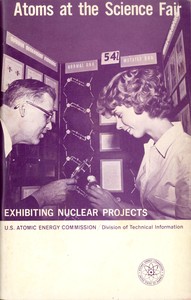
Atoms at the Science Fair: Exhibiting Nuclear Projects — Reading Notes
(0 User reviews)
969
Project Gutenberg
2021
Not confirmed
Science -- Exhibitions; Nuclear physics -- Exhibitions
Readers of public-domain and historical texts
Project Gutenberg digital edition
en
Edition facts
Words
16,092
Reading time
70 min
Text sections
3
The source record for Atoms at the Science Fair: Exhibiting Nuclear Projects — Reading Notes measures this digital text at 16,092 words, 1 hr 10 min estimated reading time, and 3 detected text sections.
The text analysis averages about 21.3 words per sentence, while the detected sections provide another way to judge how the source is divided.
Project Gutenberg metadata also associates the work with “Science -- Exhibitions,” connecting these edition facts with the source record’s subject description.
Source:
Project Gutenberg record #65893
This 1968 U.S. Atomic Energy Commission booklet advises students on planning, designing, and building nuclear science fair exhibits, with emphasis on the authorial choices in diction, dialogue, and description that shape its instructional tone.
Editorial Edition Score
4.5/5
★★★★★
★★★★★
Calculated from edition completeness, EPUB availability, text structure and catalogue metadata. Not a user rating.
How this score is calculated
- Description quality20 pts
- Title & short description10 pts
- Source metadata20 pts
- Text length15 pts
- Chapters / structure15 pts
- EPUB file integrity20 pts
Total of 100 points, scaled to a 2.5-5.0 range. Editions with an empty description or a missing EPUB file are not scored.
Edition quality
Public-domain source text
Read the source text
The source text is kept in the dedicated reader, separate from this catalogue record and its commentary.
The booklet opens with a direct address to "young exhibitors, their science teachers, project counselors, and parents," immediately establishing a multi-audience instructional purpose. Its diction is consistently practical and encouraging, as seen in phrases like "we trust this booklet will encourage students" and "above all, have fun." The authors avoid technical jargon in favor of accessible language, yet they maintain an authoritative tone by referencing the AEC's role and the National Science Fair-International.
The structure is methodical, moving from project selection to exhibit design to competition rewards. Notably, the authors explicitly state they omit "detailed advice on conducting science projects" to preserve the student's initiative, a deliberate rhetorical choice that shapes the booklet as a guide for framing rather than prescribing.
Instructional Voice and Audience
The authors consistently use second-person pronouns ("you," "your") to create a direct, mentoring relationship with the reader. For instance, they advise: "choose a topic which can be investigated with materials and equipment available to you at school or at home." This choice personalizes the guidance while maintaining an official, institutional tone. The booklet also addresses multiple audiences simultaneously, as when it notes that judges interview students to "identify the most outstanding nuclear-related exhibits." The voice shifts between imperative instructions ("plan your exhibit content") and motivational statements ("you will gain some of the experience needed for victory"), reflecting the dual goal of instruction and encouragement.
Descriptive Language of Exhibit Design
The authors employ concrete, visual language when describing exhibit construction. They discuss "color backgrounds," "trial layouts," and "letter your text"—terms that ground abstract design principles in tangible actions. The description of the judging process is similarly specific: judges look for "clarity and ingenuity" in explaining the project. The booklet also uses comparative descriptions, such as contrasting a winning exhibit with others, to illustrate effective design. However, the excerpts do not include detailed aesthetic judgments; instead, the focus remains on functional advice, like allocating "definite times—particularly on weekends and holidays" for project work.
Dialogue and Reported Speech
The excerpts contain minimal direct dialogue, but the authors incorporate reported speech from judges and officials. For example, they describe how AEC Special Awards judges "identify the most outstanding nuclear-related exhibits" through interviews, and they quote Edward J. Brunenkant's foreword. The booklet also includes hypothetical dialogue in the "Quo Vadis?" section, where the authors imagine a student's internal reasoning: "First, resolve now to enter science fair competition this year." This technique transforms abstract advice into a conversational, step-by-step plan. The absence of student voices in the excerpts suggests the authors prioritize the expert perspective over peer examples.
Recurring Details and Structural Patterns
Several recurring details anchor the booklet's advice. The phrase "science fair" appears frequently, often paired with "project" or "exhibit," reinforcing the central theme. The authors repeatedly emphasize deadlines, such as "finish by mid-February" and "late January and early February," grounding the guidance in a real academic calendar. The structure of each section follows a pattern: a heading, a series of numbered or bulleted steps, and a concluding motivational remark. For instance, the "Quo Vadis?" section lists six steps from "resolve now" to "have fun." This pattern creates a predictable, easy-to-follow framework that mirrors the orderly process it advocates.
This booklet is best read as a period-specific artifact of science education in the late 1960s, reflecting the U.S. Atomic Energy Commission's public outreach. Its authorial choices—direct address, concrete language, and structured lists—aim to demystify nuclear science for a young audience. Readers should note that the excerpts do not reveal how the booklet handles safety or ethical considerations, topics likely addressed in the appendices. The editorial note here focuses solely on the observable diction, dialogue, and descriptive patterns within the provided text.
That old Atoms at the Science Fair booklet stayed with me because its careful, almost parental tone made something technical feel tender. I kept thinking how the quiet voice guides without pushing—much like the way Standard Measures of United States, Great Britain and France History and actual comparisons. With appendix on introduction of the mètre — Key Ideas to Explore gently holds old units, letting their strangeness feel familiar. That gentleness lingers longest.
There are no reviews for this eBook.
There are no comments for this eBook.
Reader reflection
Your personal reading reflection
Build a private reading journal entry for this title.
Your progress
0
/
10
2
Did this book hold your interest?
3
How likely are you to recommend this book?
4
Did the language feel accessible?
5
Did this book create an emotional response?
6
How would you describe its reading pace?
7
How distinctive were its ideas or approach?
8
What did you appreciate most?
9
What is the main idea you are taking away?
10