1

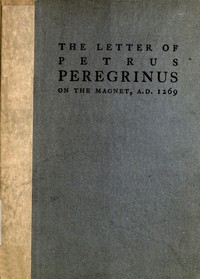
The Letter of Petrus Peregrinus on the Magnet, A.D. 1269 — Text and Context
(0 User reviews)
1385
Project Gutenberg
2015
Not confirmed
Magnetism -- Early works to 1800
Readers of public-domain and historical texts
Project Gutenberg digital edition
en
Edition facts
Words
11,301
Reading time
50 min
Text sections
2
Before opening The Letter of Petrus Peregrinus on the Magnet, A.D. 1269 — Text and Context, the edition data offers a quick orientation: 11,301 words, 50 min estimated reading time, and 2 detected text sections.
The text analysis averages about 29.3 words per sentence, while the detected sections provide another way to judge how the source is divided.
Project Gutenberg metadata also associates the work with “Magnetism -- Early works to 1800,” connecting these edition facts with the source record’s subject description.
Source:
Project Gutenberg record #50524
Petrus Peregrinus's 1269 letter systematically describes lodestone polarity, magnetic attraction, and the construction of a floating compass, grounding celestial influence in experimental observation.
Editorial Edition Score
4.5/5
★★★★★
★★★★★
Calculated from edition completeness, EPUB availability, text structure and catalogue metadata. Not a user rating.
How this score is calculated
- Description quality20 pts
- Title & short description10 pts
- Source metadata20 pts
- Text length15 pts
- Chapters / structure15 pts
- EPUB file integrity20 pts
Total of 100 points, scaled to a 2.5-5.0 range. Editions with an empty description or a missing EPUB file are not scored.
Edition quality
Read the Text
own to Columbus when he sailed from the shores of the Old World in 1492 as appears from the surprise with which he noticed the deviation of the needle from North as well as from the consternation of his pilots. Columbus has the unquestionable merit of being the first to observe and record the change of declination with change of place.
The first printed edition of the Epistola, now very rare, was prepared by Achilles Gasser, a physician of Lindau, a man well versed in mathematics, astronomy, history and philosophy. The work was printed in Augsburg in 1558. A copy of this early print is among the treasures of the Wheeler collection in the library of the American Institute of Electrical Engineers, New York. It was from this text that the translation which follows was made.
Besides the Latin edition of Gasser, 1558, there is also that of Libri in his _Histoire des Sciences Mathématiques_, 1838; of Bertelli, 1868, and Hellmann, 1898. Bertelli’s is a learned and exhaustive work in which the Barnabite monk, sometimes called by mistake, Barnabita, instead of Bertelli, collates and compares the readings of the two Vatican codices with other texts, adding copious references and explanatory notes. It appeared in the _Bulletino di Bibliografia e di Storia delle Scienze Matematiche e Fisiche_ for 1868.
Of translations, we have that which Richard Eden made from Taisnier’s pirated extracts, the first dated edition appearing in 1579. Cavallo’s _Treatise on Magnetism_, 1800, also contains some of the more remarkable passages. The only complete English translation that we have, appeared in 1902 from the scholarly pen of Prof. Silvanus P. Thompson, of London. It is an _édition de luxe_ beautifully rubricated, but limited to 250 copies. The translation was based on the texts of Gasser and Hellmann, amended by reference to a manuscript in the author’s possession, dated 1391. We are informed that Mr. Fleury P. Mottelay, of New York, the learned translator of Gilbert’s _De Magnete_, possesses a manuscript version by Prof. Peirce, of Harvard, of the Paris codex, of which he made a careful study in an endeavor to decipher the illegible parts.
THE LETTER OF PEREGRINUS
PART I CHAPTER I PURPOSE OF THIS WORK
At your earnest request, I will now make known to you, in an unpolished narrative, the undoubted though hidden virtue of the lodestone, concerning which philosophers up to the present time give us no information, because it is characteristic of good things to be hidden in darkness until they are brought to light by application to public utility. Out of affection for you, I will write in a simple style about things entirely unknown to the ordinary individual. Nevertheless I will speak only of the manifest properties of the lodestone, because this tract will form part of a work on the construction of philosophical instruments. The disclosing of the hidden properties of this stone is like the art of the sculptor by which he brings figures and seals into existence. Although I may call the matters about which you inquire evident and of inestimable value, they are considered by common folk to be illusions and mere creations of the imagination. But the things that are hidden from the multitude will become clear to astrologers and students of nature, and will constitute their delight, as they will also be of great help to those that are old and more learned.
CHAPTER II QUALIFICATIONS OF THE EXPERIMENTER
You must know, my dear friend, that whoever wishes to experiment, should be acquainted with the nature of things, and should not be ignorant of the motion of the celestial bodies. He must also be skilful in manipulation in order that, by means of this stone, he may produce these marvelous effects. Through his own industry he can, to some extent, indeed, correct the errors that a mathematician would inevitably make if he were lacking in dexterity. Besides, in such occult experimentation, great skill is required, for very frequently without it the desired result cannot be obtained, because there are many things in the domain of reason which demand this manual dexterity.
CHAPTER III CHARACTERISTICS OF A GOOD LODESTONE
The lodestone selected must be distinguished by four marks—its color, homogeneity, weight and strength. Its color should be iron-like, pale, slightly bluish or indigo, just as polished iron becomes when exposed to the corroding atmosphere. I have never yet seen a stone of such description which did not produce wonderful effects. Such stones are found most frequently in northern countries, as is attested by sailors who frequent places on the northern seas, notably in Normandy, Flanders and Picardy. This stone should also be of homogeneous material; one having reddish spots and small holes in it should not be chosen; yet a lodestone is hardly ever found entirely free from
Petrus Peregrinus opens his 1269 letter not with abstract theory but with a hands-on procedure: marking the poles of a round lodestone by floating it on water and observing its alignment. This practical starting point sets the tone for a work that blends meticulous experiment with cosmological speculation. The letter is divided into two parts: the first examines the lodestone's properties—polarity, attraction, and the way iron acquires magnetic virtue—while the second describes instruments that exploit these phenomena, including a floating compass and a device for measuring azimuth. Throughout, Peregrinus insists on repeatable tests, such as balancing the stone on pivots and checking its motion at different hours, yet he also invokes the heavens as the ultimate source of magnetic virtue.
Polarity as the Organizing Principle
Peregrinus’s first major claim is that every lodestone has two poles, one seeking north and the other south. He demonstrates this by floating the stone: it rotates until the poles align with the world’s poles. The language is precise: “the northern part of the stone turns to the north, and the southern to the south.” He then shows that opposite poles attract, like poles repel, and that a piece of iron touched by one pole acquires that same pole’s orientation. This polarity is not merely a property but the key to all magnetic behavior. He even notes that breaking a lodestone produces two complete magnets, each with its own north and south—a observation that would later become foundational.
Celestial Virtue and Experimental Caution
Having established polarity, Peregrinus argues that the lodestone’s virtue comes from the heavens: “the poles of the lodestone receive their virtue from the poles of the world.” He supports this with a test: mount a balanced round stone on pivots, align it with the meridian, and observe whether it follows the celestial motion. If it does not, he warns, “ascribe the failure to your own lack of skill rather than to a defect in nature.” This sentence reveals a careful experimenter who acknowledges human error. He also notes that the needle points to the celestial pole, not the pole star, because the meridians intersect at the poles—a correction of common belief.
From Theory to Instrument: The Floating Compass
Part II shifts to construction. Peregrinus describes filing a lodestone into an elongated shape, enclosing it in two sealed wooden capsules, and floating it in a vessel of water. The vessel’s rim is marked with the four cardinal points, determined by a meridian thread. A smooth strip of wood is placed across the capsules as a diameter; when aligned with the meridian, it is fixed, and the capsules are engraved with 360 divisions. This device, he says, will “indicate forever the meridian of that place.” The instructions are detailed: the capsules must be light, waterproof, and cemented carefully. The result is a portable compass that can also serve as an astrolabe for finding the ascendant.
The Astrological Horizon and the Limits of Evidence
Peregrinus’s instruments are not purely navigational; they are designed for astrological reckoning. With his floating compass, he claims, “you will need no timepiece, for by it you can know the ascendant at any hour.” The letter’s final chapters describe measuring the azimuth of the sun, moon, or any star, using the compass’s graduated circle. This fusion of magnetism and astrology reflects the 13th-century worldview, but the excerpts break off before the full azimuth procedure is given. What remains clear is that Peregrinus sees no conflict between empirical testing and celestial influence: the lodestone’s behavior is both a natural phenomenon and a link to the heavens.
Readers should approach this letter as a working document: it is part manual, part philosophical treatise, and part promise of future instruments. The translation by Brother Arnold preserves the direct, instructional tone, though the introductory notice by Brother Potamian provides useful historical context. Because the excerpts are incomplete, especially toward the end, the full scope of Peregrinus’s azimuth instrument remains unclear. What survives is a vivid snapshot of medieval science in action—experimental, speculative, and deeply practical.
I remember being struck, reading Petrus’s old letter, how a floating needle could feel so much like a quiet commitment to the world. That same patient faith in measurement seems to live again, oddly, in Nuclear Clocks Revised — Themes and Context. It’s less a discovery than a remembering, a slow tapping at the wall of what we assume time is. Makes me miss simpler instruments.
There are no reviews for this eBook.
There are no comments for this eBook.
Reader reflection
Your personal reading reflection
Build a private reading journal entry for this title.
Your progress
0
/
10
2
Was reading this book enjoyable?
3
How likely are you to recommend this book?
4
What was the reading difficulty like?
5
How distinctive were its ideas or approach?
6
How valuable was this book for your own interests?
7
Did you relate to its people, ideas, or situations?
8
Did this book create an emotional response?
9
What changed or sharpened your thinking?
10