1

Nuclear Clocks Revised — Themes and Context
(0 User reviews)
2337
Project Gutenberg
2015
Not confirmed
Radioactive dating
Readers of public-domain and historical texts
Project Gutenberg digital edition
en
Edition facts
Words
17,558
Reading time
77 min
Text sections
3
The catalog record for Nuclear Clocks Revised — Themes and Context provides practical reading context through 17,558 words, 1 hr 17 min estimated reading time, and 3 detected text sections.
The text analysis averages about 19.0 words per sentence, while the detected sections provide another way to judge how the source is divided.
Project Gutenberg metadata also associates the work with “Radioactive dating,” connecting these edition facts with the source record’s subject description.
Source:
Project Gutenberg record #49070
Henry Faul's 1966 booklet explains radioactive dating methods—carbon-14, rubidium-strontium, uranium-lead, and potassium-argon—using specific minerals like biotite, feldspar, and zircon. The text emphasizes closed systems and concordia analysis, grounded in the Atomic Energy Commission's educational series.
Editorial Edition Score
4.5/5
★★★★★
★★★★★
Calculated from edition completeness, EPUB availability, text structure and catalogue metadata. Not a user rating.
How this score is calculated
- Description quality20 pts
- Title & short description10 pts
- Source metadata20 pts
- Text length15 pts
- Chapters / structure15 pts
- EPUB file integrity20 pts
Total of 100 points, scaled to a 2.5-5.0 range. Editions with an empty description or a missing EPUB file are not scored.
Edition quality
Public-domain source text
Read the source text
The source text is kept in the dedicated reader, separate from this catalogue record and its commentary.
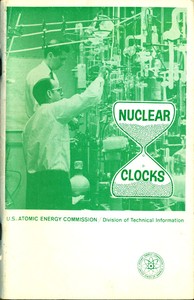
Henry Faul's Nuclear Clocks, published in 1966 as part of the Atomic Energy Commission's Understanding the Atom series, opens with a disarmingly plain question: 'How old is a rock?' The booklet then builds a methodical case for radioactive dating, treating each isotopic system as a distinct 'clock' with its own materials and limitations. Faul's prose is direct and technical, yet accessible—he explains that a mineral like biotite records only the last cooling event, while feldspar may preserve the original crystallization age. The text is structured around practical geology: how to choose the right mineral, how to interpret discordant ages, and what the numbers mean for understanding Earth's history.
Closed Systems and the Logic of Decay
Faul repeatedly returns to the concept of a 'closed system'—a mineral that has retained both parent and daughter isotopes since formation. He notes that the theory was clear by 1910, but the challenge was satisfying 'all those ifs.' The booklet explains that mica (biotite) is useful for potassium-argon dating but resets easily with heat, showing 'when the rock last cooled.' In contrast, feldspar remains closed even at temperatures that melt other minerals, making it reliable for rubidium-strontium dating. Faul emphasizes cross-checking: if biotite and feldspar from the same rock give concordant ages, the rock has not been reheated. This logic is central to the book's method.
Zircon and the Concordia Curve
A standout passage describes zircon, a heavy, hard accessory mineral that contains uranium and little lead. Faul explains that even if lead is lost, the Concordia analysis—developed by G. W. Wetherill—can correct for it. By plotting ratios of lead isotopes from two uranium decay chains, geologists can find the true age from the upper intersection of a chord with the Concordia curve. Faul calls this 'an elaborate technique utilizing difficult chemical procedures,' but notes it has 'proved invaluable in solving some important geologic problems.' The explanation is concise and avoids oversimplification, giving readers a clear sense of the method's power and complexity.
Practical Applications and Geologic Context
Faul connects dating methods to real-world problems: locating ore deposits, calibrating the geologic time scale, and dating archaeological sites like the 14,000-year-old burial in Sudan. He discusses the 'Old Man from Olduvai' and Precambrian stratigraphy, showing how nuclear clocks inform both human prehistory and deep Earth history. The booklet also addresses analytical techniques and mineral selection—for example, screening feldspar for low original strontium using X-ray fluorescence. These details ground the theoretical discussion in laboratory practice, making the book a practical guide as much as an explanatory text.
Faul's booklet is best read as a primer on method rather than a survey of results. Readers interested in the mechanics of dating—how to choose a mineral, what assumptions are made, and how discordant ages are interpreted—will find clear, example-driven explanations. The Atomic Energy Commission's framing as public education means the text assumes no specialized knowledge, but it rewards careful attention to the interplay between theory and laboratory practice.
That rainy afternoon, Henry Faul’s little booklet kept circling back to zircon crystals—how they hold their clock steady, shut tight against the world. It made me think of other sturdy certainties, ones that bend rather than break. So I wandered into The A B C of Relativity — Inside the Classic, and the rain felt less like gravity, more like a quiet carousel.
There are no reviews for this eBook.
There are no comments for this eBook.
Reader reflection
Take a moment to reflect on this book
Create a short personal record of your experience with this book.
Your progress
0
/
10
2
Did this book hold your interest?
3
How likely are you to recommend this book?
4
How much effort did this book require?
5
Did the book deliver what you hoped for?
6
How distinctive were its ideas or approach?
7
Would you like to discuss this book with someone?
8
Was the book easy to understand?
9
What did this book teach you most?
10