1

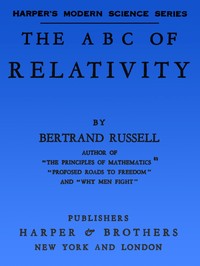
The A B C of Relativity — Inside the Classic
(0 User reviews)
137
Project Gutenberg
2022
Not confirmed
Relativity (Physics)
Readers of public-domain and historical texts
Project Gutenberg digital edition
en
Edition facts
Words
50,530
Reading time
220 min
Text sections
17
The source record for The A B C of Relativity — Inside the Classic measures this digital text at 50,530 words, 3 hr 40 min estimated reading time, and 17 detected text sections.
The text analysis averages about 24.8 words per sentence, while the detected sections provide another way to judge how the source is divided.
Project Gutenberg metadata also associates the work with “Relativity (Physics),” connecting these edition facts with the source record’s subject description.
Source:
Project Gutenberg record #67104
Bertrand Russell's 1925 introduction to relativity explains Einstein's revolution in non-mathematical language, emphasizing the need to reshape our inherited imaginative picture of the physical world.
Editorial Edition Score
4.8/5
★★★★★
★★★★★
Calculated from edition completeness, EPUB availability, text structure and catalogue metadata. Not a user rating.
How this score is calculated
- Description quality20 pts
- Title & short description10 pts
- Source metadata20 pts
- Text length15 pts
- Chapters / structure15 pts
- EPUB file integrity20 pts
Total of 100 points, scaled to a 2.5-5.0 range. Editions with an empty description or a missing EPUB file are not scored.
Edition quality
Public-domain source text
Read the source text
The source text is kept in the dedicated reader, separate from this catalogue record and its commentary.
Bertrand Russell opens The A B C of Relativity by acknowledging that Einstein's achievement is widely known but poorly understood, wrapped in mathematical technicalities. He argues that popular accounts often become unintelligible just when they begin to say something important. Russell's aim is to express the new ideas in non-mathematical language, demanding a change in our imaginative picture of the world—a picture inherited from remote ancestors and learned in early childhood. He compares this shift to the Copernican revolution, noting that Einstein's ideas will seem easy to a generation that grows up with them, but for his contemporaries a deliberate effort of imaginative reconstruction is unavoidable.
From Everyday Measures to Cosmic Laziness
Russell begins with familiar, concrete examples: measuring lengths using parts of the human body—a foot, a cubit, a span—and judging distances by walking time. He then gradually introduces the counterintuitive notion that a body left to itself chooses the route that makes the time between two stages of its journey as long as possible, a principle he calls a “law of cosmic laziness.” This is his way of explaining geodesics in space-time without mathematics. The transition from everyday measures to this abstract law shows Russell's method: he anchors new concepts in ordinary experience before stretching the reader's imagination.
Light Rays and Free Bodies as Guides
Russell presents two empirical ways to discover geodesics in space-time: light rays and freely moving bodies. A light ray travels so that the interval between any two parts of it is zero, and this holds for distant parts as well. Freely moving bodies—the sun, stars, planets, satellites, and falling bodies in a vacuum—also follow geodesics. He notes that standing on the earth involves electromagnetic forces that prevent you from falling through, because the earth, though solid-looking, is mostly empty space. This observation ties the abstract geometry of space-time to the everyday experience of standing upright.
The Special Theory in Small Regions
A key postulate relates the general theory to the special theory: within any small region where the intensity of gravitation is practically uniform, the special theory can be applied. On the earth's surface, such a region must be small enough for the approximation to hold. Russell uses this to bridge the two theories, showing how the special theory's results remain useful locally. This section exemplifies his careful scaffolding: he never assumes the reader can leap from one concept to another without a clear logical step.
Imaginative Reconstruction as the Core Task
Throughout the excerpts, Russell returns to the theme of changing our inherited picture of the world. He insists that the difficulty of relativity is not mathematical but imaginative. The book's structure—starting with touch and sight, moving through clocks and foot rules, to space-time and gravitation—is designed to rebuild the reader's mental model step by step. Russell's voice is patient and direct, often using analogies (the ray of light traveling around the solar system) and even humor (the “law of cosmic laziness”) to ease the conceptual shift. The reader is asked not to memorize formulas but to see the world differently.
Russell's The A B C of Relativity is best read as an exercise in imaginative reconstruction. The book does not aim to teach the mathematics of relativity but to reshape how one pictures space, time, and motion. Readers should expect to encounter familiar ideas—distance, duration, speed—redefined from the ground up. The effort required is not technical but conceptual: a willingness to let go of the intuitive picture inherited from childhood and to adopt a new one, piece by piece.
Reading about reshaping our imaginative picture of the world brought back sitting in my grandfather’s study, watching him trace old diagrams of magnetism. The Natural Philosophy of William Gilbert and His Predecessors — Background and Themes once gave me a similar quiet jolt, how an older mind’s strange certainties still hum with life beneath our own. It felt less like history, more like listening.
There are no reviews for this eBook.
There are no comments for this eBook.
Reader reflection
How did this book work for you?
Your answers remain private and are stored only in this browser.
Your progress
0
/
10
2
How did the book work for you overall?
3
Would you recommend this book to another reader?
4
How much effort did this book require?
5
How strongly did the book affect you emotionally?
6
Which aspect of the book did you value most?
7
Would you like to discuss this book with someone?
8
Do you expect to return to this book?
9
Which lesson or insight stayed with you?
10