1

Our Atomic World: The Story of Atomic Energy — A Closer Reading
(0 User reviews)
2257
Project Gutenberg
2021
Not confirmed
Nuclear energy -- Popular works
Readers of public-domain and historical texts
Project Gutenberg digital edition
en
Edition facts
Words
12,953
Reading time
57 min
Text sections
2
This digital edition of Our Atomic World: The Story of Atomic Energy — A Closer Reading is described by source-level measurements including 12,953 words, 57 min estimated reading time, and 2 detected text sections.
The text analysis averages about 19.9 words per sentence, while the detected sections provide another way to judge how the source is divided.
Project Gutenberg metadata also associates the work with “Nuclear energy -- Popular works,” connecting these edition facts with the source record’s subject description.
Source:
Project Gutenberg record #66246
Examines the author's choices in diction, dialogue, and description within this 1963 Atomic Energy Commission booklet, noting how it balances technical exposition with accessible analogies and a restrained, factual tone.
Editorial Edition Score
4.5/5
★★★★★
★★★★★
Calculated from edition completeness, EPUB availability, text structure and catalogue metadata. Not a user rating.
How this score is calculated
- Description quality20 pts
- Title & short description10 pts
- Source metadata20 pts
- Text length15 pts
- Chapters / structure15 pts
- EPUB file integrity20 pts
Total of 100 points, scaled to a 2.5-5.0 range. Editions with an empty description or a missing EPUB file are not scored.
Edition quality
Public-domain source text
Read the source text
The source text is kept in the dedicated reader, separate from this catalogue record and its commentary.
This booklet, part of the U.S. Atomic Energy Commission's Understanding the Atom series, presents atomic energy through a lens of deliberate authorial choices. C. Jackson Craven, a physicist and educator, employs a diction that is precise yet accessible, often using analogies to bridge technical concepts. The narrative voice is consistently factual and restrained, avoiding dramatic language even when describing pivotal events like the Trinity test. Instead, Craven lets the phenomena speak for themselves, as when he notes that the first atomic explosion 'completely vaporized a tall steel tower and melted several acres of surrounding surface sand.' This choice of concrete, observable detail over hyperbole characterizes the entire work.
Diction: Balancing Precision and Accessibility
Craven's word choice reflects his dual audience of curious laypeople and students. He defines terms like 'isotopes' and 'transuranic elements' in context, often embedding definitions within the narrative flow. For instance, he explains that neptunium and plutonium were named 'after the planets Neptune and Pluto, which lie beyond Uranus in the solar system,' a mnemonic that aids retention without oversimplifying. Technical terms such as 'gaseous diffusion' are introduced with concrete descriptors: 'compressing normal uranium, in the form of uranium hexafluoride gas, against a porous barrier containing millions of holes, each smaller than two-millionths of an inch.' The specificity of 'two-millionths of an inch' grounds the abstract process in a tangible scale. Craven avoids jargon-laden sentences, instead breaking complex ideas into digestible clauses. His diction is consistently neutral, even when discussing the bomb's use: 'A ²³⁵U bomb was dropped on Hiroshima, Japan, on August 6, 1945. Three days later a plutonium bomb was dropped on Nagasaki, Japan. Hostilities ended on August 14, 1945.' The flat, chronological reporting here is a deliberate stylistic choice that lets the facts carry weight without editorializing.
Voice: The Educator as Narrator
The narrative voice is that of a patient instructor, evident in the book's structure and explanatory asides. Craven frequently uses the passive voice to emphasize processes over agents: 'The new elements were named neptunium and plutonium.' This choice shifts focus to the scientific discovery itself. He also employs direct address sparingly, as in the foreword's 'It is essential that all Americans gain an understanding of this vital force,' but the main text maintains a third-person, authoritative tone. The voice is notably devoid of self-reference; Craven never says 'I' or 'we' in the excerpts, instead presenting information as established fact. This aligns with the booklet's institutional origin. However, the voice is not dry: it occasionally uses vivid imagery, such as describing the Oak Ridge plant as containing 'miles of piping, and countless pumps,' which conveys scale without exaggeration. The chronology sections are presented as a list of dates and events, further reinforcing the voice of a chronicler rather than a commentator.
Description: Concrete Details Over Sensationalism
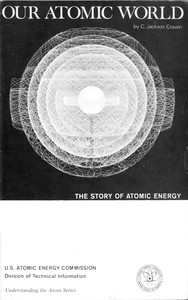
Craven's descriptive choices consistently prioritize factual precision over emotional impact. When describing the first atomic bomb test, he writes: 'The heat from that first man-made nuclear explosion completely vaporized a tall steel tower and melted several acres of surrounding surface sand. The flash of light was the brightest the earth had ever witnessed.' The details are specific—'tall steel tower,' 'several acres'—and the final phrase is a measured superlative ('the brightest the earth had ever witnessed') that avoids hyperbole. Similarly, the description of the gaseous diffusion plant focuses on engineering specifications: 'millions of holes, each smaller than two-millionths of an inch.' This emphasis on measurable quantities reflects Craven's background in physics. He also uses analogies sparingly but effectively, such as comparing the naming of transuranic elements to planetary order. The cover description is treated as a caption: 'The center represents the nucleus, greatly exaggerated in size. The fine lines represent the electrons whirling about the nucleus.' This matter-of-fact tone extends to all visual elements, treating them as explanatory tools rather than artistic flourishes.
Structure: Chronology as a Rhetorical Device
The book's structure mirrors its didactic purpose, moving from historical foundations to contemporary applications. The table of contents reveals a clear progression: from Greek curiosity about matter, through the discovery of the nucleus and isotopes, to fission and the bomb, and finally to peaceful uses and international cooperation. This chronological arrangement serves as a narrative arc, with each chapter building on the previous. Craven uses section headings as signposts, such as 'The Alchemists' Dream Comes True' for transmutation, which adds a touch of historical resonance. The inclusion of a chronology (pages 18-19) and suggested references further reinforces the educational framework. Within chapters, Craven employs a pattern of stating a discovery, explaining its significance, and then linking it to the next development. For example, after describing plutonium's fissionability, he immediately notes the practical advantage: 'Since plutonium is chemically different from uranium, it offered the tremendous advantage that it could readily be concentrated by conventional chemical techniques.' This logical flow guides the reader through complex material without abrupt jumps.
Readers approaching this booklet should attend to how Craven's authorial choices shape the presentation of atomic energy. His diction, voice, description, and structure work together to create a text that is informative without being sensational, and educational without being condescending. The restraint in language—particularly when discussing the bombings—invites readers to draw their own conclusions. This editorial note highlights those choices as a lens for understanding the work's rhetorical strategy within its historical context.
That rainy afternoon, I kept returning to the booklet’s careful silences—how its factual tone still let wonder slip through. Long after closing it, I found myself thinking about time itself, which sent me toward Nuclear Clocks Revised — Themes and Context, another quiet companion for a grey sky. Both left me with the same taste: clarity gently held.
There are no reviews for this eBook.
There are no comments for this eBook.
Reader reflection
How will you remember this book?
Save your reaction, strongest insight, and memorable passage.
Your progress
0
/
10
2
How did the book work for you overall?
3
Is this a title you would suggest to others?
4
Did the language feel accessible?
5
How did the reading compare with what you expected?
6
Could you apply anything you learned?
7
Was the book moving at the right speed?
8
Do you expect to return to this book?
9
What is the main idea you are taking away?
10