1

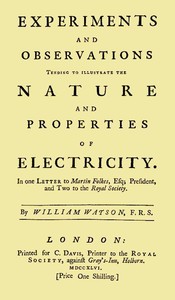
Experiments and Observations Tending to Illustrate the Nature and Properties of Electricity In One Letter to Martin Folkes, Esq; President, and Two to the Royal Society — Reading Notes
(0 User reviews)
1356
Project Gutenberg
2014
Not confirmed
Electricity -- Early works to 1850
Readers of public-domain and historical texts
Project Gutenberg digital edition
en
Edition facts
Words
12,310
Reading time
54 min
Text sections
5
The catalog record for Experiments and Observations Tending to Illustrate the Nature and Properties of Electricity In One Letter to Martin Folkes, Esq; President, and Two to the Royal Society — Reading Notes provides practical reading context through 12,310 words, 54 min estimated reading time, and 5 detected text sections.
The text analysis averages about 32.3 words per sentence, while the detected sections provide another way to judge how the source is divided.
Project Gutenberg metadata also associates the work with “Electricity -- Early works to 1850,” connecting these edition facts with the source record’s subject description.
Source:
Project Gutenberg record #46168
William Watson's 1746 letters to the Royal Society detail electrical experiments with camphor, gunpowder, and cold water, arguing that electrical fire is true flame. The preface explains the work's origin as separate Philosophical Transactions pieces, now collected to satisfy public curiosity.
Editorial Edition Score
4.5/5
★★★★★
★★★★★
Calculated from edition completeness, EPUB availability, text structure and catalogue metadata. Not a user rating.
How this score is calculated
- Description quality20 pts
- Title & short description10 pts
- Source metadata20 pts
- Text length15 pts
- Chapters / structure15 pts
- EPUB file integrity20 pts
Total of 100 points, scaled to a 2.5-5.0 range. Editions with an empty description or a missing EPUB file are not scored.
Edition quality
Read the Text
pirit was at least ten Feet.
YOU all know, that there is the repulsive Power of Electricity, as well as the attractive; inasmuch as you are able, when a Feather or such-like light Substance is replete with Electricity, to drive it about a Room, which Way you please. This repulsive Power continues, until either the Tube loses its excited Force, or the Feather attracts the Moisture from the Air, or comes near to some non-electric Substance; if so, the Feather is attracted by, and its Electricity lost in, whatever Non-Electric it comes near. In electrified Bodies, you see a perpetual Endeavour to get rid of their Electricity. This induced me to make the following Experiment. I placed a Man upon a Cake of Wax, who held in one of his Hands a Spoon with the warm Spirits, and in the other a Poker with the Thread. I rubbed the Tube amongst the Thread, and electrified him as before. I then ordered a Person not electrified to bring his Finger near the Middle of the Spoon; upon which, the Flash from the Spoon and Spirit was violent enough to fire the Spirit. This Experiment I then repeated three Times. In this Method, the Person by whose Finger the Spirit of Wine is fired, feels the Stroke much more violent, than when the electrical Fire goes from him to the Spoon. This Method for the Sake of Distinction, we will call the repulsive Power of Electricity.
THE late Dr. _Desaguliers_ has observed in his excellent Dissertation concerning Electricity, "That there is a Sort of Capriciousness attending these Experiments, or something unaccountable in their Phænomena, not to be reduced to any Rule. For sometimes an Experiment, which has been made several Times successively, will all at once fail." Now I imagine that the greatest Part, if not the Whole of this Matter, depends upon the Moisture or Dryness of the Air, a sudden though slight Alteration in which, perhaps not sufficient to be obvious to our Faculties, may be perceived by the very subtle Fire of Electricity. For
_1st_, I CONCEIVE, that the Air itself (as has been observed by Dr. _Desaguliers_) is an _Electric per se_ and of the vitreous Kind; therefore it repels the Electricity arising from the glass Tube, and disposes it to electrify whatever non-electrical Bodies receive the Effluvia from the Tube.
_2dly_, THAT Water is a _non-Electric_, and of Consequence a Conductor of Electricity; this is exemplified by a Jett of Water being attracted by the Tube, _from either Electric_'s _per se_ conducting Electricity, and _non-Electric_'s more readily when wetted; but what is more to my present Purpose, is, that if you only blow through a dry glass Tube, the Moisture from your Breath will cause that Tube to be a Conductor of Electricity.
THESE being premised; in proportion as the Air is replete with watery Vapours, the Electricity arising from the Tube, instead of being conducted as proposed, is, by means of these Vapours, communicated to the circum-ambient Atmosphere and dissipated as fast as excited.
THIS Theory has been confirmed to me by divers Experiments, but by none more remarkably than on the Evening of the Day I made those before-mention'd; when the Vapours, which in the Afternoon by the Sun's Heat, and a brisk Gale were dissipated, and the Air perfectly dry, descended again in great Plenty upon the Absence of both, and the Evening was very damp. For between seven and eight o'Clock, I attempted again the same Experiments in the same Manner, without being able to make any of them succeed; though all those mention'd in this Paper with others of less Note, were made in Half an Hour's Time.
I AM the more particular in this, being willing to save the Labour of those, who are desirous of making these Kind of Trials; for although some of the lesser Experiments may succeed almost at any Time, yet I never could find that the more remarkable ones would succeed but in dry Weather.
_I am, Gentlemen,_ _Your most obedient,_ _humble Servant,_ W. WATSON.
_London, April 25. 1745._
TO THE ROYAL SOCIETY.
IN some Papers I lately did myself the Honour to lay before you, I acquainted you of some Experiments in Electricity; particularly I took notice of having been able to fire Spirit of Wine by what I call'd the repulsive Power thereof; which I have not heard had been thought of by any of those _German_ Gentlemen, to whom the World is obliged for many surprizing Discoveries in this Part of natural Philosophy.
HOW far strictly speaking the Spirit in this Operation may be said to be fired by the repulsive Power of Electricity, or how far that Power, which repels light Substances when fully impregnated with Electricity, fires the Spirit, may probably
William Watson's 1746 collection of three letters—one to Royal Society president Martin Folkes and two to the Society itself—presents a series of electrical experiments that build toward a specific argument: that electrical fire is "truly Flame, and that extreamly subtil." The preface reveals that these papers were originally read at separate meetings and printed privately before a second edition was demanded by public curiosity. Watson emphasizes that he presents them "in the same Dress wherein they appeared before the very honourable and learned Body," preserving the chronological order of discovery.
Readers approaching these letters for the first time will find a methodical experimenter who carefully distinguishes between substances that conduct electricity ("non-electrics") and those that do not ("electrics per se"). The excerpts show Watson testing the limits of electrical fire by attempting to ignite various materials, from camphor to gunpowder, and noting surprising failures and successes.
The Preface as a Window into 1740s Scientific Publishing
Watson's preface is unusually candid about the work's publication history. He explains that the letters were originally intended only for the Philosophical Transactions, printed in the order they were read. To satisfy "the Impatience of several learned and very valuable Friends," he had a few copies printed together, then broke up the press. The resulting public demand forced a second edition. This backstory matters for readers because it explains the work's structure: each letter was composed as a standalone communication, not as a unified treatise. Watson also acknowledges Martin Folkes and Sir Hans Sloane by name, noting their direct involvement in the experiments. The preface thus functions as both an apology for the work's piecemeal origin and a record of the social networks that supported early electrical research.
Cold Water as a Medium for Fire
One of the most striking experiments described involves a wet sponge held by an electrified man. Watson prepared a mucilage from fleawort seeds, squeezed it into a sponge, and observed that electrified drops "hung some Inches from the Sponge." Using a single drop of this cold liquid, he ignited both spirit of wine and inflammable air. His commentary highlights the paradox: "That a Drop of cold Water ... should be the Medium of Fire and Flame." This experiment is central to Watson's argument that electrical fire is a material substance capable of passing through water without extinguishing. For readers, this passage exemplifies Watson's method: he isolates a variable (the water's temperature and consistency), tests it against known combustibles, and draws a conclusion about the nature of electricity itself.
The Stubborn Case of Gunpowder
Watson devotes considerable attention to his attempts to fire gunpowder by electricity, most of which failed. He tried gunpowder warm and cold, whole and powdered, but "never could make it succeed." His explanation is twofold: gunpowder's vapors are not inflammable, and the sulfur in the composition must be "nearly in the State of Accension" before flame can ignite it. He demonstrates this by showing that a spoon heated by burning spirit will not fire the powder until the sulfur melts. However, Watson succeeds by grinding gunpowder with camphor or inflammable chemical oil, then warming it. The electrical flash then fires the oil's vapor, which in turn ignites the powder so quickly that "frequently they appear as the same and not successive Operations." This section reveals Watson's careful attention to negative results and his willingness to modify materials to achieve a desired effect.
Camphor and the Repulsive Power of Electricity
Camphor, a vegetable resin and an "Electric per se," provides Watson with a key demonstration. He notes that camphor will not take fire from an electrified finger because "Electric's per se excited, or electrified Bodies, exert their Force by snapping upon Electric's per se, though not excited." But when camphor is warmed in a spoon, its volatile vapors become susceptible. The finger of an electrified man, or even a sword, will snap onto the spoon and ignite the surrounding vapor, lighting the whole quantity. Watson also observes that the same effect can be produced "by the repulsive Power of Electricity," without direct contact. This experiment reinforces his claim that electrical fire is a subtle flame, capable of acting at a distance through repulsion. For readers, the camphor trials illustrate how Watson uses a substance's known properties (volatility, resinous nature) to predict and then demonstrate electrical behavior.
Watson's letters reward a reader who pays attention to the experimental conditions he specifies: the temperature of materials, the presence of moisture, the distance between electrified bodies. The failures are as instructive as the successes, particularly his inability to fire plain gunpowder. The work is best approached as a series of discrete investigations rather than a systematic treatise, with each letter building on the previous one. Readers may find it useful to track Watson's evolving definition of electrical fire as he accumulates evidence from different substances.
That rainy afternoon, I lingered over Watson’s camphor and cold water, the electric fire flickering through his careful prose. His letters felt alive, urgent. Later, restless, I reached for something else on the shelf—The A B C of Relativity — Inside the Classic—and found the same quiet thrill: another mind, trying to make invisible things tangible, patiently asking me to look closer.
There are no reviews for this eBook.
There are no comments for this eBook.
Reader reflection
Before you leave, reflect on the book
Use these questions to collect your thoughts before moving on.
Your progress
0
/
10
2
How did the book work for you overall?
3
How likely are you to recommend this book?
4
What was the reading difficulty like?
5
How closely did the book connect with your experience?
6
Could you see yourself revisiting this book?
7
Could you apply anything you learned?
8
What did you appreciate most?
9
What is the main idea you are taking away?
10