1

Einstein, the searcher — Themes and Context
(0 User reviews)
795
Project Gutenberg
2023
Not confirmed
Relativity (Physics); Einstein, Albert, 1879-1955
Readers of public-domain and historical texts
Project Gutenberg digital edition
en
Edition facts
Words
96,692
Reading time
421 min
Text sections
12
For Einstein, the searcher — Themes and Context, the stored edition analysis reports 96,692 words, 7 hr 1 min estimated reading time, and 12 detected text sections.
The text analysis averages about 26.1 words per sentence, while the detected sections provide another way to judge how the source is divided.
Project Gutenberg metadata also associates the work with “Relativity (Physics),” connecting these edition facts with the source record’s subject description.
Source:
Project Gutenberg record #70678
Alexander Moszkowski's 1921 work presents Einstein's theories through reconstructed dialogues, blending biographical insight with accessible explanations. The book emphasizes Einstein's own words and conceptual imagery, such as the ladybug-on-a-sphere analogy for curved space, offering a unique portrait of the scientist as both thinker and conversationalist.
Editorial Edition Score
4.8/5
★★★★★
★★★★★
Calculated from edition completeness, EPUB availability, text structure and catalogue metadata. Not a user rating.
How this score is calculated
- Description quality20 pts
- Title & short description10 pts
- Source metadata20 pts
- Text length15 pts
- Chapters / structure15 pts
- EPUB file integrity20 pts
Total of 100 points, scaled to a 2.5-5.0 range. Editions with an empty description or a missing EPUB file are not scored.
Edition quality
Public-domain source text
Read the source text
The source text is kept in the dedicated reader, separate from this catalogue record and its commentary.
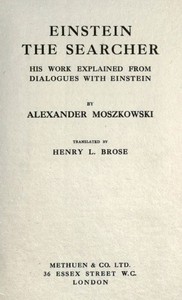
Alexander Moszkowski's Einstein, the Searcher (1921) is neither a conventional biography nor a systematic textbook. Instead, it presents Einstein's theories as they emerged from informal dialogues, with the scientist himself speaking in reconstructed conversations. Moszkowski emphasizes that the book owes its existence to these exchanges, which took place "far removed from academic purposes." The result is a hybrid work: part exposition of relativity, part intellectual portrait, where Einstein's own voice and conceptual imagery—such as the famous ladybug crawling on a transparent sphere—carry the argument.
A Portrait Drawn from Conversation
Moszkowski frames his book as distinct from the growing literature about Einstein. Where other works treat Einstein "objectively," this one includes him "subjectively"—the reader hears Einstein speak. The preface insists that the book is "neither a course of lectures nor anything similar aiming at a systematic order." Instead, it promises the kind of eloquence that arose during social hours, without a predetermined instructional plan. This conversational origin shapes the book's structure: explanations unfold through dialogue, with Einstein responding to Moszkowski's prompts. The translator, Henry L. Brose, notes that any lack of accuracy from simplification is to be debited to him, not to Einstein. The reader is thus warned that the arguments, while faithful in spirit, have been adapted for a general audience.
The Ladybug and the Sphere: A Concrete Analogy
A central excerpt illustrates Moszkowski's method. To explain a finite yet unbounded universe, Einstein offers a detailed visual analogy: a transparent sphere resting on a white table, with a ladybug crawling along a meridian. A point-light at the North Pole casts the insect's shadow onto the table. As the ladybug moves upward, its shadow grows and recedes; at the North Pole the shadow jumps to infinity, then returns from the opposite side. The analogy is worked out step by step, with attention to the shadow's size, position, and the critical moment of the jump "from plus infinity to minus infinity." Moszkowski credits Einstein with the "new form of representing the argument," which is "as important as it is fascinating." The passage demonstrates how the book translates abstract geometry into a concrete, almost tactile scenario.
The Finite Universe and Its Implications
Moszkowski reports Einstein's conclusion: "The universe, both as regards extent and mass, has finite limits and can be measured." This claim is presented not as a speculation but as a result derived from the theory. The author acknowledges the difficulty of picturing such a universe but insists that "all that is required is a power of imagination that is great enough to follow a pictorial description." The book thus positions itself as a guide for the willing reader, one who can adopt "the right attitude towards a sort of figurative representation." The finite universe is a recurring theme, and the ladybug analogy serves as its emblem. Moszkowski does not provide proofs or equations; instead, he offers a conceptual bridge, trusting that the reader's imagination, properly directed, can grasp the idea.
The Translator's Role and the Book's Limitations
Henry L. Brose's translation from the German original includes a frank admission: any lack of accuracy from simplification is his responsibility. This transparency alerts the reader that the text is twice mediated—first by Moszkowski's reconstruction of conversations, then by Brose's rendering into English. The book does not claim to be a verbatim transcript; it is a crafted work that prioritizes clarity over scholarly precision. Readers interested in Einstein's exact words or mathematical derivations should look elsewhere. What the book offers instead is a sense of how Einstein thought aloud, how he reached for analogies, and how he communicated with non-specialists. The conversational tone and the vivid imagery are the book's chief virtues, but they come with the caveat that the arguments have been simplified and shaped.
Readers approaching Einstein, the Searcher should treat it as a historical document of scientific popularization, not as a definitive exposition. The dialogues are reconstructed, the analogies are Einstein's but the framing is Moszkowski's. Pay attention to the moments where the text acknowledges its own limitations—the translator's caveat, the insistence on imagination over rigor. These are clues to the book's character: it is a portrait of a mind at work, filtered through an admirer's lens, and valuable precisely for that subjective angle.
There’s something tender about Moszkowski’s old dialogues—how Einstein’s ladybug crawls across the sphere, and you almost feel the curve beneath your own fingers. It reminds me of nights spent watching the sky, wondering at light’s patient travel. Later, I found the same quiet awe in Auroræ: Their Characters and Spectra — Inside the Classic, those shimmering ribbons explained like a whispered secret.
There are no reviews for this eBook.
There are no comments for this eBook.
Reader reflection
What did you think of this book?
Answer a few questions and save a private reflection on this device.
Your progress
0
/
10
2
How did the book work for you overall?
3
Would you encourage someone else to read it?
4
Did the language feel accessible?
5
How did the reading compare with what you expected?
6
Did it raise ideas you would like to talk about?
7
Could you see yourself revisiting this book?
8
Did the story or argument move comfortably?
9
Which lesson or insight stayed with you?
10