1

Auroræ: Their Characters and Spectra — Inside the Classic
(0 User reviews)
95
Project Gutenberg
2017
Not confirmed
Auroras
Readers of public-domain and historical texts
Project Gutenberg digital edition
en
Edition facts
Words
86,903
Reading time
378 min
Text sections
14
The catalog record for Auroræ: Their Characters and Spectra — Inside the Classic provides practical reading context through 86,903 words, 6 hr 18 min estimated reading time, and 14 detected text sections.
The text analysis averages about 17.5 words per sentence, while the detected sections provide another way to judge how the source is divided.
Project Gutenberg metadata also associates the work with “Auroras,” connecting these edition facts with the source record’s subject description.
Source:
Project Gutenberg record #56159
This editorial note examines how Capron's 1879 monograph on auroral spectra guides a first reading through its preface, catalog of observed lines, and dedication to Piazzi Smyth, highlighting the interplay of poetic epigraph, scientific cataloging, and observational detail.
Editorial Edition Score
4.9/5
★★★★★
★★★★★
Calculated from edition completeness, EPUB availability, text structure and catalogue metadata. Not a user rating.
How this score is calculated
- Description quality20 pts
- Title & short description10 pts
- Source metadata20 pts
- Text length15 pts
- Chapters / structure15 pts
- EPUB file integrity20 pts
Total of 100 points, scaled to a 2.5-5.0 range. Editions with an empty description or a missing EPUB file are not scored.
Edition quality
Public-domain source text
Read the source text
The source text is kept in the dedicated reader, separate from this catalogue record and its commentary.
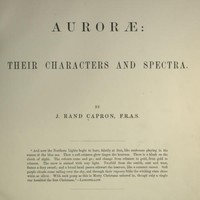
The book opens with a poetic epigraph from Longfellow, describing the Northern Lights in vivid, romantic language—'a blush on the cheek of night'—before immediately shifting to a scientific preface. This juxtaposition sets the tone: Capron aims to bridge aesthetic wonder and empirical study. The preface notes that aurorae 'charm and interest scientific and non-scientific observers alike,' and positions the work as filling a gap left by encyclopedic articles that lack illustrations. The dedication to Professor Charles Piazzi Smyth, 'one of the earliest spectroscopic observers of the Aurora,' signals the book's emphasis on spectroscopy as a key method.
The Epigraph as Entry Point
The Longfellow quotation that precedes the title page is not mere decoration. It primes the reader for a work that treats the aurora as both a spectacle and a subject of measurement. The lines describe shifting colors—'crimson to gold, from gold to crimson'—and a 'broad band passeth athwart the heavens.' These visual elements recur in Capron's later descriptions of auroral forms and spectra. A first-time reader might note how the poetic language anticipates the scientific vocabulary: where Longfellow writes 'fiery sword,' Capron later catalogues 'streamers' and 'arcs.' The epigraph thus serves as a conceptual bridge between the lay observer's awe and the spectroscopist's precision.
Cataloguing the Lines: A Window into Method
A central excerpt lists observed auroral lines with wavelengths and attributions to astronomers like Ångström, Winlock, and Vogel. Capron presents his own catalogue 'in a letter to Nature, dated November 9th, 1872,' enumerating eight lines from red to indigo. This section reveals the collaborative, cumulative nature of 19th-century auroral science. The reader sees how multiple observers—Piazzi Smyth, the Rev. T. W. Webb, R. J. Friswell—contribute measurements, often with slight discrepancies (e.g., Zöllner's 6270 vs. Capron's 6230). Capron does not resolve these differences but records them, inviting the reader to consider the challenges of spectroscopic observation: variable instruments, atmospheric conditions, and the aurora's own 'flickering movement.'
The Role of the Dedicatee
Capron dedicates the volume to Charles Piazzi Smyth, Astronomer Royal for Scotland, 'one of the earliest spectroscopic observers of the Aurora and Zodiacal Light.' This dedication is not ceremonial; Smyth's observations appear throughout the excerpts. For instance, Smyth's description of the February 4, 1872 aurora includes precise wavelengths for the green line (5579) and red line (6370), and notes 'extremely faint greenish and bluish lines.' By foregrounding Smyth, Capron aligns his own work with a lineage of spectroscopic inquiry. A first-time reader might use this dedication as a clue to the book's intellectual heritage: it is less a popular survey than a technical contribution to an ongoing scientific conversation.
Structure and the Reader's Path
The excerpts suggest a book organized around observational data rather than narrative. The preface acknowledges the 'exhaustive way' of the Encyclopædia Britannica article but argues for the value of illustrations—a hint that the full text includes plates. The later excerpt, dense with tables of wavelengths and observer names, indicates that Capron expects readers to engage with numerical data. A first-time reader should approach the book as a reference work: the preface provides context, the dedication signals key contributors, and the body presents a compendium of observations. The poetic opening may soften this technical core, but the reader should be prepared for detailed spectroscopic analysis rather than continuous prose.
Capron's Auroræ rewards a reader who moves between its literary frame and its scientific substance. The epigraph and dedication offer entry points, while the catalogues of lines demand careful attention. A first reading might focus on how Capron weaves together multiple observers' accounts, revealing the collaborative, provisional nature of 19th-century auroral science. The book stands as a record of a moment when spectroscopy was transforming the study of atmospheric phenomena.
That rainy afternoon, I lingered over Capron's preface, his careful catalog of auroral lines feeling less like data and more like a meditation on patience. His dedication to Piazzi Smyth stuck with me—that quiet reverence for measurement as devotion. Later, idly, I found myself reaching for The Meaning of Relativity Four lectures delivered at Princeton University, May, 1921 — A Closer Reading, seeking the same unhurried wonder in equations.
There are no reviews for this eBook.
There are no comments for this eBook.
Reader reflection
Your personal reading reflection
Build a private reading journal entry for this title.
Your progress
0
/
10
2
Was reading this book enjoyable?
3
Is this a title you would suggest to others?
4
How much effort did this book require?
5
How understandable was the text?
6
Which element worked best for you?
7
How personally connected did you feel to the book?
8
What did you think about the pace?
9
In one sentence, what did you learn?
10