1

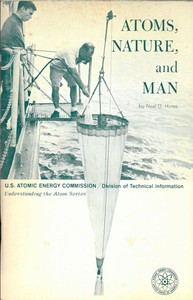
Atoms, Nature, and Man: Man-made Radioactivity in the Environment — Key Ideas to Explore
(0 User reviews)
1247
Project Gutenberg
2015
Not confirmed
Nuclear energy
Readers of public-domain and historical texts
Project Gutenberg digital edition
en
Edition facts
Words
15,555
Reading time
68 min
Text sections
3
The source record for Atoms, Nature, and Man: Man-made Radioactivity in the Environment — Key Ideas to Explore measures this digital text at 15,555 words, 1 hr 8 min estimated reading time, and 3 detected text sections.
The text analysis averages about 21.0 words per sentence, while the detected sections provide another way to judge how the source is divided.
Project Gutenberg metadata also associates the work with “Nuclear energy,” connecting these edition facts with the source record’s subject description.
Source:
Project Gutenberg record #48038
Neal O. Hines examines how man-made radioactivity moves through air, water, and land, drawing on Pacific test-site surveys and Columbia River studies. The book traces detection methods, biological uptake, and environmental pathways from 1946 to the mid-1960s, emphasizing the need for precise observation over alarm.
Editorial Edition Score
4.5/5
★★★★★
★★★★★
Calculated from edition completeness, EPUB availability, text structure and catalogue metadata. Not a user rating.
How this score is calculated
- Description quality20 pts
- Title & short description10 pts
- Source metadata20 pts
- Text length15 pts
- Chapters / structure15 pts
- EPUB file integrity20 pts
Total of 100 points, scaled to a 2.5-5.0 range. Editions with an empty description or a missing EPUB file are not scored.
Edition quality
Read the Text
uced a miscellany of radioactive products presenting unexplored possibilities of hazard. The word “fallout” was coined to describe the deposition on the earth of radioactive debris from nuclear explosions.
The first peacetime nuclear tests, conducted at Bikini in 1946 in a military-scientific exercise designated Operation Crossroads, were designed to assess the effects of nuclear weapons on naval vessels. The test organization, Joint Task Force One, an adaptation of the wartime joint task force combat concept, was a massive waterborne force including 42,000 members of the armed services, civilian scientists, consultants, and observers.
Bikini Atoll was selected for the tests because, among other things, it was remote from heavily populated areas, it offered a protected anchorage, and it had the relatively stable and predictable meteorological and oceanographic conditions considered essential to operations in which the unknowns loomed so large. Three test detonations originally were projected; two ultimately were carried out. The first, Test Able, was an airdrop of an atomic bomb on July 1, 1946, over a test fleet of 70 ships anchored in Bikini Lagoon. The second, Test Baker, was the detonation on July 25 of an atomic device suspended in the lagoon 90 feet below a small target vessel.
Although Crossroads was a military program, the mobilization of scientific interests was in many ways of historic proportions. For months before the explosions, oceanographers studied the waters and the structure of the mid-Pacific basin and meteorologists the winds and upper airs. Geologists, zoologists, botanists, and other specialists examined the atoll in detail. Bikini became, as it remains to this day, one of the most thoroughly familiar ocean structures in the world.
There was awareness, even then, of the significance of radioactivity as an element of nuclear effect. The task force made elaborate preparations to assure the safety of personnel and sent to the atoll thousands of radiation-detection instruments. Plans were made to observe the effects of radioactivity on test animals placed on ships of the target fleet.
The Underwater Detonation
The first of the Bikini events, Test Able, the explosion of a bomb dropped from an aircraft over the target fleet, sank a number of major vessels, left others sinking or crippled, contaminated many with radiation, and laid a plume of fallout northward over the rim of the atoll into the waters of the ocean. It was Test Baker, however, the underwater explosion, that would make Bikini the subject of radiobiological investigations for many years.
The Baker test was the first occasion in which nuclear debris was mixed with water and ocean sludge and returned to the area of detonation. The explosive device was of what later would be called nominal size, its force equivalent to 20,000 tons of TNT. The test still is regarded as a classic demonstration of the phenomena of shallow-water atomic explosion.
At the moment of release, the surface water of the lagoon was first lifted and then penetrated by a lighted bubble that vanished in seconds in a hollow column of water of gigantic dimensions—a column 2000 feet in diameter (its walls 300 feet thick) rising to a height of 6000 feet and containing 1,000,000 tons of water. At the base of the column, foam was churned upward for several hundred feet, and, moving out from the base, as the column sank back into the lagoon, surged a monstrous wave initially more than 80 feet high.
Radioactivity in the water was intense. The immediate total was described as equal to “many hundred tons of radium”. Decay and dilution of radioactive materials quickly reduced the total radioactivity. After 3 days, by which time water contamination had spread over an area of 50 square miles, the dose rate from the water was well within safe limits for persons remaining for brief periods. Yet it was several more days before inspection and scientific parties could spend useful time among the surviving target vessels.
At the bottom of the lagoon, below the point of detonation, Navy divers months later found that the explosion had scooped out thousands of tons of mud and coral sediment, creating a shallow basin half a mile wide. This basin, in the slow settling of returning sludge, became an area from which long-lived radioactivity entered Bikini’s biological system.
In 3 weeks of final work after Test Baker, the Bikini scientific teams took from the islands and the lagoon many hundreds of samples of plants, corals, crabs, fish, plankton, and water. They noted that radioactivity was present in all samples taken from every part of the atoll, which indicated an early uptake of radionuclides by the biota[9] and suggested that there was a continuing circulation of radioactive debris in the water. They took samples of fish in the open ocean outside the atoll and made comparative collections at other atolls. The instruments and techniques for analyzing
Neal O. Hines opens not with alarm but with a measured observation: mankind modifies the environment in “uncounted subtle and unpredictable ways.” The book, part of the Atomic Energy Commission’s Understanding the Atom series, immediately establishes a tone of cautious inquiry. Hines draws on his own experience in radiobiological surveys at Bikini, Eniwetok, and Christmas Island, grounding the discussion in firsthand evidence rather than speculation. The introduction frames man-made radioactivity as both a potential hazard and a scientific tool—its detectability, Hines argues, can reveal how minerals and nutrients move through ecosystems. This dual perspective, risk and opportunity, shapes the entire work.
From Pacific Atolls to River Systems
The book’s middle sections shift from ocean surveys to freshwater studies, using specific sites to illustrate general principles. Hines describes how residual radioactivity in the sea a month after nuclear tests could be mapped by counting plankton samples—a method that revealed strontium-90 and cesium-137 enter marine cycles only in minute amounts. He notes that “practically no fission products are found in fish,” a finding that challenges simple assumptions about contamination. On land, the Columbia River near Hanford, Washington, becomes a long-term laboratory. Observations begun in 1943 tracked low-level effluents from plutonium reactors, establishing concentration factors for phytoplankton, algae, insects, and fish. Hines contrasts this with studies at Oak Ridge, Tennessee, where trace amounts of strontium-90 released into the Tennessee River were followed through tributary streams. The section emphasizes that rivers vary radically by season, making general understanding difficult—yet they are the routes by which wastes reach the sea.
Biological Pathways and Unanswered Questions
Hines devotes careful attention to how radionuclides enter living organisms. Natural radionuclides already participate in plant metabolism; man-made ones mix with stable isotopes, increasing the total amount of each element available for growth cycles. The author points out that some artificial nuclides, such as uranium or radium, have “no known metabolic role” yet are still incorporated. This raises a dual prospect: a possible long-term hazard, and the chance that detectability will reveal much about nutrient cycles. The text does not resolve these tensions but presents them as open questions. For instance, strontium-90 is not strongly concentrated by marine organisms, so its fate in the ocean remains unclear. Hines reports that some observers believe it moves in deep currents and may eventually resurface—a process some think has already begun. These uncertainties are left for the reader to weigh.
Estuaries and the Challenge of Complexity
Estuaries, where fresh and salt water mix, present the most difficult conditions for study. Hines describes a 1961 program on the lower Columbia River that used trace amounts of effluent radioactivity to verify dispersion patterns of river water in the Pacific Ocean. Oceanographers and radiobiologists collaborated, studying both biological distribution and physical mixing. The author notes that estuaries are significant because of the many forms of life that flourish there, yet tidal action complicates every measurement. This section underscores a recurring theme: environmental systems are singular, yet parts of a whole. Hines does not offer easy conclusions but instead shows how each environment—ocean, river, estuary, land—requires its own methods while remaining connected to others. The reader is left with a sense of the painstaking, site-specific work required to understand man-made radioactivity’s movement.
The Author’s Grounding in Field Experience
Hines’s authority comes from direct involvement. He was a member of survey teams visiting Bikini and Eniwetok in 1949 and 1956, and Christmas Island in 1962. His earlier book, Proving Ground (1962), detailed radiobiological studies in the Pacific from 1946 to 1961. This background informs the present work’s emphasis on empirical observation over theory. The excerpts show a writer who has handled plankton nets and counted samples, not merely compiled reports. The book’s structure—moving from introduction to specific environments to unresolved problems—mirrors the investigative process itself. Readers should note that Hines avoids sweeping statements; instead, he presents data and invites scrutiny. The tone is that of a scientist reporting to fellow citizens, in keeping with the Atomic Energy Commission’s stated goal of helping Americans “discharge thoughtfully their responsibilities as citizens.”
Hines’s book is best read as a document of its time—1966—when nuclear testing had created a new kind of environmental question. The author does not argue for or against nuclear energy; he shows what was known and what remained unknown. Readers interested in the history of environmental monitoring, or in how scientists first grappled with global fallout, will find a careful, site-specific account. The value lies not in drama but in the patient accumulation of evidence from Pacific atolls, Columbia River gravel, and plankton nets.
I kept thinking how patient that old monitoring work was, charting Strontium-90 through clover and river silt, waiting for numbers to mean something. There’s a quieter satisfaction in revisiting those same pathways now, through the lens of Nuclear Clocks Revised — Themes and Context—like turning over a familiar stone and finding the light underneath has aged gently, too.
There are no reviews for this eBook.
There are no comments for this eBook.
Reader reflection
Record your reading impressions
A brief reflection can help important ideas stay with you longer.
Your progress
0
/
10
2
What was your overall reaction to the book?
3
Would you pass this book on to a friend?
4
Did the language feel accessible?
5
How much did the book move you?
6
Could you apply anything you learned?
7
How original did the book feel?
8
Did any part of the book feel personally relevant?
9
What is the main idea you are taking away?
10