1

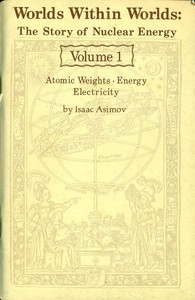
Worlds Within Worlds: The Story of Nuclear Energy, Volume 1 (of 3) Atomic Weights; Energy; Electricity — Edition Insights
(0 User reviews)
1220
Project Gutenberg
2015
Not confirmed
Nuclear energy -- Popular works
Readers of public-domain and historical texts
Project Gutenberg digital edition
en
Edition facts
Words
15,232
Reading time
67 min
Text sections
3
Before opening Worlds Within Worlds: The Story of Nuclear Energy, Volume 1 (of 3) Atomic Weights; Energy; Electricity — Edition Insights, the edition data offers a quick orientation: 15,232 words, 1 hr 7 min estimated reading time, and 3 detected text sections.
The text analysis averages about 19.8 words per sentence, while the detected sections provide another way to judge how the source is divided.
Project Gutenberg metadata also associates the work with “Nuclear energy -- Popular works,” connecting these edition facts with the source record’s subject description.
Source:
Project Gutenberg record #49819
Asimov traces the intertwined histories of atomic weights, electricity, and energy, using specific discoveries and scientists to build a foundation for understanding nuclear energy. The excerpts show his method of explaining concepts through historical context and precise examples.
Editorial Edition Score
4.5/5
★★★★★
★★★★★
Calculated from edition completeness, EPUB availability, text structure and catalogue metadata. Not a user rating.
How this score is calculated
- Description quality20 pts
- Title & short description10 pts
- Source metadata20 pts
- Text length15 pts
- Chapters / structure15 pts
- EPUB file integrity20 pts
Total of 100 points, scaled to a 2.5-5.0 range. Editions with an empty description or a missing EPUB file are not scored.
Edition quality
Public-domain source text
Read the source text
The source text is kept in the dedicated reader, separate from this catalogue record and its commentary.
Asimov opens by placing atomic power within a lineage of technological marvels—steam engines, automobiles, television—yet insists that nothing before 1939 matched the "fantastic" and "unbelievable" nature of what man has done with the atom. This framing, from the booklet's foreword, sets an ambitious tone: the story is not merely technical but a chapter in human wonder. The volume then proceeds through three intertwined strands: atomic weights, electricity, and energy. Asimov's method is to ground each concept in a historical narrative, naming researchers and their specific contributions. The excerpts reveal a careful structure: he builds from the familiar (carbon's atomic weight) to the subtle (isotopes of oxygen) to the consequential (uranium-235's shorter half-life). Readers should expect a patient, cumulative exposition rather than a dramatic arc.
Atomic Weights as a Historical Puzzle
Asimov treats atomic weights not as fixed numbers but as a problem that scientists solved piecemeal. He notes that 98.9% of carbon atoms are 12C, while 1.1% are 13C, explaining why the atomic weight hovers near 12. The discovery of deuterium by Harold Urey gets special attention: because 2H has nearly twice the mass of 1H, it differs chemically more than other isotopes, earning the name from a Greek word meaning "second." Asimov then recounts the tension between chemists and physicists over standards—chemists used oxygen's average atomic weight of 16.000, while physicists preferred 16O as exactly 16.0000. The compromise in 1961, setting 12C as the standard, resolved a long-standing discrepancy. This section demonstrates Asimov's skill at making a dry subject feel like a detective story, with competing standards and gradual refinements.
Electricity and the Unseen Particles
The electricity strand introduces cathode rays and the structure of the atom, though the excerpts focus more on the energy strand. Asimov's approach is to show how units of electricity were defined and how experiments revealed subatomic particles. He mentions radioactivity as a bridge between electricity and nuclear energy. The text implies a logical progression: understanding electricity led to probing the atom's interior, which in turn uncovered radioactivity. Readers will notice Asimov's habit of naming scientists and their dates—a technique that personalizes the science without overwhelming the narrative. The section on units of electricity likely explains coulombs and amperes, but the excerpts do not provide full detail. What is clear is that Asimov treats electricity as one of three "intertwining strands" that must be understood before nuclear energy can be discussed.
Energy: From Work to Conservation
Asimov defines energy through the concept of work: "exerting a force on a body and making it move through some distance." He gives concrete examples—lifting a weight, driving a nail—then expands to heat, electricity, magnetism, sound, and light as forms of energy. The law of conservation of energy emerges as a unifying bond, a rule that scientists sought to cover all forms. Asimov traces this law through chemical energy, electrons, and the energy of the sun and radioactivity. His prose is economical: he explains that a moving hammer drives a nail while a stationary one does not, illustrating kinetic energy without jargon. The section sets up the later volumes, which will explore mass-energy equivalence and nuclear reactions. Readers should note how Asimov builds from everyday experience to abstract principles, a hallmark of his explanatory style.
Isotopes and the Path to Fission
The excerpts culminate in the discovery of uranium-235 by Arthur Dempster in 1935. Asimov notes that 0.7% of uranium atoms are 235U, with a half-life of 700 million years compared to 238U's 4500 million years. He explains that 235U begins the actinium series, not actinium itself. This detail is crucial: it shows how isotopic differences have practical consequences for radioactivity. Asimov also covers thorium, where virtually all atoms are 232Th. The section demonstrates his ability to connect microscopic properties to observable phenomena (half-lives, decay series). For a first-time reader, this is the payoff: the earlier discussions of atomic weights and isotopes directly inform the understanding of nuclear fission, which will be the focus of Volume 3. Asimov's narrative arc becomes clear: each strand—atomic weights, electricity, energy—converges on the nucleus.
Asimov's booklet is best read as a layered introduction: the historical details are not decoration but the scaffolding for later concepts. Pay attention to the dates and names—they mark the pace of discovery. The three strands (atomic weights, electricity, energy) are interwoven, so skipping ahead may obscure connections. This volume ends before fission is described; it prepares the ground. For readers new to nuclear physics, Asimov's patient, example-driven prose offers a solid foundation without assuming prior knowledge.
I remember how Dr. Asimov’s patient unraveling of atomic weights always felt like watching someone sort a vast, dusty archive by lamplight. And that quiet kinship with the simpler The Story of Electricity — Story, Setting & Ideas, where a familiar spark begins as a curiosity. Both share that gentle, steady hand, leading a wandering mind from a single thread to a shining tapestry, without ever raising its voice.
There are no reviews for this eBook.
There are no comments for this eBook.
Reader reflection
What was your reading experience?
Capture what you thought, learned, and would like to remember.
Your progress
0
/
10
2
How did the book work for you overall?
3
How likely are you to recommend this book?
4
Did the language feel accessible?
5
What was the strongest part of the book?
6
How useful were the ideas in this book?
7
Did the story or argument move comfortably?
8
How strong was your personal connection to the text?
9
What did this book teach you most?
10