1

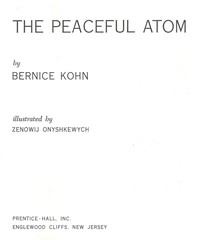
The peaceful atom — Reading Companion
(0 User reviews)
658
Project Gutenberg
2023
Not confirmed
Atoms; Atoms -- Juvenile literature; Nuclear energy -- Juvenile literature
Readers of public-domain and historical texts
Project Gutenberg digital edition
en
Edition facts
Words
10,827
Reading time
48 min
Text sections
2
Before opening The peaceful atom — Reading Companion, the edition data offers a quick orientation: 10,827 words, 48 min estimated reading time, and 2 detected text sections.
The text analysis averages about 15.5 words per sentence, while the detected sections provide another way to judge how the source is divided.
Project Gutenberg metadata also associates the work with “Atoms,” connecting these edition facts with the source record’s subject description.
Source:
Project Gutenberg record #70047
This editorial note examines Bernice Kohn's 1963 introduction to atomic energy, focusing on its conversational voice, structural pacing, and use of analogies to explain complex concepts to young readers.
Editorial Edition Score
4.5/5
★★★★★
★★★★★
Calculated from edition completeness, EPUB availability, text structure and catalogue metadata. Not a user rating.
How this score is calculated
- Description quality20 pts
- Title & short description10 pts
- Source metadata20 pts
- Text length15 pts
- Chapters / structure15 pts
- EPUB file integrity20 pts
Total of 100 points, scaled to a 2.5-5.0 range. Editions with an empty description or a missing EPUB file are not scored.
Edition quality
Public-domain source text
Read the source text
The source text is kept in the dedicated reader, separate from this catalogue record and its commentary.
Bernice Kohn opens The Peaceful Atom with a direct question—"Do you ever look at the things around you and wonder what they are made of?"—that immediately establishes a conversational, inquisitive tone. The prose moves briskly from everyday objects (carrots, bikes, baseballs) to the staggering scale of atoms: "It would take about 20 million atoms to make a dot as big as this one over the letter i." This blend of the familiar and the astonishing is a hallmark of the book's approach.
The narrative voice is that of an enthusiastic explainer, using second-person address and rhetorical questions to keep the reader engaged. Kohn avoids jargon where possible, defining terms like "fossil fuels" in plain language. The pacing is deliberate: early chapters build a foundation of atomic basics before moving into applications, each section ending with a hook that propels the reader forward.
A Conversational Guide to the Invisible
Kohn's language is carefully calibrated for a juvenile audience. She uses analogies that draw on a child's experience: atoms are "building blocks" that make everything, and a single atom is compared to the dot over an i. The voice is never condescending; instead, it invites curiosity. When introducing the atomic age, she contrasts the present with the past: "When your father and mother were children, no one had ever heard of atomic energy." This temporal framing makes the subject feel immediate and important.
The author also employs a rhythmic pattern of question and answer. Chapter 1 asks, "Why is this the atomic age?" and answers by distinguishing between knowledge of atoms and the ability to harness them. This technique recurs throughout, creating a Socratic dialogue between text and reader. The result is a book that feels less like a lecture and more like a guided discovery.
Pacing from Fundamentals to Futuristic Visions
The book's structure moves from the smallest scales to grand applications. Early chapters ("The Smallest Thing There Is," "What's in an Atom?") establish core concepts at a measured pace, using repetition and simple diagrams. Then the narrative accelerates: Chapter 8, "Atoms for Transport," leaps into speculative designs for atomic locomotives and airplanes. Kohn describes a Russian locomotive that "will travel for almost a year without new fuel" and an atomic plane that could carry "50 tons more of people or cargo." These passages shift from explanation to imagination, inviting the reader to envision a transformed world.
The pacing is not uniform; it mirrors the excitement of the topic. Technical explanations are interspersed with vivid predictions, such as the image of a train running on "a piece of uranium the size of a marble." This alternation keeps the reader engaged while ensuring that the underlying science is not lost.
Recurring Details and the Human Element
Throughout the excerpts, Kohn returns to certain motifs: the scarcity of fossil fuels, the safety challenges of radiation, and the ingenuity of scientists. She emphasizes that atomic energy is a tool to be used wisely. In the chapter on tracers, she explains how radioisotopes can find leaks in pipes "without tearing the building apart," highlighting practical benefits. The human element is never far; the book is written as if the author is speaking directly to a child, using examples like "your father and mother" to bridge generations.
The illustrations by Zenowij Onyshkewych are not described in the text, but the captions ("atomic plane," "Geiger counter") suggest a visual component that complements the verbal explanations. The book's tone remains optimistic but grounded, acknowledging problems like radioactive waste while expressing confidence in future solutions.
Readers approaching The Peaceful Atom should note that it is a product of its time—1963, at the height of Cold War optimism about nuclear energy. The book does not address weapons or disasters, focusing instead on peaceful applications. Its value lies in its clear, enthusiastic exposition and its ability to make the invisible world of atoms tangible. For those interested in the history of science communication, it offers a snapshot of how atomic energy was presented to a generation of young readers.
I remember my father’s old copy of that Kohn book, how it made the invisible feel like a story. This morning, I found myself reading Experiments and Observations Tending to Illustrate the Nature and Properties of Electricity In One Letter to Martin Folkes, Esq; President, and Two to the Royal Society — Reading Notes, and felt that same quiet wonder at static spark and shared curiosity.
There are no reviews for this eBook.
There are no comments for this eBook.
Reader reflection
What did you think of this book?
Answer a few questions and save a private reflection on this device.
Your progress
0
/
10
2
How did the book work for you overall?
3
Would you recommend this book to another reader?
4
What was the reading difficulty like?
5
What was the strongest part of the book?
6
Did it raise ideas you would like to talk about?
7
Did the story or argument move comfortably?
8
How strongly did the book affect you emotionally?
9
What did this book teach you most?
10