1

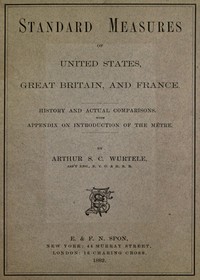
Standard Measures of United States, Great Britain and France History and actual comparisons. With appendix on introduction of the mètre — Key Ideas to Explore
(0 User reviews)
2940
Project Gutenberg
2017
Not confirmed
Weights and measures -- History; Metric system
Readers of public-domain and historical texts
Project Gutenberg digital edition
en
Edition facts
Words
7,958
Reading time
35 min
Text sections
2
Before opening Standard Measures of United States, Great Britain and France History and actual comparisons. With appendix on introduction of the mètre — Key Ideas to Explore, the edition data offers a quick orientation: 7,958 words, 35 min estimated reading time, and 2 detected text sections.
The text analysis averages about 21.9 words per sentence, while the detected sections provide another way to judge how the source is divided.
Project Gutenberg metadata also associates the work with “Weights and measures -- History,” connecting these edition facts with the source record’s subject description.
Source:
Project Gutenberg record #54208
An 1882 investigation by railroad engineer Arthur S. C. Wurtele into the history and actual comparisons of standard measures in the United States, Great Britain, and France, revealing discrepancies in scientific reductions and advocating for clearer reporting of measurement conditions.
Editorial Edition Score
4.3/5
★★★★★
★★★★★
Calculated from edition completeness, EPUB availability, text structure and catalogue metadata. Not a user rating.
How this score is calculated
- Description quality20 pts
- Title & short description10 pts
- Source metadata20 pts
- Text length15 pts
- Chapters / structure15 pts
- EPUB file integrity20 pts
Total of 100 points, scaled to a 2.5-5.0 range. Editions with an empty description or a missing EPUB file are not scored.
Edition quality
Read the Text
distance measured from Dunkirk to Barcelona was 9° 40´ 24·24´´ of arc, or 1,075,059 mètres, as reduced to the new standard.
The “toise de Peru” was the standard used in the work at a temperature of 13° R.
Two base-lines were measured with Borda’s compensating bars of brass and platinum; one at Melun, near Paris, 6076 toises long, and the second at Perpignan, 6028 toises long, and though over 900,000 mètres apart, the calculated length differed by only 10 pouces.
This meridian was afterward, in 1806, extended by Gen. Roy to Greenwich, on the north, and by Biot and Arago to Formentera, on the south. The results, as given by Laplace in centesimal degrees and mètres, are as follows:
Greenwich 57·19753° ·0 mètres. Pantheon, Paris 54·27431° 292,719·3 “ Formentera 42·96178° 1,423,636·1 “
The middle of the arc being 50·079655° Cent., or 45° 4´ 18·0822´´ Sexa., and the middle degree centesimal being very nearly 100,000 mètres.
The determination of the final result of these geodetic measurements was referred to a committee of 20 members; 9 named by the French Government, and the others by the governments of Holland, Savoy, Denmark, Spain, Tuscany, and of the Cisalpine, Ligurian, and Swiss republics, on the invitation of France.
This committee established the meridian quadrant at 5,130,740 toises; making the mètre 0·513074 of the toise, or 36·9413 pouces, or 443·296 lignes, and the toise 1·94903659 mètres.
Iron standard mètre bars, 12 in number were made by Borda, also 2 of platinum and 4 standard toise bars.
The 12 standard iron mètre bars were sent to different countries, after being verified by the French Government, and on the 2d of November, 1801, the mètrical système was legalized by France, and the standard unit of length declared to be the ten millionth part of a meridian quadrant of the earth, as defined by the distance at a temperature of 0° Centigrade (32° F.) between two points on a platinum bar in the keeping of the Academy of Science at Paris. This standard bar is used only once every ten years for exact comparisons, as stated by Dr. F. A. P. Barnard.
About 1837 Bessel, by a combination of 11 measured arcs of meridian, deduced the quadrant of meridian as 5,131,179·81 toises instead of 5,130,740 toises, as fixed by law. This would make to quadrant 10,000,565·278 legal mètres, or would increase the mètre length from 443·296 lignes to 443·334 lignes, agreeing very nearly with result obtained by Airy in 1830, from a combination of 13 measured arcs.
The following are the measured arcs used by Bessel and Airy; the combinations being indicated by initial letters, A and B.
_Measurer._ _Mid. Lat._ _Arc._ _Length._ B.--Svanberg, Sweden +66° 20´ 10·0´´ 1° 37´ 19·6´´ 593,277 feet A.--Maupertuis, Sweden +66° 19´ 37·0´´ 0° 57´ 30·4´´ 351,832 “ A.--Struve, Russia +58° 17´ 37·0´´ 3° 35´ 5·2´´ 1,309,742 “ B.--Struve and Tenner, Russia +56° 3´ 55·5´´ 8° 2´ 28·9´´ 2,937,439 “ B.--Bessel and Bayer, Prussia +54° 58´ 26·0´´ 1° 30´ 29·0´´ 551,073 “ B.--Schumacher, Denmark +54° 8´ 13·7´´ 1° 31´ 53·3´´ 559,121 “ A, B.--Ganss, Hanover +52° 32´ 16·6´´ 2° 0´ 57·4´´ 736,425 “ A.--Roy and Kater, England +52° 35´ 45·0´´ 3° 57´ 13·1´´ 1,442,953 “ B.-- “ “ “ +52° 2´ 19·0´´ 2° 50´ 23·5´´ 1,036,409 “ A.--Lacaille and Cassini, France +46° 52´ 2·0´´ 8° 20´ 0·3´´ 3,040,605 “ A, B.--Delambre and Mechin, France +44° 51´ 2·5´´ 12° 22´ 12·7´´ 4,509,832 “ A.--Boscovich, Rome +42° 59´ ·0´´ 2° 9´ 47·0´´ 787,919 “ A.--Mason and Dixon, America +39° 12´ ·0´´ 1° 28´ 45·0´´ 538,100 “ A, B.--Lambton, India +16° 8´ 21·5´´ 15° 57´ 40·7´´ 5,794,598 “ A, B.--Lambton and Everest, India +12° 32´ 20·8´´ 1° 34´ 56·4´´ 574,318 “ A, B.--Lacondamine, Peru - 1° 31´ 0·4´´ 3° 7´ 3·5´´ 1,131,050 “ A.--Lacaille, Cape Good Hope -33° 18´ 30·0´´ 1° 13´ 17·5´´ 445,506 “ B.--Maclear, “ “ -35° 43´ 20·0´´ 3° 34´ 34·7´´ 1,301,993 “ A.--Plana and Cartessi, Piedmont -------------- 1° 7´ 31·1´´ ------------
The following different lengths of the mètre have been obtained:
As adopted by France, 1801 443·296 lignes. According to Delambre 443·264 “ “ Bessel 443·33394 “ “ Airy 443·32387 “ “ Clarke 443·36146 “ From Peru Meridian 443·440 “
The length of a pendulum vibrating 100,000 times in a mean solar day was determined in numerous careful experiments by Biot, Arago, and Mathieu, in mètres of 443·296 lignes, as follows:
Dunkirk 56·67 lat. Cent. 0 above sea 0·7419076 mètres. Paris 54·26 “ 65 “ 0·7418870 “ “ by Borda 54·26 “ 0 “ 0·7416274 “ Bordeau 49·82 “ 0 “ 0·7412615 “ Formentera 42·96 “ 196 “ 0·7412061 “
Borda also determined the length of the seconds pendulum at Paris, in vacuo:
First result 440·5595 lignes = 0·9938267 mètre. Second result “ “ = 0·9938460 “ As given by Ganot “
Arthur S. C. Wurtele, an assistant engineer on the New York Central & Hudson River Railroad, opens his 1882 investigation by noting that a standard measure of length appears simple—merely a bar of metal—but quickly reveals a tangle of scientific reductions. He observes that every author assumes the right to use his own judgment about which reduction is most exact, producing a confusing difference in apparently exact figures. Wurtele aims to indicate the cause of this confusion by presenting the roots of the figures used as statements of length, rather than offering a single authoritative table.
The Problem of Conflicting Reductions
Wurtele identifies a central defect in existing comparisons: the omission of necessary facts such as the material of the bars, the temperature at which comparison was made, and the standard temperatures used. He argues that comparisons should be made of double yards and metres with the old French toise, as the limit of exactness would be doubled. The text includes a long table of different reductions of the metre in inches, ranging from 39.368 (Phoenixville Hand-book) to 39.3828 (Wollaston and Playfair, 1814), demonstrating the wide spread of values. Wurtele notes that the legal value in England is 39.37079 inches, but the latest reduction by Clarke in 1866 gives 39.37043 inches, which he considers probably the most exact.
Temperature and the Limits of Precision
Wurtele cites Sir Joseph Whitworth's claim that the smallest length measurable with certainty is 1/40000 of an inch, with an ultimate possibility of 1/1000000 of an inch. However, imperceptible variations of temperature affect these infinitesimal lengths to such an extent that Whitworth believes the limit can only be reached at a standard temperature of 85° F., to avoid the effect of heat from the body. Wurtele suggests that it would be preferable to give comparisons at the same temperature in connection with the corrected result, so that international comparisons of scientific measurements may not be vitiated by accidental variations.
Historical Comparisons and Their Discrepancies
The text recounts a series of historical comparisons between English and French standards. When the metre standard was established in France in 1799, it was compared with Sir George Schuckburg's standard yard by Captain Kater, yielding a metre equal to 39.37079 inches. Later comparisons by Wollaston and Playfair in 1814 gave 39.3828 inches, while the French Academy of Sciences deduced 39.3824 inches at 32° F., which reduced to 62° F. would be 39.3711 inches. Wurtele also presents a table of different reductions of the French toise into English feet, with values ranging from 6.3945925921 feet (Kater, 1799) to 6.39625 feet (Nystrom).
Wurtele's Methodological Approach
Wurtele's method is to give the figures of actually observed comparisons and reductions, rather than selecting a single authoritative value. He examines authorities including Kelly's Universal Cambist, Maunder's Weights and Measures, Encyclopaedia Britannica, Smithsonian Reports, and Coast Survey Reports. He notes that the only concise and clear statement he found was J. E. Hilgard's 1876 report to the Coast Survey on standards, which he was gratified to find coincides with his own deductions. The text thus serves as a compendium of conflicting data, with Wurtele acting as a compiler who highlights the sources of confusion rather than resolving them.
Readers should approach Wurtele's tables as a record of historical disagreement rather than a definitive reference. The author's own preference for Clarke's 1866 reduction is stated, but the work's value lies in its documentation of the many values in circulation. Those interested in the history of metrology will find a snapshot of late-19th-century confusion, while engineers may note the practical challenge of reconciling standards across nations.
I keep coming back to Wurtele’s 1882 tables, those stubborn inches and meters that refuse to align neatly. There’s a quiet ache in his wish for clearer records. It reminds me how The Einstein Theory of Relativity: A Concise Statement — A Closer Reading also asks us to trust what shifts beneath our measuring sticks. Different centuries, same small vertigo.
There are no reviews for this eBook.
There are no comments for this eBook.
Reader reflection
How will you remember this book?
Save your reaction, strongest insight, and memorable passage.
Your progress
0
/
10
2
How did the book work for you overall?
3
Would you pass this book on to a friend?
4
Did the language feel accessible?
5
How valuable was this book for your own interests?
6
How personally connected did you feel to the book?
7
Was the book moving at the right speed?
8
How distinctive were its ideas or approach?
9
Which lesson or insight stayed with you?
10