1

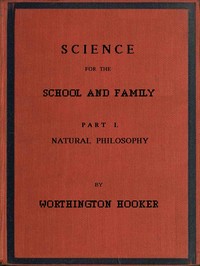
Science for the School and Family, Part I. Natural Philosophy — Edition Insights
(0 User reviews)
121
Project Gutenberg
2016
Not confirmed
Science; Physics
Readers of public-domain and historical texts
Project Gutenberg digital edition
en
Edition facts
Words
112,592
Reading time
490 min
Text sections
24
The catalog record for Science for the School and Family, Part I. Natural Philosophy — Edition Insights provides practical reading context through 112,592 words, 8 hr 10 min estimated reading time, and 24 detected text sections.
The text analysis averages about 19.7 words per sentence, while the detected sections provide another way to judge how the source is divided.
Project Gutenberg metadata also associates the work with “Science,” connecting these edition facts with the source record’s subject description.
Source:
Project Gutenberg record #52921
Worthington Hooker's 1873 textbook uses everyday examples and over 300 engravings to explain mechanics, from levers to compound machines, emphasizing practical understanding over abstract theory.
Editorial Edition Score
4.9/5
★★★★★
★★★★★
Calculated from edition completeness, EPUB availability, text structure and catalogue metadata. Not a user rating.
How this score is calculated
- Description quality20 pts
- Title & short description10 pts
- Source metadata20 pts
- Text length15 pts
- Chapters / structure15 pts
- EPUB file integrity20 pts
Total of 100 points, scaled to a 2.5-5.0 range. Editions with an empty description or a missing EPUB file are not scored.
Edition quality
Public-domain source text
Read the source text
The source text is kept in the dedicated reader, separate from this catalogue record and its commentary.
Worthington Hooker's Natural Philosophy opens with a telling preface: Daniel Webster's complaint about being forced to read Coke on Littleton without understanding it. Hooker uses this anecdote to argue that science instruction should begin with the plain and intelligible, not the abstract. Throughout the book, he applies this principle by grounding each mechanical concept in familiar actions—pushing a door, using tongs, drawing water from a well. The text moves systematically from simple levers to compound machines, with nearly 300 engravings that visualize each principle. Hooker's voice is direct and pedagogical, often addressing the reader as 'you' and posing questions that invite active reasoning.
From Door Hinges to Elbow Joints
Hooker introduces the lever not as an abstract formula but as a phenomenon the reader has already experienced. He describes pushing a door near the hinges—a lever of the third kind—and contrasts it with pushing at the edge, a lever of the second kind. The hand near the hinge moves through a small space and must exert considerable force; at the edge, the hand moves farther but with less effort. This concrete comparison makes the mechanical advantage immediately tangible. Hooker then extends the analogy to the human body, calling the biceps muscle 'the most beautiful example' of a third-class lever. The muscle inserts just below the elbow, pulling near the fulcrum to sacrifice power for speed. He notes that when great weights are lifted, the fact that muscles act at such disadvantage makes the 'exhibition of power wonderful.' The shift from door to anatomy is characteristic of Hooker's method: he moves fluidly between domestic objects and biological structures, showing that the same physical laws govern both.
The Perpetual Lever and the Platform Scale
After establishing the three classes of levers, Hooker turns to compound levers—systems where multiple levers are connected. He provides a worked example: three levers each with arms of 2 and 1 inches. One pound at A balances two at B, which balances four at C, which balances eight at D. The rule is that equilibrium occurs when the power is to the weight as the product of all short arms to the product of all long arms. Hooker then shows how this principle is applied in a platform scale for weighing hay or coal. The load rests on a platform supported by two levers; their long arms press on a third lever, and the pressure is transmitted by a rod to a small lever where a small weight balances the heavy load. He emphasizes that the arrangement secures 'accuracy and the occupation of a small space.' The wheel and axle, he explains, is essentially a 'constant succession of levers'—a perpetual lever. The same rule applies: the power and weight are related by the radii of wheel and axle. Hooker's progression from simple to compound, from theory to practical device, mirrors his overall architectural strategy.
Recurring Images: The Body as Machine
Throughout the excerpts, Hooker returns to the human body as a site of mechanical demonstration. The biceps and elbow joint illustrate the third-class lever; the act of lifting a ladder by its rungs shows the same principle. He describes the hand pushing a door, the fingers using tongs, the arm raising a weight. These examples are not decorative—they are central to his argument that natural philosophy is not remote from daily experience. The body itself is a machine, and understanding its mechanics reveals the wisdom of its design. Hooker's language is precise: the muscle 'pulls upon the forearm very near the fulcrum,' and the object of this arrangement 'is to secure quickness of movement.' He contrasts this with the need for power in lifting heavy loads, where the same mechanical disadvantage makes strength 'wonderful.' The body recurs as a touchstone, grounding abstract ratios in the reader's own physical sensations. This pattern of moving from the familiar (a door) to the anatomical (the elbow) and back to the mechanical (a windlass) gives the text a rhythmic, almost conversational structure.
Structure: A Ladder of Increasing Complexity
Hooker's book is organized as a progressive ascent from simple to complex machines, but within each topic he employs a consistent three-step pattern: state the principle, illustrate with a common object, then extend to a practical application. The lever chapter begins with the definition and rule, moves through door hinges and tongs, and culminates in the compound lever of a platform scale. The wheel and axle is introduced as a 'perpetual lever,' then exemplified by the windlass and the well. Each section builds on the previous one: the compound lever depends on the simple lever; the wheel and axle is a special case of the lever. Hooker also uses numerical examples—'1 pound at A will balance 2 at B'—to make the mathematics concrete. The engravings (nearly 300 in the full volume) are integral to this structure, providing visual confirmation of the mechanical relationships described in the text. The overall movement is from the elementary to the compound, from the domestic to the industrial, always with the reader's own body as the starting point.
Hooker's Natural Philosophy rewards a reader who pauses to test each principle against physical experience. The book is best approached not as a passive lesson but as a series of invitations to observe—how a door swings, how a muscle flexes, how a scale balances. The engravings are worth close attention, as they often contain details that the text assumes the reader will infer. Hooker's method is cumulative: later chapters depend on earlier ones, so reading sequentially is essential. The preface's warning against 'hardest books first' is a clue to the author's own design: this is a book meant to be understood, not merely read.
Hooker’s engravings of levers and pulleys felt less like lessons and more like quiet blueprints for how the world holds together. That old sense of order returns in The Machinery of the Universe: Mechanical Conceptions of Physical Phenomena — Reading Companion, where the same patient logic seems to hum underneath everything, as reassuring as a familiar clock. I find myself lingering there.
There are no reviews for this eBook.
There are no comments for this eBook.
Reader reflection
How did this book work for you?
Your answers remain private and are stored only in this browser.
Your progress
0
/
10
2
Did this book hold your interest?
3
Would you recommend this book to another reader?
4
Did the language feel accessible?
5
How did the reading compare with what you expected?
6
What was its emotional impact?
7
Did the book give you something worth debating?
8
Did the book offer a fresh perspective?
9
What is the main idea you are taking away?
10