1

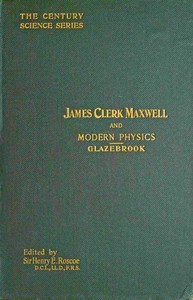
James Clerk Maxwell and Modern Physics — Inside the Classic
(0 User reviews)
3503
Project Gutenberg
2021
Not confirmed
Physics -- History; Maxwell, James Clerk, 1831-1879
Readers of public-domain and historical texts
Project Gutenberg digital edition
en
Edition facts
Words
64,877
Reading time
283 min
Text sections
19
James Clerk Maxwell and Modern Physics — Inside the Classic can be approached with a clearer sense of reading commitment from its source measurements: 64,877 words, 4 hr 43 min estimated reading time, and 19 detected text sections.
The text analysis averages about 25.7 words per sentence, while the detected sections provide another way to judge how the source is divided.
Project Gutenberg metadata also associates the work with “Physics -- History,” connecting these edition facts with the source record’s subject description.
Source:
Project Gutenberg record #65359
Richard Glazebrook's 1896 biography examines Maxwell's contributions to kinetic theory and electromagnetism, using detailed equations and analogies like Balfour Stewart's train illustration to explain viscosity. The text balances technical exposition with historical context, showing how Maxwell built on predecessors like Waterston and Clausius.
Editorial Edition Score
4.8/5
★★★★★
★★★★★
Calculated from edition completeness, EPUB availability, text structure and catalogue metadata. Not a user rating.
How this score is calculated
- Description quality20 pts
- Title & short description10 pts
- Source metadata20 pts
- Text length15 pts
- Chapters / structure15 pts
- EPUB file integrity20 pts
Total of 100 points, scaled to a 2.5-5.0 range. Editions with an empty description or a missing EPUB file are not scored.
Edition quality
Public-domain source text
Read the source text
The source text is kept in the dedicated reader, separate from this catalogue record and its commentary.
Glazebrook opens his account of Maxwell's work by confronting a difficulty: the problems Maxwell attacked are of 'such magnitude and complexity' that describing his share in the advance of physical science is 'no light labour.' The preface sets a tone of careful exposition rather than popular biography, and the chapters that follow bear this out. Equations appear frequently, but Glazebrook also reaches for analogies—such as Balfour Stewart's image of passengers jumping between trains to illustrate viscosity—to make the physics tangible. The result is a hybrid work: part intellectual history, part technical primer, written by a colleague who was himself a Fellow of Trinity College and Assistant Director of the Cavendish Laboratory.
Kinetic Theory and the Mean Free Path
Glazebrook devotes substantial space to Maxwell's work on the kinetic theory of gases, tracing how Maxwell derived the equality of mean kinetic energy for molecules of different gases at the same temperature. The text reproduces key equations—such as T = ½ mv² and p = ⅓ N mv²—and shows how they lead to the laws of Boyle, Charles, and Avogadro. A striking feature is the attention given to priority: Glazebrook notes that Waterston had enunciated two great laws in 1845 and 1851, but they remained unknown until Maxwell independently arrived at similar results in 1859. The discussion of the mean free path compares Maxwell's derivation with that of Clausius, and Glazebrook explains how experiments on gas viscosity can determine the length of that path. The exposition is technical but never assumes the reader is already fluent; each step is justified.
Viscosity as Momentum Diffusion
To explain internal friction in gases, Glazebrook introduces an analogy from Balfour Stewart: two trains running in opposite directions, with passengers jumping across. Each passenger carries momentum into the other train, reducing the relative speed of the two trains—just as, in a gas, molecules crossing from one stream to another carry their momentum with them, producing an apparent frictional force. Glazebrook writes that 'internal friction or viscosity is due to the diffusion of momentum across this common surface.' The effect is limited because particles soon acquire the velocity of the stream they enter. This section exemplifies Glazebrook's method: he presents Maxwell's mathematical results alongside concrete images, making the abstract concept of momentum transfer accessible without oversimplifying the underlying physics.
The Structure of a Scientific Biography
Glazebrook's book is part of the Century Science Series, edited by Sir Henry Roscoe, and its format reflects that series' aim to combine life and work. The volume includes a frontispiece portrait of Maxwell from a painting by G. Lowes Dickinson, and the preface acknowledges the difficulty of the task. Glazebrook does not attempt a full personal biography; instead, he focuses on Maxwell's scientific contributions, embedding them in the context of nineteenth-century physics. The text moves from kinetic theory to electromagnetism (though the excerpts provided do not include the latter), and the author's own position as a Cambridge physicist lends authority. Readers should expect equations and derivations, but also a clear sense of how Maxwell's ideas developed from and against those of his predecessors.
Glazebrook's account rewards readers who are willing to follow the mathematics, but it also offers those with a general interest in scientific history a window into how Maxwell's contemporaries understood his work. The analogies—trains, streams, diffusing molecules—serve as bridges between formal theory and physical intuition. Because the excerpts cover only the kinetic theory portion, the treatment of electromagnetism and Maxwell's equations is not represented here; the full book likely extends the same methodical approach to those topics.
Reading Glazebrook’s portrait of Maxwell, I kept pausing over those train diagrams—how a simple illustration could carry such weight. It reminded me of an older schoolbook I once leafed through, where the same patient clarity seemed to invite wonder rather than demand mastery. There is a gentleness in that approach. Science for the School and Family, Part I. Natural Philosophy — Edition Insights holds that quiet spirit too, I think.
There are no reviews for this eBook.
There are no comments for this eBook.
Reader reflection
How did this book work for you?
Your answers remain private and are stored only in this browser.
Your progress
0
/
10
2
How did the book work for you overall?
3
Would you recommend this book to another reader?
4
How demanding did the text feel?
5
Was the book easy to understand?
6
How strongly did the book affect you emotionally?
7
Did it raise ideas you would like to talk about?
8
How would you describe its reading pace?
9
Which lesson or insight stayed with you?
10