1

A Course of Mechanical, Magnetical, Optical, Hydrostatical and Pneumatical Experiments perform'd by Francis Hauksbee, and the Explanatory Lectures read by William — Story, Setting & Ideas
(0 User reviews)
1865
Project Gutenberg
2013
Not confirmed
Physics -- Early works to 1800; Physical instruments; Physics -- Experiments
Readers of public-domain and historical texts
Project Gutenberg digital edition
en
Edition facts
Words
19,718
Reading time
86 min
Text sections
3
For A Course of Mechanical, Magnetical, Optical, Hydrostatical and Pneumatical Experiments perform'd by Francis Hauksbee, and the Explanatory Lectures read by William — Story, Setting & Ideas, the stored edition analysis reports 19,718 words, 1 hr 26 min estimated reading time, and 3 detected text sections.
The text analysis averages about 31.6 words per sentence, while the detected sections provide another way to judge how the source is divided.
Project Gutenberg metadata also associates the work with “Physics -- Early works to 1800,” connecting these edition facts with the source record’s subject description.
Source:
Project Gutenberg record #44019
This editorial note examines the structure and recurring imagery in an 18th-century lecture-demonstration manual by Francis Hauksbee and William Whiston, focusing on the interplay between textual description and diagrammatic representation, the use of geometric framing, and the movement from mechanical laws to optical phenomena.
Editorial Edition Score
4.5/5
★★★★★
★★★★★
Calculated from edition completeness, EPUB availability, text structure and catalogue metadata. Not a user rating.
How this score is calculated
- Description quality20 pts
- Title & short description10 pts
- Source metadata20 pts
- Text length15 pts
- Chapters / structure15 pts
- EPUB file integrity20 pts
Total of 100 points, scaled to a 2.5-5.0 range. Editions with an empty description or a missing EPUB file are not scored.
Edition quality
Public-domain source text
Read the source text
The source text is kept in the dedicated reader, separate from this catalogue record and its commentary.
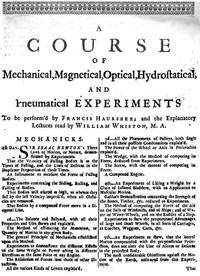
The work opens with a crisp enumeration of experiments grouped by day, each day devoted to a distinct branch of mechanics. The first day begins with Newton's three laws of motion, then proceeds through falling bodies, compound forces, and pendulums. This sequential, almost calendrical structure imposes a pedagogical rhythm: each experiment is a discrete unit, yet the cumulative effect is a systematic traversal of physical principles. The text does not merely list procedures; it embeds each demonstration within a larger argument about the order of nature.
The Architecture of Demonstration
The book's organization mirrors the layout of a lecture course. Each day's heading announces a cluster of experiments, and within each cluster the experiments are numbered and described in terse, imperative prose. For example, the first day includes “An Instrument to measure the Force of Falling Bodies” and “Experiments concerning the Sliding, Rolling, and Falling of Bodies.” This structure suggests that the reader is expected to follow the sequence as if attending the lectures. The headings function as signposts, guiding the reader from one physical concept to the next without digression.
The text also relies heavily on cross-references to figures. In the hydrostatics section, for instance, the description of an inverted syphon refers to “Fig. 2” and explains why fluids press according to perpendicular altitude. The figures are not merely illustrations; they are integral to the argument. The reader must constantly shift attention between verbal description and visual diagram, a movement that mirrors the experimentalist's own shift between theory and apparatus.
Geometric Framing and Optical Precision
In the optical portion, the text adopts a distinctly geometric language. The explanation of the rainbow involves precise angles: “an Angle of about 52 Degrees and a half” for the secondary bow, and “about 41 Degrees” for the primary. The description traces the path of rays through spherical drops, specifying the number of refractions and reflections. This geometric framing turns a natural phenomenon into a calculable event. The reader is asked to visualize rays as lines, drops as spheres, and the observer's eye as a point on a cone.
The text also emphasizes the constancy of these angles: “because the Angles F O P, E O P, as well as those H O P, G O P, are ever the same, the same Colours must still be circular.” This insistence on invariance reveals a deeper commitment to mathematical regularity. The rainbow is not merely described; it is derived from first principles of refraction and reflection, and the derivation is presented as a series of logical steps that the reader can retrace.
Recurring Motifs: Weight, Balance, and Level
Throughout the hydrostatical experiments, the concepts of weight, balance, and level recur with striking frequency. The first figure in the hydrostatics plate shows a balance used “to weigh Water in its own Element, and in the Air.” The experiment demonstrates that water's weight is the same in both media, a counterintuitive result that the text explains by invoking the displaced fluid's weight. Similarly, the inverted syphon illustrates why fluids press according to perpendicular altitude, not quantity of matter. The small tube balances the large one because velocity compensates quantity.
This motif extends to the description of tubes of all shapes: “if their lower Orifices be put under tinged Water, and Oil be poured on the Surface, the tinged Water will equally be pressed upwards through all the Tubes.” The image of a common level, maintained despite varying shapes and densities, reinforces the idea of a universal principle governing fluid statics. The reader is repeatedly shown that apparent irregularities—different quantities, different shapes—resolve into a single law.
Movement Between Scales: From Pendulums to the Sea
One of the most striking features of the mechanics section is the way it moves between scales of phenomena. The sixth day includes “An Experiment to shew the Analogy between the Swings of a Pendulum and the Waves of the Sea.” Here, a laboratory device is explicitly linked to a vast natural process. The pendulum's swing becomes a model for ocean waves, suggesting that the same mathematical laws govern both. This analogical leap is characteristic of the work's method: it treats the laboratory as a microcosm where universal principles can be isolated and measured.
Similarly, the fourth day includes experiments on the force of air on windmill sails and water on water-wheels, as well as the proportional advantages of large and small wheels in carriages. These applications ground abstract mechanics in everyday technology. The text does not remain in the realm of pure theory; it constantly points outward to practical devices and natural phenomena, creating a dynamic movement between the controlled experiment and the world beyond the lecture hall.
Readers approaching this work should attend to the interplay between text and diagram, as the figures are not decorative but essential to the argument. The book rewards a sequential reading, following the order of days and experiments, but also invites comparison across sections—for instance, how the geometric reasoning of the optics section echoes the proportional reasoning of the mechanics. By tracing the recurring motifs of balance, level, and analogical scaling, one can discern the intellectual architecture of an early modern physics course.
In old Hauksbee’s manual, you watch light bend through prisms and lenses, each experiment a patient step toward understanding what the eye can’t grasp alone. There’s a similar quiet courage in James Clerk Maxwell and Modern Physics — Inside the Classic, where unseen fields are coaxed into form. Both books share that gentle, stubborn faith: that equations and demonstrations can hold a whisper of the universe’s order, if we sit with them long enough.
There are no reviews for this eBook.
There are no comments for this eBook.
Reader reflection
Record your reading impressions
A brief reflection can help important ideas stay with you longer.
Your progress
0
/
10
2
Was reading this book enjoyable?
3
How likely are you to recommend this book?
4
How easy was the book to follow?
5
Did any part of the book stay with you emotionally?
6
How useful were the ideas in this book?
7
Was the book what you thought it would be?
8
Was the book easy to understand?
9
In one sentence, what did you learn?
10