1

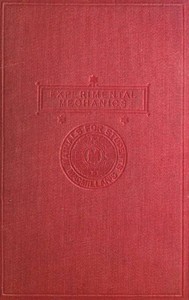
Experimental Mechanics A Course of Lectures Delivered at the Royal College of Science for Ireland — A Reader’s Guide
(0 User reviews)
1126
Project Gutenberg
2020
Not confirmed
Mechanics
Readers of public-domain and historical texts
Project Gutenberg digital edition
en
Edition facts
Words
94,245
Reading time
410 min
Text sections
27
Before opening Experimental Mechanics A Course of Lectures Delivered at the Royal College of Science for Ireland — A Reader’s Guide, the edition data offers a quick orientation: 94,245 words, 6 hr 50 min estimated reading time, and 27 detected text sections.
The text analysis averages about 20.2 words per sentence, while the detected sections provide another way to judge how the source is divided.
Project Gutenberg metadata also associates the work with “Mechanics,” connecting these edition facts with the source record’s subject description.
Source:
Project Gutenberg record #61732
Ball's lecture notes from the Royal College of Science for Ireland detail experimental mechanics using Willis's apparatus, with precise measurements of beam deflection and projectile motion, aimed at artisan audiences.
Editorial Edition Score
4.9/5
★★★★★
★★★★★
Calculated from edition completeness, EPUB availability, text structure and catalogue metadata. Not a user rating.
How this score is calculated
- Description quality20 pts
- Title & short description10 pts
- Source metadata20 pts
- Text length15 pts
- Chapters / structure15 pts
- EPUB file integrity20 pts
Total of 100 points, scaled to a 2.5-5.0 range. Editions with an empty description or a missing EPUB file are not scored.
Edition quality
Public-domain source text
Read the source text
The source text is kept in the dedicated reader, separate from this catalogue record and its commentary.
Ball's preface reveals that these lectures were delivered to a large evening class of artisans at the Royal College of Science in Dublin, eighteen years before the revised edition. He emphasizes the need for visible, durable, and adaptable apparatus, adapting Professor Willis's system to avoid 'varnish, mahogany, and glass cases.' The book is structured as a series of lectures, each building on experimental demonstrations.
The opening lecture introduces force composition with a simple definition and measurement, then proceeds to equilibrium of two and three forces. Ball's style is direct and instructional, often addressing the reader as if present in the lecture hall.
Apparatus Designed for Visibility and Reuse
Ball explicitly states his apparatus requirements: 'substantial proportions visible from every part of his lecture room,' 'universal character,' and 'well-designed and well-made parts that shall be strong and durable.' He rejects ornamental materials, focusing instead on functionality. The cathetometer, described in the beam deflection excerpt, exemplifies this: a small telescope on a vertical pillar with a scale, used to measure deflections as small as 0.19 inches. Ball notes that even a simpler apparatus could measure deflection, but the cathetometer provides precision. The system allows repeated combinations, as seen in the table of nine experiments with increasing loads.
The Role of Measurement and Tables
Ball's lectures rely heavily on quantitative data. In the beam deflection excerpt, he presents Table XXIII with columns for experiment number, load, and deflection. He describes the procedure: the tray and chains weigh exactly 14 lbs, and the cathetometer is levelled using screws. The assistant suspends the tray while Ball observes through the telescope, noting the cross descends. He then lowers the telescope to realign the spider's web, reading the scale. The table shows loads from 14 to 140 lbs, with deflections increasing from 0.19 to 2.37 inches. Ball interprets the data, noting the beam curves downwards until it breaks.
From Lecture Hall to Practical Application
Ball connects experiments to real-world structures: 'A rafter of a roof, the flooring of a room, a gangway from the wharf to a ship, many forms of bridge, and innumerable other examples, might be given of beams strained in this manner.' This grounding in everyday engineering is consistent with his audience of artisans. The projectile motion lecture (implied by the opening epigraph) similarly ties parabolic paths to practical gunnery. Ball's approach is to demonstrate principles with apparatus, then show their relevance, without abstract theorizing.
The Author's Voice and Pedagogical Strategy
Ball writes in first-person plural, often addressing the reader directly: 'While I look through the telescope my assistant suspends the tray.' He describes his own actions and observations, creating a sense of shared experiment. The preface notes the book is for teachers who 'frequently desires to enforce his lessons by exhibiting working apparatus.' Ball's tone is authoritative but accessible, avoiding jargon. He explains the cathetometer's parts and function step by step, ensuring even non-specialists can follow. The repeated use of 'we' and 'you' invites the reader into the lecture room.
Ball's lectures reward a reader who follows the experiments sequentially, noting how each builds on the last. The tables and figures are integral, not decorative. Readers may wish to replicate the demonstrations with simple materials, as Ball intended. The book is best approached as a manual for active learning, not a passive text.
It is a curious thing, how two volumes can share a quiet kinship across a century. Ball’s Glasgow lectures, with their careful beams and falling bodies, speak of the same patient wonder that moved Hauksbee’s demonstrations before a curious Royal Society in A Course of Mechanical, Magnetical, Optical, Hydrostatical and Pneumatical Experiments perform'd by Francis Hauksbee, and the Explanatory Lectures read by William — Story, Setting & Ideas. Both knew the delight of making invisible forces answer to human hands.
There are no reviews for this eBook.
There are no comments for this eBook.
Reader reflection
How will you remember this book?
Save your reaction, strongest insight, and memorable passage.
Your progress
0
/
10
2
How much did you enjoy the reading experience?
3
Would you recommend this book to another reader?
4
Did the language feel accessible?
5
How useful did the reading feel?
6
Was the book easy to understand?
7
How personally connected did you feel to the book?
8
Would a second reading be valuable?
9
What changed or sharpened your thinking?
10