1

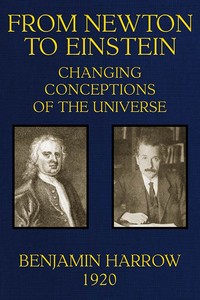
From Newton to Einstein: Changing Conceptions of the Universe — Reading Notes
(0 User reviews)
248
Project Gutenberg
2019
Not confirmed
Relativity (Physics); Ether (Space); Gravitation; Einstein, Albert, 1879-1955; Newton, Isaac, Sir, 1642-1727
Readers of public-domain and historical texts
Project Gutenberg digital edition
en
Edition facts
Words
29,950
Reading time
131 min
Text sections
6
From Newton to Einstein: Changing Conceptions of the Universe — Reading Notes can be approached with a clearer sense of reading commitment from its source measurements: 29,950 words, 2 hr 11 min estimated reading time, and 6 detected text sections.
The text analysis averages about 21.2 words per sentence, while the detected sections provide another way to judge how the source is divided.
Project Gutenberg metadata also associates the work with “Relativity (Physics),” connecting these edition facts with the source record’s subject description.
Source:
Project Gutenberg record #60271
This editorial note examines how Benjamin Harrow structures his popular 1920 exposition of relativity, tracing the movement from Newtonian mechanics through the ether problem to Einstein's unified theory, with attention to recurring images and the interplay between technical explanation and biographical framing.
Editorial Edition Score
4.7/5
★★★★★
★★★★★
Calculated from edition completeness, EPUB availability, text structure and catalogue metadata. Not a user rating.
How this score is calculated
- Description quality20 pts
- Title & short description10 pts
- Source metadata20 pts
- Text length15 pts
- Chapters / structure15 pts
- EPUB file integrity20 pts
Total of 100 points, scaled to a 2.5-5.0 range. Editions with an empty description or a missing EPUB file are not scored.
Edition quality
Public-domain source text
Read the source text
The source text is kept in the dedicated reader, separate from this catalogue record and its commentary.
Benjamin Harrow's 1920 volume moves through three conceptual stages—Newton, the ether, and Einstein—each building on the last. The book's structure mirrors the historical shift it describes: from a universe of absolute space and time to one where measurement depends on the observer's frame. Harrow repeatedly uses the image of a "peep into the beyond" to characterize Einstein's work, and he frames the theory's complexity by noting that even popular expositions require further popular introductions. The second edition adds photographs of key physicists and an appendix with contributions from Einstein, J. S. Ames, and others, making the book a layered document of early relativity reception.
Three-Part Architecture
Harrow divides his exposition into three main chapters: Newton, The Ether and Its Consequences, and Einstein. This sequence is not merely chronological—it is pedagogical. The Newton chapter establishes the classical framework that the ether chapter then destabilizes, setting up Einstein's synthesis as a resolution. The appendix, which occupies roughly a quarter of the book, reprints lectures by Einstein, Ames, Dyson, Eddington, and Thomson. By placing these primary sources after his own explanation, Harrow lets the reader encounter the theory in two voices: his simplified account and the originals' more technical formulations. The preface explicitly warns that even the appendix's "popular expositions" may need further introduction, acknowledging the difficulty of the material.
Recurring Images of Vision and Beyond
Harrow twice uses the phrase "a peep into the beyond" to describe Einstein's achievement—once in the opening Einstein section and again in the chapter's closing. This image of limited, privileged sight recurs in the book's emphasis on experimental confirmation: the deflection of starlight during an eclipse, the Barnard Medal citation, and the testimonies of Planck and others. Harrow also contrasts Einstein's wartime isolation with the public manifesto of German professors, framing the scientist as a figure who sees beyond national conflict. The visual motif is reinforced by the inclusion of portraits and photographs, making the reader a viewer of both the theory and its proponents.
Movement Between Technical and Biographical
Harrow alternates between explaining physical concepts and sketching the lives of scientists. The Einstein chapter, for example, opens with a biographical paragraph—birth, patent office, Zurich, Prague, Berlin—before plunging into relativity. This movement mirrors the book's overall strategy: the reader is led from the familiar (a person's career) to the unfamiliar (curved spacetime). Harrow also uses quotations from authorities (Lagrange, Arago, Planck) to bridge the gap between popular and expert discourse. The effect is a text that constantly shifts registers, never staying long in pure abstraction. The preface's note that the book is "little" and "popular" signals an awareness of its audience's need for varied pacing.
The Ether as Conceptual Pivot
The second chapter, "The Ether and Its Consequences," functions as the book's hinge. Harrow does not treat the ether as a mere historical curiosity; he presents it as a necessary step in the argument, showing how its properties led to contradictions that only relativity could resolve. The chapter's title emphasizes consequences rather than history, pointing forward to Einstein. Harrow's treatment of the Michelson-Morley experiment is implied rather than detailed in the excerpts, but the inclusion of Michelson's photograph in the second edition signals its importance. By structuring the book as a three-act drama, Harrow makes the ether chapter the moment of crisis before the Einsteinian resolution.
Readers approaching this book should expect a work that moves briskly through history, biography, and physics, often within a single page. Harrow's method is to assemble voices—Newton's laws, Planck's praise, Einstein's own words—rather than to argue a single thesis. The appendix offers a chance to compare the popularizer's voice with the originals. For those new to relativity, the book's structure provides a clear path: start with Newton, watch the ether fail, then see Einstein rebuild. The photographs and portraits remind us that these ideas emerged from specific people in a specific time.
Reading Harrow’s gentle insistence that Einstein’s theory grew from Newton’s unfinished questions, I thought of Mary Somerville’s quiet reverence for the same stubborn mysteries. Her A Preliminary Dissertation on the Mechanisms of the Heavens — Themes and Context feels like an earlier, softer breath of that same wonder. Both books treat the cosmos less as a problem than as a slow, patient acquaintance.
There are no reviews for this eBook.
There are no comments for this eBook.
Reader reflection
Your personal reading reflection
Build a private reading journal entry for this title.
Your progress
0
/
10
2
Did this book hold your interest?
3
Would you encourage someone else to read it?
4
How easy was the book to follow?
5
How valuable was this book for your own interests?
6
How clearly were the main ideas presented?
7
Would you read this book again?
8
Did any part of the book feel personally relevant?
9
What did this book teach you most?
10