1

Relativity: The Special & the General Theory A Popular Exposition, 3rd ed. — Text and Context
(0 User reviews)
1140
Project Gutenberg
2011
Not confirmed
Relativity (Physics)
Readers of public-domain and historical texts
Project Gutenberg digital edition
en
Edition facts
Words
34,930
Reading time
152 min
Text sections
44
The catalog record for Relativity: The Special & the General Theory A Popular Exposition, 3rd ed. — Text and Context provides practical reading context through 34,930 words, 2 hr 32 min estimated reading time, and 44 detected text sections.
The text analysis averages about 26.6 words per sentence, while the detected sections provide another way to judge how the source is divided.
Project Gutenberg metadata also associates the work with “Relativity (Physics),” connecting these edition facts with the source record’s subject description.
Source:
Project Gutenberg record #36114
Einstein's preface warns readers of the need for patience and a university-entrance-level education, while the opening chapters use thought experiments like the train-and-embankment to build the special theory. Later sections extend to general relativity, predicting light deflection by gravity, with a 1918 note updating the third edition.
Editorial Edition Score
4.8/5
★★★★★
★★★★★
Calculated from edition completeness, EPUB availability, text structure and catalogue metadata. Not a user rating.
How this score is calculated
- Description quality20 pts
- Title & short description10 pts
- Source metadata20 pts
- Text length15 pts
- Chapters / structure15 pts
- EPUB file integrity20 pts
Total of 100 points, scaled to a 2.5-5.0 range. Editions with an empty description or a missing EPUB file are not scored.
Edition quality
Einstein opens his preface with a frank assessment of what he expects from his reader: a standard of education corresponding to a university matriculation examination, and, despite the book's shortness, a fair amount of patience and force of will. He warns that he will repeat himself frequently for clarity, leaving elegance to tailors and cobblers. The first chapter then launches into a thought experiment involving a railway embankment and a moving train, asking whether two lightning flashes that are simultaneous for an observer on the embankment are also simultaneous for an observer on the train. This concrete scenario, rather than abstract mathematics, is the book's primary pedagogical tool.
The excerpts show that Einstein builds his argument stepwise, from special to general relativity, using analogies such as a uniformly accelerated chest to represent a gravitational field. By Section XXII, he derives a key prediction: light rays passing near the sun should be deflected by 1.7 seconds of arc, a result he notes can be tested during a total solar eclipse. The third edition includes a brief 1918 note praising a detailed manual on the general theory, indicating the book's place in an ongoing scientific conversation.
A Preface That Sets the Terms
Einstein's preface is unusually direct about the book's demands. He states that the work presumes a standard of education corresponding to a university matriculation examination, and that despite its shortness, it requires a fair amount of patience and force of will. He admits to repeating himself frequently, paying no attention to elegance, and scrupulously following Boltzmann's precept that elegance should be left to the tailor and the cobbler. He also warns that he has treated the empirical physical foundations in a step-motherly fashion, so that readers unfamiliar with physics may not feel like the wanderer who could not see the forest for trees. This preface is not a mere formality; it is a contract with the reader, setting expectations for the rigorous, repetitive, and conceptually demanding journey ahead.
Thought Experiments as Engines of Discovery
The excerpts reveal that Einstein's primary method is the thought experiment. In the opening chapters, he asks the reader to imagine a railway embankment and a train moving along it. Two lightning flashes strike the embankment at points A and B. For an observer at the midpoint of the embankment, the flashes are simultaneous. But for an observer on the train, who is moving toward one flash and away from the other, the flashes appear to occur at different times. This simple scenario forces the reader to confront the relativity of simultaneity. Later, Einstein introduces a chest accelerating upward in space, which he equates to a uniform gravitational field. By considering a light ray entering the chest, he shows that its path must appear curved to an observer inside, leading to the prediction that light is deflected by gravity. These thought experiments are the book's backbone, translating abstract principles into vivid, visualizable situations.
From Special to General: The Argument's Architecture
The book's structure mirrors the historical development of relativity. The early sections (I–XIX) develop the special theory, which applies to reference bodies in uniform motion. Einstein then introduces the problem of rotating reference bodies, noting that Newton saw the objection but could not resolve it, and that Mach recognized it most clearly. This leads to the general principle of relativity, which holds for all bodies of reference, whatever their state of motion. In Section XXII, Einstein shows how the general principle allows one to derive properties of gravitational fields purely theoretically. He calculates that a light ray grazing the sun should be deflected by 1.7 seconds of arc, a prediction that could be tested during a total eclipse. The excerpts thus trace a clear logical path: from the special theory's limited domain, through the inadequacy of classical mechanics, to the general theory's broader framework and its testable consequences.
The Third Edition's Added Layer
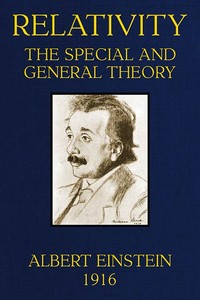
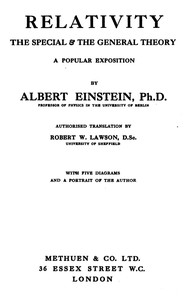
The excerpts include a note to the third edition, dated 1918, in which Einstein mentions an excellent and detailed manual on the general theory that has appeared. This note, placed after the original 1916 preface, signals that the book is part of a rapidly evolving field. The third edition also includes a portrait of the author and five diagrams, though the excerpts do not show them. The note does not revise the book's content but acknowledges that other works now exist for readers who want a more thorough treatment. This editorial layer reminds the reader that the book was written during the development of general relativity itself—the first edition appeared in 1916, the same year Einstein published his foundational paper on the subject. The third edition thus offers a snapshot of a theory still being refined, with the author himself pointing to supplementary resources.
Readers approaching this book for the first time should take Einstein's preface seriously: patience is required, and the thought experiments demand active engagement. The excerpts show that the book is not a popularization in the modern sense but a rigorous exposition that expects the reader to work through each step. Pay close attention to the transitions between special and general relativity, and note how Einstein uses concrete scenarios to illuminate abstract concepts. The third edition's added note reminds us that this is a living document, not a final statement.
Years among these shelves have taught me how patiently the mind waits for its proofs. Einstein’s little book asks that of us, much like the old address by The natural and artificial disintegration of the elements An address by Professor Sir Ernest Rutherford — Background and Themes, where a similar quiet wonder unfolds—the invisible giving way to structure, both men trusting their readers to sit with the strange until it becomes familiar.
There are no reviews for this eBook.
There are no comments for this eBook.
Reader reflection
How did this book work for you?
Your answers remain private and are stored only in this browser.
Your progress
0
/
10
2
How did the book work for you overall?
3
Would you encourage someone else to read it?
4
Did the language feel accessible?
5
What did you think about the pace?
6
Would you like to discuss this book with someone?
7
How strongly did the book affect you emotionally?
8
How personally connected did you feel to the book?
9
What is the main idea you are taking away?
10