1

James Clerk Maxwell and Modern Physics — Inside the Classic
(0 User reviews)
3408
Project Gutenberg
2021
Not confirmed
Physics -- History; Maxwell, James Clerk, 1831-1879
Readers of public-domain and historical texts
Project Gutenberg digital edition
en
Edition facts
Words
64,877
Reading time
283 min
Text sections
19
James Clerk Maxwell and Modern Physics — Inside the Classic can be approached with a clearer sense of reading commitment from its source measurements: 64,877 words, 4 hr 43 min estimated reading time, and 19 detected text sections.
The text analysis averages about 25.7 words per sentence, while the detected sections provide another way to judge how the source is divided.
Project Gutenberg metadata also associates the work with “Physics -- History,” connecting these edition facts with the source record’s subject description.
Source:
Project Gutenberg record #65359
Richard Glazebrook's 1896 biography examines Maxwell's contributions to kinetic theory and electromagnetism, using detailed equations and analogies like Balfour Stewart's train illustration to explain viscosity. The text balances technical exposition with historical context, showing how Maxwell built on predecessors like Waterston and Clausius.
Editorial Edition Score
4.8/5
★★★★★
★★★★★
Calculated from edition completeness, EPUB availability, text structure and catalogue metadata. Not a user rating.
How this score is calculated
- Description quality20 pts
- Title & short description10 pts
- Source metadata20 pts
- Text length15 pts
- Chapters / structure15 pts
- EPUB file integrity20 pts
Total of 100 points, scaled to a 2.5-5.0 range. Editions with an empty description or a missing EPUB file are not scored.
Edition quality
Read the Text
“One who has enriched the inheritance left by Newton and has consolidated the work of Faraday--one who impelled the mind of Cambridge to a fresh course of real investigation--has clearly earned his place in human memory.” It was thus that Professor Lewis Campbell and Mr. Garnett began in 1882 their life of James Clerk Maxwell. The years which have passed, since that date, have all tended to strengthen the belief in the greatness of Maxwell’s work and in the fertility of his genius, which has inspired the labours of those who, not in Cambridge only, but throughout the world, have aided in developing the seeds sown by him. My object in the following pages will be to give some very brief account of his life and writings, in a form which may, I hope, enable many to realise what Physical Science owes to one who was to me a most kind friend as well as a revered master.
The Clerks of Penicuik, from whom Clerk Maxwell was descended, were a distinguished family. Sir John Clerk, the great-great-grandfather of Clerk Maxwell, was a Baron of the Exchequer in Scotland from 1707 to 1755; he was also one of the Commissioners of the Union, and was in many ways an accomplished scholar. His second son George married a first cousin, Dorothea Maxwell, the heiress of Middlebie in Dumfriesshire, and took the name of Maxwell. By the death of his elder brother James in 1782 George Clerk Maxwell succeeded to the baronetcy and the property of Penicuik. Before this time he had become involved in mining and manufacturing speculations, and most of the Middlebie property had been sold to pay his debts.
The property of Sir George Clerk Maxwell descended in 1798 to his two grandsons, Sir George Clerk and Mr. John Clerk Maxwell. It had been arranged that the younger of the two was to take the remains of the Middlebie property and to assume with it the name of Maxwell. Sir George Clerk was member for Midlothian, and held office under Sir Robert Peel. John Clerk Maxwell was the father of James Clerk Maxwell, the subject of this sketch.[1]
John Clerk Maxwell lived with his widowed mother in Edinburgh until her death in 1824. He was a lawyer, and from time to time did some little business in the courts. At the same time he maintained an interest in scientific pursuits, especially those of a practical nature. Professor Campbell tells us of an endeavour to devise a bellows which would give a continuous draught of air. In 1831 he contributed to the _Edinburgh Medical and Philosophical Journal_ a paper entitled “Outlines of a Plan for combining Machinery with the Manual Printing Press.”
In 1826 John Clerk Maxwell married Miss Frances Cay, of North Charlton, Northumberland. For the first few years of their married life their home was in Edinburgh. The old estate of Middlebie had been greatly reduced in extent, and there was not a house on it in which the laird could live. However, soon after his marriage, John Clerk Maxwell purchased the adjoining property of Glenlair and built a mansion-house for himself and his wife. Mr. Maxwell superintended the building work. The actual working plans for some further additions made in 1843 were his handiwork. A garden was laid out and planted, and a dreary stony waste was converted into a pleasant home. For some years after he settled at Glenlair the house in Edinburgh was retained by Mr. Maxwell, and here, on June 13, 1831, was born his only son, James Clerk Maxwell. A daughter, born earlier, died in infancy. Glenlair, however, was his parents’ home, and nearly all the reminiscences we have of his childhood are connected with it. The laird devoted himself to his estates and to the education of his son, taking, however, from time to time his full share in such county business as fell to him. Glenlair in 1830 was very much in the wilds; the journey from Edinburgh occupied two days. “Carriages in the modern sense were hardly known to the Vale of Urr. A sort of double gig with a hood was the best apology for a travelling coach, and the most active mode of locomotion was in a kind of rough dog-cart known in the family speech as a hurly.”[2]
Mrs. Maxwell writes thus[3], when the boy was nearly three years old, to her sister, Miss Jane Cay:--
“He is a very happy man, and has improved much since the weather got moderate. He has great work with doors, locks, keys, etc., and ‘Show me how it doos’ is never out of his mouth. He also investigates the hidden course of streams and bell-wires--the way the water gets from the pond through the wall and a pend or small bridge
Glazebrook opens his account of Maxwell's work by confronting a difficulty: the problems Maxwell attacked are of 'such magnitude and complexity' that describing his share in the advance of physical science is 'no light labour.' The preface sets a tone of careful exposition rather than popular biography, and the chapters that follow bear this out. Equations appear frequently, but Glazebrook also reaches for analogies—such as Balfour Stewart's image of passengers jumping between trains to illustrate viscosity—to make the physics tangible. The result is a hybrid work: part intellectual history, part technical primer, written by a colleague who was himself a Fellow of Trinity College and Assistant Director of the Cavendish Laboratory.
Kinetic Theory and the Mean Free Path
Glazebrook devotes substantial space to Maxwell's work on the kinetic theory of gases, tracing how Maxwell derived the equality of mean kinetic energy for molecules of different gases at the same temperature. The text reproduces key equations—such as T = ½ mv² and p = ⅓ N mv²—and shows how they lead to the laws of Boyle, Charles, and Avogadro. A striking feature is the attention given to priority: Glazebrook notes that Waterston had enunciated two great laws in 1845 and 1851, but they remained unknown until Maxwell independently arrived at similar results in 1859. The discussion of the mean free path compares Maxwell's derivation with that of Clausius, and Glazebrook explains how experiments on gas viscosity can determine the length of that path. The exposition is technical but never assumes the reader is already fluent; each step is justified.
Viscosity as Momentum Diffusion
To explain internal friction in gases, Glazebrook introduces an analogy from Balfour Stewart: two trains running in opposite directions, with passengers jumping across. Each passenger carries momentum into the other train, reducing the relative speed of the two trains—just as, in a gas, molecules crossing from one stream to another carry their momentum with them, producing an apparent frictional force. Glazebrook writes that 'internal friction or viscosity is due to the diffusion of momentum across this common surface.' The effect is limited because particles soon acquire the velocity of the stream they enter. This section exemplifies Glazebrook's method: he presents Maxwell's mathematical results alongside concrete images, making the abstract concept of momentum transfer accessible without oversimplifying the underlying physics.
The Structure of a Scientific Biography
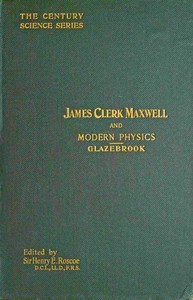
Glazebrook's book is part of the Century Science Series, edited by Sir Henry Roscoe, and its format reflects that series' aim to combine life and work. The volume includes a frontispiece portrait of Maxwell from a painting by G. Lowes Dickinson, and the preface acknowledges the difficulty of the task. Glazebrook does not attempt a full personal biography; instead, he focuses on Maxwell's scientific contributions, embedding them in the context of nineteenth-century physics. The text moves from kinetic theory to electromagnetism (though the excerpts provided do not include the latter), and the author's own position as a Cambridge physicist lends authority. Readers should expect equations and derivations, but also a clear sense of how Maxwell's ideas developed from and against those of his predecessors.
Glazebrook's account rewards readers who are willing to follow the mathematics, but it also offers those with a general interest in scientific history a window into how Maxwell's contemporaries understood his work. The analogies—trains, streams, diffusing molecules—serve as bridges between formal theory and physical intuition. Because the excerpts cover only the kinetic theory portion, the treatment of electromagnetism and Maxwell's equations is not represented here; the full book likely extends the same methodical approach to those topics.
Reading Glazebrook’s portrait of Maxwell, I kept pausing over those train diagrams—how a simple illustration could carry such weight. It reminded me of an older schoolbook I once leafed through, where the same patient clarity seemed to invite wonder rather than demand mastery. There is a gentleness in that approach. Science for the School and Family, Part I. Natural Philosophy — Edition Insights holds that quiet spirit too, I think.
There are no reviews for this eBook.
There are no comments for this eBook.
Reader reflection
How did this book work for you?
Your answers remain private and are stored only in this browser.
Your progress
0
/
10
2
How did the book work for you overall?
3
Would you recommend this book to another reader?
4
How demanding did the text feel?
5
Was the book easy to understand?
6
How strongly did the book affect you emotionally?
7
Did it raise ideas you would like to talk about?
8
How would you describe its reading pace?
9
Which lesson or insight stayed with you?
10