1

Electricity for the 4-H Scientist — Reading Notes
(0 User reviews)
1852
Project Gutenberg
2011
Not confirmed
Electricity -- Juvenile literature
Readers of public-domain and historical texts
Project Gutenberg digital edition
en
Edition facts
Words
23,384
Reading time
102 min
Text sections
4
For Electricity for the 4-H Scientist — Reading Notes, the stored edition analysis reports 23,384 words, 1 hr 42 min estimated reading time, and 4 detected text sections.
The text analysis averages about 15.7 words per sentence, while the detected sections provide another way to judge how the source is divided.
Project Gutenberg metadata also associates the work with “Electricity -- Juvenile literature,” connecting these edition facts with the source record’s subject description.
Source:
Project Gutenberg record #38036
An editorial note on Eric B. Wilson's 1962 4-H bulletin, examining how its credit-point system, safety hazard hunt, and bell-wiring lessons align with or diverge from the catalog subject 'Electricity -- Juvenile literature'.
Editorial Edition Score
4.6/5
★★★★★
★★★★★
Calculated from edition completeness, EPUB availability, text structure and catalogue metadata. Not a user rating.
How this score is calculated
- Description quality20 pts
- Title & short description10 pts
- Source metadata20 pts
- Text length15 pts
- Chapters / structure15 pts
- EPUB file integrity20 pts
Total of 100 points, scaled to a 2.5-5.0 range. Editions with an empty description or a missing EPUB file are not scored.
Edition quality
Public-domain source text
Read the source text
The source text is kept in the dedicated reader, separate from this catalogue record and its commentary.
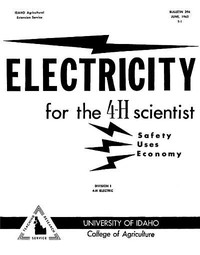
Eric B. Wilson's Electricity for the 4-H Scientist (1962) is a project bulletin from the Idaho Agricultural Extension Service, not a standalone juvenile trade book. Its catalog subject 'Electricity -- Juvenile literature' suggests a general introduction, but the excerpts reveal a tightly structured 4-H curriculum built around credit points, age-tiered goals, and demonstration-based learning. The opening pages lay out a table of minimum credit points by age and year in project, framing electricity as a series of measurable tasks rather than a subject for passive reading.
Credit Points as a Structural Device
The bulletin's organization is driven by a credit-point system, not by narrative or conceptual progression. Each lesson carries a point value (e.g., 'B-5 What Makes Motors Run' is worth 5 credits), and members must accumulate a minimum total based on their age and years of participation. This structure turns the book into a menu of activities: readers are told they 'may skip the less important or less interesting parts' as long as they master 'basic lessons' verified by the 'What Did You Learn' questions. The catalog subject 'Electricity -- Juvenile literature' implies a general readership, but the text is explicitly addressed to 4-H members aged 10 and older, with goals tailored to club requirements. The credit system is a form of gamification long before that term existed, and it shapes every aspect of the book's voice and pacing.
Safety as a Concrete, Localized Practice
Lesson B-9, 'Let's Be Friends With Electricity,' reframes safety as a hands-on 'Hazard Hunt.' Readers are instructed to inspect their own homes for specific dangers: 'octopus wiring,' extension cords under rugs, cracked insulators, loose prongs. The text includes a reproducible chart where the member records each hazard, its location, and what was done about it. One sample entry notes a 'Loose prong on lamp plug' in the living room, replaced with a new plug. This is not abstract advice but a documented, verifiable activity. The catalog subject does not capture this procedural, almost audit-like approach to safety. The bulletin treats electrical hazards as discoverable through systematic observation, not as a list of warnings to memorize.
Bells and Buzzers as a Communication System
Lesson B-10, 'How Electric Bells Work—For You,' positions bells and buzzers as practical messaging tools for farm and home. The opening scenario—having to walk or shout to deliver a message—frames the technology as a labor-saving device. The text explains electromagnetism through a diagram of a bell circuit, then asks readers to 'plan and install a bell system for your home or farm.' The lesson connects to Samuel Morse's telegraph (1840) but immediately pivots to contemporary uses: doorbells, service-station signals, kitchen timers, school bells, alarms. The catalog subject 'Electricity -- Juvenile literature' suggests a general science topic, but the excerpt shows a vocational, problem-solving orientation. The bell is not a curiosity but a tool to 'be your eyes and voice in a dozen places at once.'
Readers should approach this bulletin as a period artifact of 4-H pedagogy, not as a modern textbook. The credit-point system, the emphasis on demonstration and charting, and the farm-home context are integral to understanding its content. The catalog subject 'Electricity -- Juvenile literature' is accurate but incomplete; the work is better described as a project guide for rural youth in a specific institutional framework. The excerpts suggest that the book's value lies in its concrete, activity-based approach to electrical knowledge, grounded in the material conditions of 1960s Idaho.
That gray afternoon, I kept thinking about how Wilson’s bell-wiring diagrams made a stubborn kind of sense, each click earned by patient, careful hands. It reminded me of another kind of order hiding in plain sight—how light bends, how time stretches—and I found myself reaching for Relativity: The Special and General Theory — Inside the Classic instead of the soldering iron I’d meant to fetch.
There are no reviews for this eBook.
There are no comments for this eBook.
Reader reflection
How did this book work for you?
Your answers remain private and are stored only in this browser.
Your progress
0
/
10
2
How did the book work for you overall?
3
Would you recommend this book to another reader?
4
What was the reading difficulty like?
5
Would you start a conversation about this book?
6
Could you follow the author’s main argument?
7
What was the strongest part of the book?
8
How did the pace of the book feel?
9
What did this book teach you most?
10