1

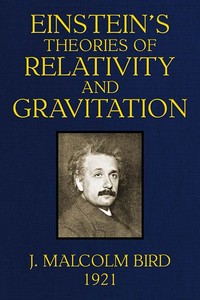
Einstein's Theories of Relativity and Gravitation A selection of material from the essays submitted in the competition for the Eugene Higgins prize of $5,000 — Edition Insights
(0 User reviews)
1295
Project Gutenberg
2020
Not confirmed
Relativity (Physics)
Readers of public-domain and historical texts
Project Gutenberg digital edition
en
Edition facts
Words
97,801
Reading time
426 min
Text sections
24
The source record for Einstein's Theories of Relativity and Gravitation A selection of material from the essays submitted in the competition for the Eugene Higgins prize of $5,000 — Edition Insights measures this digital text at 97,801 words, 7 hr 6 min estimated reading time, and 24 detected text sections.
The text analysis averages about 26.3 words per sentence, while the detected sections provide another way to judge how the source is divided.
Project Gutenberg metadata also associates the work with “Relativity (Physics),” connecting these edition facts with the source record’s subject description.
Source:
Project Gutenberg record #63372
This editorial note examines how the preface and winning essay in Bird's 1921 compilation prepare a first-time reader for Einstein's theories, focusing on the deliberate arrangement of material and the pedagogical strategy of building from the Special to the General Theory.
Editorial Edition Score
4.9/5
★★★★★
★★★★★
Calculated from edition completeness, EPUB availability, text structure and catalogue metadata. Not a user rating.
How this score is calculated
- Description quality20 pts
- Title & short description10 pts
- Source metadata20 pts
- Text length15 pts
- Chapters / structure15 pts
- EPUB file integrity20 pts
Total of 100 points, scaled to a 2.5-5.0 range. Editions with an empty description or a missing EPUB file are not scored.
Edition quality
Read the Text
Chapter II. is intended so to bring the mind of the reader into contact with certain philosophical problems presented to us by our experiences with the external world and our efforts to learn the facts about it, that he may approach the subject of relativity with an appreciation of the place it occupies as a phase of human thought and a pillar of the scientific structure. Until the reader is aware of the existence of these problems and the directions taken by the efforts, successful and unsuccessful, to unravel them, he is not equipped to comprehend the doctrine of relativity at all; he is in much the same case as a child whose education had reached only the primer stage, if asked to read the masterpieces of literature. He lacks not alone the vocabulary, but equally the mental background on which the vocabulary is based.
It will be noted that in this and the chapters immediately following it, the Editor has supplied material freely. The obvious interpretation is that satisfactory material covering the desired ground was not found in any of the essays; for we are sure the scope and number of the credited excerpts will make it clear that all contributions were adequately scrutinized in search of available passages. This "inadequacy" of the competing essays has been severely commented upon by several correspondents, and the inference drawn that as a whole the offerings were not up to the mark. Such a viewpoint is wholly unjust to the contestants. The essays which paid serious attention to the business of paving the way to relativity necessarily did so at the expense of completeness in the later paragraphs where specific explanation of the Einstein theories was in order. Mr. Law, whose essay was by all means the best of those that gave much space to introductory remarks, found himself left with only 600 words in which to tell what it was that he had been introducing. The majority of the contestants appear to have faced the same question as to subject matter which the Judges faced, and to have reached the same decision. They accordingly devoted their attention toward the prize, rather than toward the production of an essay that would best supplement that of the winner. It is for this very reason that, in these preliminary chapters, so large a proportion of the material has had to be supplied by the Editor; and this very circumstance is a tribute to the good judgment of the competitors, rather than ground for criticism of their work.
The general introduction of Chapter II. out of the way, Chapters III. and IV. take up the business of leading the reader into the actual subject of relativity. The subject is here developed in what may be called the historical order--the order in which it took form in Einstein's own mind. Both in and outside the contest of which this book is the outcome, a majority of those who have written on relativity have followed this order, which is indeed a very natural one and one well calculated to give to the rather surprising assumptions of relativity a reasonableness which they might well appear to the lay mind to lack if laid down more arbitrarily. In these two chapters no effort is made to carry the argument beyond the formulation of the Special Principle of the relativity of uniform motion, but this principle is developed in considerably more detail than would be the case if it were left entirely to the competing essayists. The reason for this is again that we are dealing with a phase of the subject which is of subordinate importance so far as a complete statement of the General Theory of Relativity is concerned, but which is of the greatest significance in connection with the effort of the layman to acquire the proper preliminary orientation toward the larger subject.
Chapter V. goes back again to general ground. Among the ideas which the competing essayists were forced to introduce into their text on a liberal scale is that of non-Euclidean geometry. The entire formulation of the General Theory of Relativity is in fact an exercise in this. The essayists--good, bad and indifferent alike--were quite unanimous in their decision that this was one thing which the reader would have to assume the responsibility of acquiring for himself. Certainly they were justified in this; for the Editor has been able to explain what non-Euclidean geometry is only by using up considerably more space than the contestants had for an entire essay. No effort has been made to set forth any of the details of any of the various non-Euclidean geometries; it has simply been the aim to draw the dividing line between Euclidean and non-Euclidean, and to make the existence of the latter appear reasonable, so
The preface to this 1921 volume immediately signals a pedagogical concern: the editor, J. Malcolm Bird, argues that previous attempts to explain Einstein have failed because they “pitchfork the reader into the intricacies of the subject without adequate preparation.” Bird’s solution is to delay the winning essay—Lyndon Bolton’s prize-winning entry—until after a substantial introductory section. The reader first encounters a detailed explanation of the contest’s genesis and then a lengthy background chapter on the Special Theory of Relativity. Only after this groundwork does the winning essay appear, beginning with a patient definition of coordinate systems and frames of reference.
Delaying the Prize Essay
The most striking structural choice in this book is that the winning essay does not open the volume. Bird anticipates that readers will expect the prize essay to be given “the post of honor,” but he deliberately places it later. In the preface, he explains that this arrangement is meant to avoid the common mistake of assuming the lay reader can jump directly into relativity. Instead, the book first provides a “preliminary background” chapter that establishes the Special Theory’s core concepts—such as the relativity of time and space—before the essayists attempt to “take us more deeply into the subject.” This ordering suggests that Bird views the winning essay not as a standalone explanation but as a text that builds on prior preparation.
The Background Chapter as Scaffolding
The background chapter, written by Bird himself, introduces the Special Theory by emphasizing the “limiting case” of unaccelerated motion. It repeatedly stresses that the revisions of fundamental concepts made for the Special Theory “will remain with us in the General” Theory. The language is careful and cumulative: the reader is told that the four-dimensional space-time continuum “persists” and that the General Theory demands “a non-Euclideanism of a much more whole-hearted type.” This chapter does not assume prior knowledge; it defines terms like “frame of reference” and explains why the mechanical principle of relativity is insufficient for electromagnetism. The prose is methodical, often using phrases like “we shall see” to guide the reader forward.
Bolton’s Opening: Coordinates and Clocks
When the winning essay finally begins, it starts not with a grand statement but with a concrete analogy: specifying points in a plane by distances from perpendicular lines. Bolton then introduces the need for synchronized clocks and defines a “Frame of Reference” as a system of axes with clocks. He explicitly states that “every observer will be supposed to be provided with such a frame partaking of his motion.” This opening is deliberately elementary, echoing the background chapter’s approach. Bolton’s prose is precise but not technical; he uses everyday language like “flat-sided box” to describe coordinate axes. The essay assumes the reader has absorbed the background material and can now follow a more detailed exposition of the mechanical principle of relativity.
A First Reading Strategy
Given the book’s structure, a first-time reader should begin with the preface and the background chapter, even if tempted to skip to the winning essay. The preface itself is a short but revealing document: it explains the editorial rationale and warns against the “great gulf” between trained mathematicians and lay readers. The background chapter then provides the vocabulary and conceptual framework needed to understand Bolton’s essay. Readers who start with Bolton may find his opening clear but may miss the context for why the Special Theory is a “limiting case.” The book rewards patience; its arrangement is itself a pedagogical argument about how to learn relativity.
This volume is best approached as a guided course rather than a reference work. The editor’s deliberate sequencing—preface, background, then essays—mirrors the gradual preparation he advocates. Readers who follow this order will find that Bolton’s essay, when it arrives, builds naturally on established ideas. The book’s structure is its most instructive feature, turning the challenge of learning relativity into a step-by-step process.
That rainy afternoon, Einstein’s leap from Special to General felt less like physics and more like a slow exhale—patterns loosening into something vaster. I closed the book and found myself drifting, almost without deciding, to The Poetry of Science; or, Studies of the Physical Phenomena of Nature — Background and Themes. Both seemed to whisper that wonder hides in the ordinary, waiting for a patient eye.
There are no reviews for this eBook.
There are no comments for this eBook.
Reader reflection
How will you remember this book?
Save your reaction, strongest insight, and memorable passage.
Your progress
0
/
10
2
Did this book hold your interest?
3
How likely are you to recommend this book?
4
How demanding did the text feel?
5
Did this book create an emotional response?
6
How did the reading compare with what you expected?
7
How closely did the book connect with your experience?
8
Did the story or argument move comfortably?
9
In one sentence, what did you learn?
10