
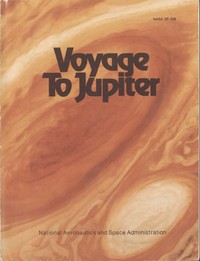
Voyage to Jupiter — Reading Notes
Edition facts
From the first pages, Voyage to Jupiter immerses the reader in the tension between expectation and astonishment. The foreword describes the flybys as “like being in the crow’s nest of a ship during landfall and passage through an archipelago of strange islands,” a metaphor that captures both the navigational precision and the constant surprise of the mission. The book does not simply report findings; it reconstructs the evolving understanding of scientists as data arrived, often upending prior models.
The Unforeseen Icy World
The treatment of Jupiter’s moons reveals how quickly assumptions collapsed. Ganymede, for instance, showed “evidence of having its own icy version of the San Andreas Fault,” a phrase that yokes terrestrial geology to an alien, frozen surface. Callisto’s “bullseye” feature—the Valhalla basin—prompted geologists to speculate that impact features on an icy crust would “slide” back into the surface, leaving only “frozen” ripple marks. The authors emphasize the provisional nature of these interpretations: the team’s language shifts from “perhaps” to “maybe” to “speculated,” underscoring that each new image forced a rethinking of how icy bodies behave.
The Red Spot and Io’s Hot Spots
Two early infrared results illustrate the book’s focus on incremental discovery. The Great Red Spot was found to be “about 3° C cooler than its surroundings,” a subtle thermal signature that extended “many kilometers above the clouds.” Meanwhile, Io’s thermal emission had “an unexpected shape to the spectrum,” leading Rudy Hanel to tentatively suggest “hot spots on the surface.” The authors do not present these as settled facts; instead, they show scientists working with incomplete data, noting that infrared measurements required “more computer processing” and were not available for a day or two. This delay becomes part of the narrative, heightening the sense of anticipation.
The Discovery of Jupiter’s Rings
Perhaps the most dramatic surprise was the discovery of Jupiter’s rings. The book recounts that Voyager 1 captured the ring in “a single eleven-minute exposure with the narrow-angle camera,” a hurried observation that produced a streaked image because of spacecraft motion. The authors note that the star field “happened to include the Beehive star cluster,” a detail that grounds the discovery in a specific astronomical coincidence. The ring image itself is described as “a multiple exposure, with six separate images side by side,” revealing the outer edge. This passage exemplifies how the book conveys the serendipity and technical constraints that shaped what Voyager saw.
Readers should approach Voyage to Jupiter not as a final summary of Jovian science, but as a chronicle of scientists in the midst of discovery. The authors preserve the tentative language, the dead ends, and the moments of sudden clarity. Pay attention to the dates and distances given in captions—they mark the pace at which understanding grew. The book rewards those who read for process as much as for result.