The Principle of Relativity — Story, Setting & Ideas
Edition facts
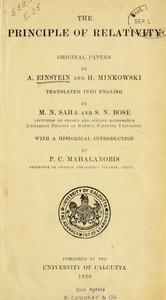
This 1920 volume, translated by Meghnad Saha and Satyendranath Bose and published by the University of Calcutta, collects three seminal papers that trace the evolution of relativity theory. The book opens with a historical introduction by P. C. Mahalanobis that frames the revolution: Lord Kelvin in 1893 celebrated the ether as a “splendid consummation,” yet by 1905 Einstein declared the ether “superfluous.” This tension between continuity and rupture runs through the entire collection.
The translations themselves are artifacts of scientific transmission. Saha and Bose, both lecturers at University College of Science, Calcutta, rendered Einstein’s and Minkowski’s German into English, making these ideas accessible to a new audience. The volume includes a biographical note on Einstein by Saha, and Minkowski’s appendix extends the mathematical formalism, showing how the relativity postulate demands symmetry in the laws of mechanics.
From Ether to Spacetime: A Decade of Rupture
Mahalanobis’s introduction sets the stage by quoting Lord Kelvin’s 1893 praise of the ether as a unified medium for light, heat, electricity, and magnetism. Ten years later, Einstein’s 1905 paper rejected that very concept. The excerpts show how the volume highlights this abrupt shift: the ether, once central, becomes unnecessary. The reader witnesses a scientific revolution compressed into a single decade, with the papers themselves as primary evidence.
The structure of the book reinforces this narrative. It begins with Einstein’s special relativity paper, then moves to Minkowski’s spacetime formulation, and finally to Einstein’s general theory. Each paper builds on the previous one, but also reinterprets it. Minkowski’s work, for instance, recasts Einstein’s kinematics in geometric terms, introducing the “world” of four dimensions. The volume thus presents not a single theory but a dialogue between physicists, each reshaping the framework.
Mathematical Formalism and the Covariance Principle
The excerpts from Minkowski’s paper reveal a dense mathematical apparatus. He introduces concepts like the “Ray-figure” (Strahl-gebilde) of a spacetime point, defined by the equation (x - x*)² + (y - y*)² + (z - z*)² = (t - t*)². This figure, he argues, can be cut by any spacetime line at only one point, due to its convexity. Such geometric reasoning is central to Minkowski’s approach: he derives the laws of motion from the relativity postulate, claiming that “the whole set of laws of motion follows from the law of energy.”
The text also shows Minkowski’s insistence on covariance. He writes that the set of four equations (22) “shows the symmetry in (x, y, z, t), which is demanded by the relativity postulate.” This symmetry is not merely aesthetic; it is a physical requirement. The appendix further develops these ideas, applying them to gravitation. Minkowski proposes a law of force between material points based on their spacetime filaments, using vectors like (OA′/B*D*)³ BD*. The mathematics is intricate, but the underlying goal is clear: to express all physical laws in a form invariant under Lorentz transformations.
Translation as Scientific Practice
The volume’s translators, Saha and Bose, were active researchers in their own right. Their work here is not passive; it shapes how the theories are presented. The biographical note on Einstein by Saha, for instance, personalizes the scientific content. The translators also had to contend with complex notation: the transcriber’s note explains that the ebook includes “ASCII Art” diagrams and special characters like [=a] for a barred ‘a’. These details remind us that the text is a material object, with its own typographical challenges.
The historical introduction by Mahalanobis, a physicist at Presidency College, Calcutta, further contextualizes the translations. He traces the development from Kelvin to Einstein, emphasizing the rapidity of change. The volume thus serves multiple purposes: it is a primary source for relativity theory, a document of early 20th-century scientific translation, and a record of how Indian scientists engaged with cutting-edge European physics. The reader should attend not only to the equations but also to the paratexts—the introduction, the biographical note, the translator’s notes—that frame the scientific content.
Readers approaching this volume should be prepared for dense mathematics and conceptual leaps. The papers are not simplified; they are the original arguments, with all their technical complexity. Pay attention to the interplay between the three main texts: Einstein’s 1905 paper, Minkowski’s geometric reinterpretation, and Einstein’s 1916 generalization. The historical introduction provides a useful roadmap, but the real reward lies in tracing how each author reworks the ideas of his predecessors. The translations themselves, made by physicists who were part of the global scientific community, add another layer of interest.