1

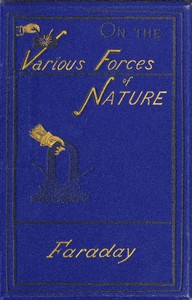
On the various forces of nature and their relations to each other — Story, Setting & Ideas
(0 User reviews)
436
Project Gutenberg
2016
Not confirmed
Physics
Readers of public-domain and historical texts
Project Gutenberg digital edition
en
Edition facts
Words
61,827
Reading time
269 min
Text sections
17
The source record for On the various forces of nature and their relations to each other — Story, Setting & Ideas measures this digital text at 61,827 words, 4 hr 29 min estimated reading time, and 17 detected text sections.
The text analysis averages about 11.3 words per sentence, while the detected sections provide another way to judge how the source is divided.
Project Gutenberg metadata also associates the work with “Physics,” connecting these edition facts with the source record’s subject description.
Source:
Project Gutenberg record #52293
Michael Faraday's lecture series, edited by William Crookes, demonstrates the interconversion of physical forces through live experiments. The text moves from gravity to electricity, using detailed apparatus descriptions and audience interactions to reveal a unified natural philosophy.
Editorial Edition Score
4.8/5
★★★★★
★★★★★
Calculated from edition completeness, EPUB availability, text structure and catalogue metadata. Not a user rating.
How this score is calculated
- Description quality20 pts
- Title & short description10 pts
- Source metadata20 pts
- Text length15 pts
- Chapters / structure15 pts
- EPUB file integrity20 pts
Total of 100 points, scaled to a 2.5-5.0 range. Editions with an empty description or a missing EPUB file are not scored.
Edition quality
Public-domain source text
Read the source text
The source text is kept in the dedicated reader, separate from this catalogue record and its commentary.
Michael Faraday's On the Various Forces of Nature opens not with a dry treatise but with a lecturer's direct address to his audience, immediately establishing a performative, experimental tone. The text is structured as a series of six lectures, each building on the last, moving from the force of gravitation through cohesion, chemical affinity, heat, magnetism, and finally electricity. Faraday's method is to demonstrate each force through live experiments, often using simple household items like a candle or a basin of water, before revealing how these forces are interconnected. The editor, William Crookes, has preserved the spontaneous quality of the lectures, including Faraday's asides and his responses to the audience's reactions. This structure—a progressive, cumulative argument supported by visible proof—makes the book a record of scientific demonstration as much as a textbook of physics.
The Architecture of Demonstration
The lectures are built around a recurring pattern: Faraday introduces a phenomenon, performs an experiment, and then explains the underlying principle. For instance, in the first lecture on gravitation, he drops a coin and a feather to show that air resistance, not gravity, causes different rates of fall. This pattern is repeated throughout, with each experiment serving as a tangible anchor for an abstract concept. The structure is cumulative; later lectures refer back to earlier demonstrations, creating a web of interconnected ideas. Faraday often uses the same apparatus in multiple ways, such as a simple magnet and coil, to illustrate different forces. This architectural approach—where each lecture is a self-contained unit that also advances a larger argument—gives the book a rhythmic, almost musical quality, as themes are introduced, developed, and then resolved.
Recurring Images: The Candle and the Lens
Two images recur throughout the lectures: the candle and the lens. The candle appears in the first lecture as a source of light and heat, and Faraday returns to it repeatedly to illustrate combustion, chemical affinity, and the conversion of energy. The lens, particularly the Fresnel lens used in lighthouses, is described in detail in the lecture on light. Faraday marvels at its construction, noting how 'ring within ring' corrects spherical aberration. These images are not mere decorations; they are functional metaphors. The candle represents the transformation of matter into energy, while the lens symbolizes the focusing and directing of forces. By returning to these concrete objects, Faraday grounds his abstract arguments in the physical world, making the invisible forces of nature visible and comprehensible.
Movement Between Scales: From the Laboratory to the Lighthouse
Faraday frequently shifts between the microscopic and the macroscopic, between the controlled environment of the laboratory and the vast scale of natural phenomena. In the lecture on heat, he begins with a small flame and then discusses the heat of the sun. In the lecture on magnetism, he moves from a simple compass needle to the Earth's magnetic field. This movement is not arbitrary; it is a deliberate rhetorical strategy to show that the same forces operate at all scales. The most striking example is the discussion of lighthouse lamps, where Faraday explains how the principles of refraction and reflection, demonstrated with a small lens in the lecture hall, are applied to guide ships at sea. This back-and-forth between the intimate and the immense gives the lectures a sense of wonder and demonstrates the universality of physical laws.
The Audience as Participant
Faraday's lectures are notable for their interactive quality. He frequently addresses the audience directly, asking them to observe, to predict outcomes, and to draw conclusions. For example, he says, 'Look at this beautiful apparatus—is it not a most charming piece of workmanship?' This rhetorical engagement turns the lecture into a shared inquiry. The text preserves these moments, including instances where Faraday responds to audience reactions, such as when he notes that a particular experiment might seem 'imperfect' because of viewing angle. This participatory structure is not merely pedagogical; it reflects Faraday's belief that science is a collaborative endeavor. The reader, like the original audience, is invited to become an active observer, to question, and to experiment mentally. This makes the book a unique blend of instruction and performance, where the reader is both student and witness.
Readers approaching this work should be prepared for a text that is as much about the process of discovery as about the facts discovered. Faraday's lectures reward careful attention to the sequence of experiments and the recurring motifs. The book is best read not as a reference but as a performance, with each lecture building on the last. For those interested in the history of science, it offers a rare glimpse into the mind of a master experimentalist at work. The editorial notes by Crookes, while minimal, provide useful context for the apparatus and terminology of the era.
Reading this lecture stirred the dusty air of my grandfather’s study, where I first flipped through his old physics primer. The quiet hum of his lamp felt like Faraday’s current. Later, Heroes of Science: Physicists — Text and Context brought back that same patient wonder, as if each page simply waited for me to slow down and listen.
There are no reviews for this eBook.
There are no comments for this eBook.
Reader reflection
How will you remember this book?
Save your reaction, strongest insight, and memorable passage.
Your progress
0
/
10
2
How did the book work for you overall?
3
Would you pass this book on to a friend?
4
Did the language feel accessible?
5
Which aspect of the book did you value most?
6
Did any part of the book stay with you emotionally?
7
Did the book offer a fresh perspective?
8
Could you follow the author’s main argument?
9
In one sentence, what did you learn?
10