
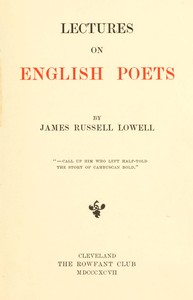
Lectures on English poets by James Russell Lowell
So, what exactly is this book? It's a collection of talks Lowell gave in the mid-1800s. He wasn't writing a dry history textbook. He was speaking to an audience, sharing his deep love and knowledge of English poetry. He starts way back with Chaucer, treating him not as a distant figure, but as a vibrant storyteller. Then he moves through the centuries, giving you the highlights on giants like Spenser, Shakespeare, Milton, Pope, and the Romantic poets like Wordsworth and Keats.
The Story
There isn't a plot in the traditional sense. The "story" here is the unfolding journey of English poetry itself. Lowell acts as your guide on this literary road trip. He points out the scenic views (the beautiful imagery), explains the tricky turns (the complex themes), and introduces you to the fascinating drivers (the poets). He connects the dots, showing how Milton's epic ambition grew from what came before, or how the Romantics rebelled against the strict rules of the 18th century. It's the story of how a nation's voice in verse evolved.
Why You Should Read It
You should read this because Lowell makes you feel the poetry. He doesn't just analyze it; he celebrates it. His writing is full of personality—you can tell which poets he admires most (he’s a huge fan of Wordsworth's connection to nature) and which styles he finds a bit stuffy. He has strong opinions, and that makes it fun. He breaks down why a simple line from Chaucer can be so powerful, or what makes Shakespeare's sonnets timeless. Reading this, you don't just learn facts; you learn how to listen to a poem, to hear its music and understand its heart. It turns reading poetry from a homework assignment into a conversation.
Final Verdict
This book is perfect for curious readers who want to deepen their understanding of poetry without getting bogged down in academic jargon. It's for the person who enjoys Shakespeare but wants to know more about his contemporaries, or for the book club member looking for a brilliant companion to the classics. If you've ever felt intimidated by poetry or history, Lowell is the encouraging, expert friend you need. He bridges the gap between the 19th century and today, reminding us why these old words still have the power to move us.
This historical work is free of copyright protections. It serves as a testament to our shared literary heritage.
Jennifer Thomas
10 months agoI was skeptical about the depth of this book at first, but the concise summaries at the end of each section are a lifesaver. An excellent example of how quality digital books should be formatted.
Paul Hernandez
8 months agoI wanted to compare this perspective with traditional views, the emphasis on ethics and sustainability within the topic is commendable. The price-to-value ratio here is simply unbeatable.
David Garcia
1 year agoAs a long-time follower of this subject matter, the structural organization allows for quick referencing of key points. A mandatory read for anyone in this industry.
Emily Lee
4 months agoI've been looking for a reliable source on this topic, and the way it handles controversial points with balance is quite professional. This has become my go-to guide for this specific topic.


Thomas Wilson
3 months agoI appreciate how this edition approaches the core problem, the wealth of information provided exceeds the average market standard. Definitely a five-star contribution to the field.