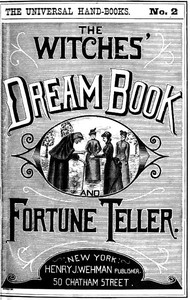
The Witches' Dream Book; and Fortune Teller by A. H. Noe
Let's be clear from the start: "The Witches' Dream Book and Fortune Teller" is not a novel. Published in 1875, it's a historical curiosity, a handbook from a time when people looked for answers in places we might not consider today.
The Story
There's no traditional plot with heroes and villains. Instead, the book is structured as a series of guides. The first and largest section is a dream dictionary. You look up symbols from your dreams—animals, objects, actions—and the book provides an interpretation, often predicting good or bad luck, news, or changes in your life. Seeing an eagle? That means you'll overcome enemies. Dreaming of butter? Get ready for prosperity! The second part shifts to active fortune-telling, with instructions for reading palms (chiromancy) and using other methods like dominoes or moles on the body to tell your fate.
Why You Should Read It
Reading this book feels like holding a conversation with the past. It's not about believing in the methods, but about understanding the mindset. In an era before modern psychology, dreams weren't just random brain noise; they were messages to be decoded. This book shows us the cultural symbols and superstitions that people took seriously. It's surprisingly personal. You can't help but play along—what would my dream from last night mean according to 1875? The interpretations are a mix of the obvious, the bizarre, and the oddly specific, which makes it endlessly entertaining. It highlights our unchanging desire to find narrative and control in a chaotic world.
Final Verdict
This book is a niche gem. It's perfect for history lovers, collectors of the occult, and anyone fascinated by vintage pop culture. If you enjoy browsing old almanacs, reading about folklore, or want a peculiar conversation starter for your coffee table, this is for you. Approach it not as a factual guide, but as a cultural artifact. It's a short, intriguing window into the hopes, fears, and imaginative logic of everyday people from a bygone era. Just don't make any major life decisions based on what you find inside!
This book is widely considered to be in the public domain. You can copy, modify, and distribute it freely.
William Martin
7 months agoIt’s rare to find such a well-structured narrative nowadays, the author’s unique perspective adds a fresh layer to the discussion. I'll be citing this in my upcoming project.
Susan Lopez
1 year agoThought-provoking and well-organized content.
James Miller
11 months agoWhile browsing through various academic sources, the data points used to support the main thesis are quite robust. Definitely a five-star contribution to the field.
George Rodriguez
5 months agoI decided to give this a try based on a colleague's recommendation, the way the author breaks down the core concepts is remarkably clear. If you want to master this topic, start right here.


Elizabeth White
2 years agoThe balance between academic rigor and readability is perfect.