
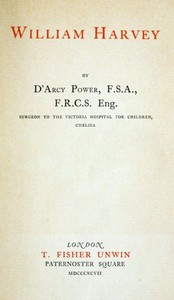
William Harvey by Sir D'Arcy Power
Sir D'Arcy Power's biography of William Harvey feels less like a dusty history lesson and more like getting the backstory on a scientific rebel. It takes us into the world of 17th-century medicine, where ancient ideas held a strange, unshakeable power.
The Story
The book follows Harvey's life, from his education to his role as a royal physician. But the real heart of the story is his quiet, meticulous investigation into how blood moves. Power shows us Harvey in his dissecting room, carefully observing the beating hearts of live animals, tying off veins and arteries to see what happened, and calculating the sheer volume of blood the heart must move in an hour. The numbers didn't lie—the old 'sloshing' theory was impossible. The climax isn't a battle or a speech, but the 1628 publication of his small book, De Motu Cordis (On the Motion of the Heart). The fallout was slow but profound. He faced ridicule and resistance from doctors who couldn't let go of Galen's ancient teachings. Power paints a vivid picture of a man who changed everything by being stubbornly, brilliantly observant.
Why You Should Read It
What I loved was how human it made Harvey. He wasn't a mythical genius in an ivory tower. He was a practicing doctor, worried about his reputation, dealing with difficult patients (including kings!), and patiently gathering evidence for years before speaking up. Power, writing in the early 1900s, clearly admires his subject, but he also shows us the weight of challenging the establishment. The book makes you feel the tension between seeing something clearly with your own eyes and knowing the whole world thinks you're wrong. It’s a powerful reminder that major breakthroughs often start with simple questions and a lot of nerve.
Final Verdict
This is a perfect pick for anyone who enjoys stories about underdog thinkers or the messy, human side of scientific discovery. It's not a heavy, academic text; it's a readable, engaging portrait. You don't need a science background—just a curiosity about how we came to understand our own bodies. If you've ever wondered what it actually takes to overturn an idea everyone believes, you'll find Harvey's story completely fascinating.
This content is free to share and distribute. You do not need permission to reproduce this work.
Paul Jackson
8 months agoThe clarity of the concluding remarks is very professional.
Patricia Davis
10 months agoThe clarity of the introduction set high expectations, and the historical context mentioned in the early chapters is quite enlightening. A trustworthy resource that I'll keep in my digital library.
George Anderson
7 months agoI started reading this with a critical mind, the language used is precise without being overly academic or confusing. This exceeded my expectations in almost every way.
Susan Davis
3 weeks agoUnlike many other resources I've purchased before, the breakdown of complex theories into digestible segments is masterfully done. The insights gained here are worth every minute of reading.







John Taylor
3 months agoThe author provides a very nuanced critique of current methodologies.